As cheap labour is no longer an advantage, Vietnamese enterprises must shift to competing through productivity, quality and the capacity to move up and master value chains.
This is also a requirement set out in Resolution No. 19-NQ/TW on renewing Viet Nam’s development model, which aims to establish a new growth model, modernise traditional growth drivers, and gradually shift towards a self-reliant, creative, humane, sustainable and integrated development model suited to each stage.
From participation to mastery of value chains
Resolution No. 19-NQ/TW identifies enterprises, the force directly creating value for the economy, as the centre of the renewal process. They must shift from cost-based competition to productivity, technology, quality and market responsiveness; from standalone operations to linkages within industrial ecosystems; and from participation to mastery, gradually leading value chains. This is not only a shift in growth drivers, but also a renewal of thinking, connectivity, and the mobilisation and use of resources to improve competitiveness and create more value for the economy.
However, not many enterprises can fully meet these requirements on their own. They need linkages and the sharing of technology, capital, markets and governance experience to form complete value chains.
Cao Huu Hieu, General Director of the Viet Nam National Textile and Garment Group (Vinatex), said Vinatex is strengthening linkages, gradually mastering technology and securing higher-value “links” in the chain. At the same time, it supports small enterprises in improving productivity, developing their own products and moving towards completing the chain from design and the supply of materials and accessories to finished-product manufacturing. This approach enhances enterprise value, gradually forms an ecosystem capable of meeting partners’ package requirements, and strengthens the competitiveness of Viet Nam’s textile and garment industry in the international arena.
The Viet Nam National Chemical Group (Vinachem), meanwhile, has chosen another direction: mastering technology and promoting research and substantive investment in science, technology and people.
According to Phung Quang Hiep, Chairman of Vinachem’s Members’ Council, Vinachem is investing in a Research and Development Centre for Science, Technology and Innovation at Hoa Lac Hi-Tech Park in Ha Noi. Covering about 3ha, with total capital of around 1.5 trillion VND, the centre aims to connect enterprises with research institutes, universities and technology partners, moving towards promoting the commercialisation of research results into products. It is expected to provide a foundation for Vinachem to improve its autonomy in raw materials, master core technologies, increase productivity and gradually affirm its key role in the chemical and fertiliser industries.
Renewing the development model is not only a task for enterprises directly engaged in production. Enterprises providing infrastructure and essential services must also change the way they operate.
Nguyen Anh Tuan, General Director of Viet Nam Electricity (EVN), said EVN has invested in developing power sources and grids, improving transmission capacity, and preparing infrastructure for high-tech industries, semiconductors, artificial intelligence, data centres and electrified transport.
EVN is also shifting strongly towards data-based governance, accelerating automation, and applying AI, IoT and Big Data in grid operation, load forecasting and the development of smart energy management systems. At the same time, it is streamlining its apparatus and increasing decentralisation and delegation of authority linked with responsibility.
Alongside this, EVN is promoting green transformation, applying ESG criteria, improving efficiency, reducing losses and increasing the ability to integrate renewable energy, in order to proactively stay ahead in meeting the needs of new economic sectors.
Elevating enterprises
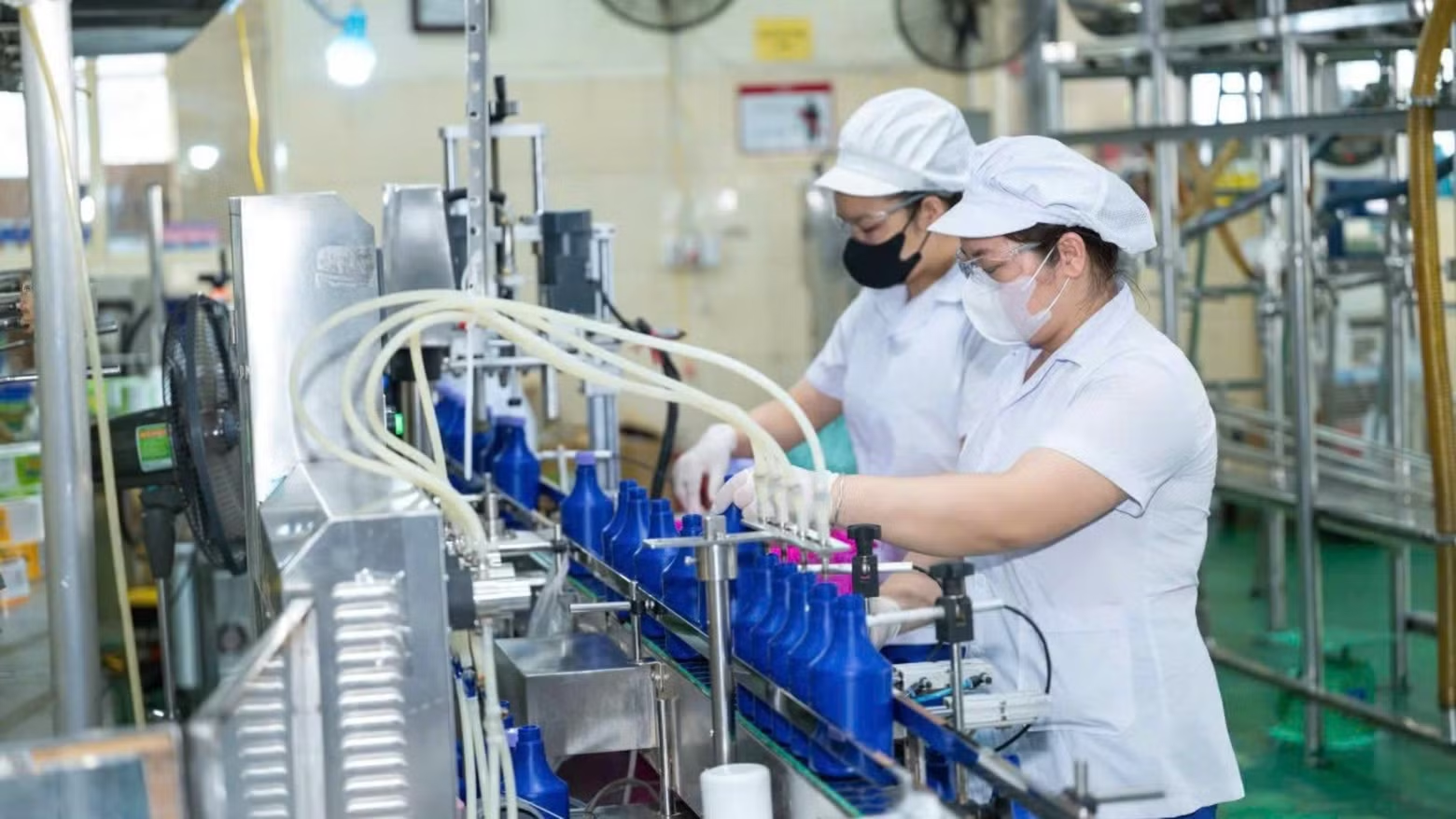
The stories of Vinatex, Vinachem and EVN show that enterprises are not beneficiaries, but direct actors in implementing Resolution No. 19-NQ/TW. More importantly, enterprises need to master high value-added stages in supply chains, hold core technologies, build brands and renew investment thinking. From there, they can become nuclei leading chains, creating momentum for other enterprises to upgrade their capacity and develop together.
However, relying only on “locomotives” will make it difficult to maintain a leading role if the system behind them still consists of enterprises weak in human resources, supporting industries and technology. Therefore, small and medium-sized enterprises first need to proactively improve their capacity and gradually move up to higher value-added stages in the chain. They must regard research and development, intellectual property, data, technology, human resource training and digital transformation not as costs, but as investments in long-term competitiveness.
This is the difference between an enterprise force that is merely large in number and one that is strong in capability and qualifications. When linkages become effective with the participation of research institutes, universities and enterprises, the synergistic strength of the entire ecosystem can be fully brought into play
For linkages to become substantive, policy plays an important role in creating an environment and motivation for enterprises to cooperate.
Dau Anh Tuan, Deputy Secretary General of the Viet Nam Chamber of Commerce and Industry (VCCI), recommended that the state continue removing institutional and business-environment bottlenecks, while improving policies to support technology, capital, innovation and business linkages.
For major projects, incentives need to be tied to requirements for developing domestic suppliers and substantive localisation rates, accompanied by specific verification mechanisms rather than stopping at commitments.
Alongside this, supply chain financing is needed to help small suppliers access capital based on contracts and receivables from lead enterprises. In this way, the capacity and reputation of large enterprises can become a “lever” helping small enterprises access capital more easily, thereby strengthening the entire supply chain.
Only when the capacity of each enterprise is enhanced, the links between them become tighter and the ecosystem is strong enough to generate synergy will new growth drivers no longer remain expectations, but become real capacity of the economy. This is the true goal of the process of renewing the country’s development model.