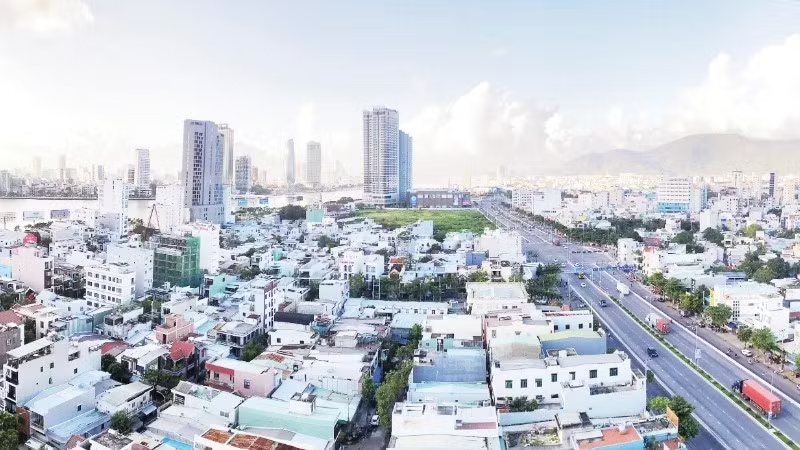
Many experts believe that an inevitable trend for ensuring sustainable urban development is to accelerate the application of science and technology, alongside digital transformation.
A sound mindset and approach
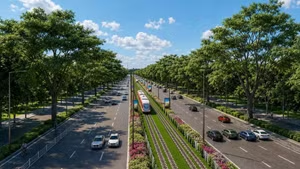
To achieve breakthrough growth, the approach to building and selecting urban development models must be appropriate. Vuong Phan Lien Trang, Deputy General Director of enCity International Consulting Company, stated that Ha Noi and Ho Chi Minh City have proposed a range of solutions, focusing on investment in core infrastructure, particularly public transport and transit-oriented development (TOD). This is expected to serve as the backbone of urban growth, restructuring urban space and becoming a model for other localities.
With substantial investment resources and a long-term vision, planning must go hand in hand with reorganising multi-layered urban spaces; harnessing and capturing land value increments generated by infrastructure development; preserving cultural, historical and landscape values; and unlocking the vast potential of underground spaces. Local authorities also need to make robust use of financial instruments and technological applications to manage planning implementation and ensure community oversight.
Sharing this view, Do Viet Chien, Vice Chairman of the Viet Nam Real Estate Association, emphasised the importance of identifying key growth centres, with major cities playing a pivotal role. Efforts should focus on restructuring and developing existing urban systems, combining preservation with redevelopment.
Localities should review their urban systems based on the overall national urban planning framework and regional socio-economic development strategies, prioritising investment in leading urban centres to create stronger spillover effects, while avoiding fragmentation, duplication and waste—particularly in areas formed through the merger of two or three former localities.
“Cities naturally evolve, and what is needed is to maximise the potential of each. The State will play a connecting role, linking them into a more significant and effective urban network,” Chien noted.
According to experts, Viet Nam’s urban development remains overly concentrated in major cities, particularly the two special urban centres of Ha Noi and Ho Chi Minh City, while insufficient attention is given to small and medium-sized cities. Tran Ngoc Chinh, Chairman of the Viet Nam Urban Planning and Development Association, observed that these smaller urban areas serve as economic and cultural hubs for their regions, yet their role has been underestimated. Land and human resources in such cities remain abundant, whereas they are nearly exhausted in larger urban centres. It is therefore necessary to clearly assign roles to different cities to prevent the dispersion of development resources.
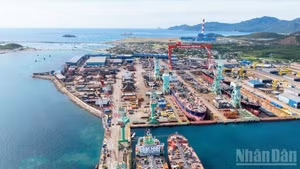
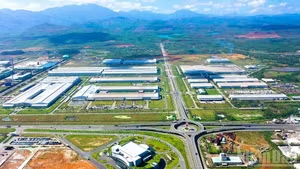
Hai Phong stands out as the only locality in the country to maintain double-digit GRDP growth for 11 consecutive years (2015–2025), with growth reaching 11.81% in 2025, thanks to the consistent and decisive implementation of comprehensive measures.
According to Nguyen Thanh Hung, Director of the Hai Phong Department of Construction, local planning efforts are always prepared in advance and carried out methodically, with priority given to transport and technical infrastructure, alongside development scenarios that account for both positive and negative impacts on urban growth.
Departments such as Finance, Construction, and Agriculture and Environment regularly hold sectoral meetings to address bottlenecks. Administrative bodies actively streamline procedures and services to facilitate investors, businesses and citizens. In addition, the city requires strict implementation of new policies, treating site clearance and public investment as top political priorities.
International experience in urban planning and development suggests that, beyond a comprehensive vision and consistent thinking, flexibility and practical alignment are essential. Dr Emmanuel Cerise, architect and Director of the Paris Region Expertise-Viet Nam, shared: “We provide general directions for urban development without rigidly assigning specific sectors to each area. At the same time, we design flexible urban development plans and programmes aligned with socio-economic conditions at each stage to avoid disruption, waste and prolonged ‘suspended’ projects.”
Promoting the application of science and technology
Recently, the Politburo issued Conclusion No. 224-KL/TW on continuing the implementation of Resolution No. 06-NQ/TW dated January 24, 2022 on the planning, construction, management and sustainable development of Viet Nam’s urban areas to 2030, with a vision to 2045. One of the key priorities is to manage and develop urban areas and urban economies in depth, based on science, technology, innovation and digital transformation; to build digital government and smart cities, ensuring a people-centred approach with data and smart infrastructure as the foundation.
Experts regard this as a breakthrough and a guiding principle for achieving rapid and sustainable urban development. The comprehensive application of technologies enables managers to move from reactive problem-solving to data-driven governance (Data-driven City). Through simulation models, development scenarios—from traffic flows to disaster impacts—can be accurately forecast, minimising planning errors and the waste of public investment, thereby optimising overall costs.
A notable example of technology-driven urban development is Bac Ninh Province, where the urbanisation rate has reached 60.3%, far exceeding the national average. The province has issued a plan on smart urban development, outlining 16 key tasks. Specifically, in 2026, the province will establish a provincial Smart Urban Development Coordination Council and develop a comprehensive smart urban development project, followed by sectoral and regional implementation plans.
The sustainable vitality of a city lies not only in its physical appearance or living environment, but also in its cultural “soul” and creative energy. Cities such as Hue, Hoi An and Da Lat demonstrate that, when properly planned, culture can become a key economic sector contributing directly to growth. The convergence of “digital infrastructure” and “cultural infrastructure” is the golden formula for building humane cities in the new era.
Alongside new approaches, a key task in the coming period is to urgently review and amend legal regulations on urban planning and management towards stronger decentralisation and delegation of authority to localities, coupled with appropriate supervisory mechanisms.
At the same time, it is essential to develop national-scale training and capacity-building programmes to standardise the workforce of architects, urban planners, engineers and administrative managers. Mechanisms to mobilise resources also play a crucial role, especially in the context of limited state budgets. Recognising the vital role of urban areas and implementing coherent, comprehensive solutions will be the key to achieving double-digit growth targets and progressing towards even higher ambitions in the future.