Cities become outstanding and earn renown because of what is different, distinctive, and rare amid what looks alike and feels familiar — features that cities increasingly absorb with ease.
Living amid cities that grow richer fast and more polished fast, we cannot help but look again, and think, about the city we inhabit to understand where it stands among other cities. What distinctive capital and potential does it possess? Keeping pace with other cities is hard enough; becoming truly distinctive is harder still.
Ha Noi stands in the midst of that competitive comparison and development. It is not massive, not splendid, and not more modern than others. Its natural endowment is not necessarily distinctive enough to build a one-of-a-kind urban identity upon. Its accumulation of material wealth is rather modest, and its age is not necessarily ancient. It lacks those buildings and architectural ensembles that, at first sight, make people instantly name the city they represent.
Ha Noi is not a city that overwhelms on encounter, that leaves one stunned and conquered. Ha Noi is, instead, a place where, if we live in it, we grow attached; we love it deeply; and whenever we must be away, we miss it as we miss home. For those who come from afar, Ha Noi feels affectionate and welcoming; the longer they stay, the more they belong — just like being at home. Ha Noi is not only a capital to be proud of. Ha Noi is a place for looking, for feeling, and for loving.
From the perspective of building the capital as a city, perhaps we should organise our thinking along three levels: how to expand the city at the macro level; how to consolidate and gently transform the components that make up the city; and how to behave towards the city’s scenes — its urban panoramas.
At the macro level, we should first raise the issue of saving land, even though the city now spans more than 3,000 sq km. Saving land matters because once land is urbanised, it will never return to natural land. The purpose of saving land is to leave it for our children and grandchildren. Therefore, urban expansion should limit land devoted to infrastructure and industry.
Villages should develop along an “agri-urban” model, preserving land for cultivation. We should be especially gentle with areas that have distinctive terrain and landscapes that could help shape the city’s identity.
The Red River runs through the city without yet being fully urbanised; its flow has not been tightly constrained by continuous embankments. Its two green banks remain fresh, though in some places there has been spontaneous encroachment. One can only hope this vast river may remain as it is — flowing as it naturally does, sometimes leaning to the left, sometimes to the right. The city should reserve for itself an airy, open expanse of space — like a form of luxury.
As for the city’s lakes, large and small, we should allow them a measure of freedom and not cinch them in. There was a time when they were filled in without hesitation; only later did we realise they are part of the urban ecology the city needs.
West Lake and Truc Bach Lake deserve to be regarded as urban wonders. Yet they seem unlikely to escape construction pressure and heavy loading on all sides.
The picture — indeed, the portrait — of Ha Noi is made up of old and new components that can be described collectively as urban scenes. These include the Red River, many lakes, the Old Quarter, and the older villages once on the outskirts. They include the neighbourhoods built in the late 19th century and the first half of the 20th century. They include the areas built after 1954, especially over the past two to three decades.
Hoan Kiem Lake, by the late 19th century, was still a pond-lake of Ha Noi’s streets. In the early 20th century it was improved, becoming the city’s central core — an accent and a scene that seems almost unparalleled. The lake’s distinct charm lies in the interweaving and gentle transformation between the water surface, the rows of trees, the surrounding road, and the lines of buildings in varied styles. Even today, it remains harmonious in the interplay of open and enclosed spaces, in a width that is just enough. One worries that if the space is opened into something too vast, the lake could begin to feel like a pond.
We have solved the issue of the Old Quarter as urban heritage, through conservation – adaptation – renovation – modernisation. Thanks to this, we have preserved without disturbance the characteristic network of streets, lanes, and alleys; the residential and shop-house structure of narrow tube houses, even if façade changes have been difficult to avoid; and the hundreds of religious and communal institutions — communal houses, temples, pagodas, and shrines — coexisting in dense street housing.
Perhaps we should undertake a comprehensive clean-up of façades and alleyways. Shabbiness, and even moss, does not necessarily mean antiquity. Many streets were once known for their goods, for shop owners, and for famous people who lived there, such as Hang Dao, Hang Ngang, Hang Gai, and Hang Bong.
The old and ancient villages close to the Ba Dinh centre, for centuries leaning against the city, form a distinctive component of the overall picture, a soft and flexible connective tissue of the city’s body.
With urbanisation speeding up — mostly through taller buildings and more solid construction — villages on the city’s edge still preserve much that is distinctive in both architecture and daily life. Along Thuy Khue Street, modern houses are packed tightly together, but they still cannot fully hide the temples, pagodas, and the many village gates. In a way, the cramped land and tightly held plots of the old villages have kept high-rises from forcing their way in.
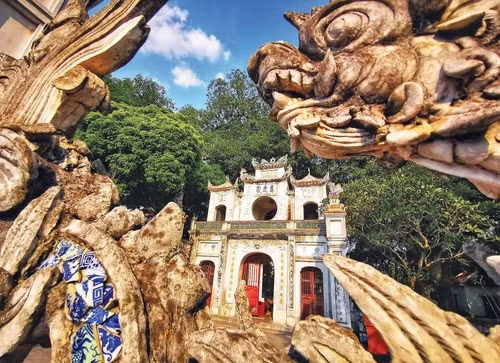
The neighbourhoods built in the late 19th century and the first half of the 20th century did not enjoy the same good fortune as the old villages. This was perhaps the most favourable place to present and assert one’s standing and achievements; and so, dozens of buildings — massive in scale and new in architectural language — have bluntly overwhelmed the roads, houses, and open spaces shaped almost a century earlier. Except for some blocks in the former Ba Dinh District, the architectural image of this period in the former Hoan Kiem District and Hai Ba Trung District has been visibly disturbed and diluted.
The influx of oversized new landmark buildings should be checked. The remaining older structures should be recognised and given prominence, and characteristic street segments should be repaired and reconnected so they can reaffirm their own identity.
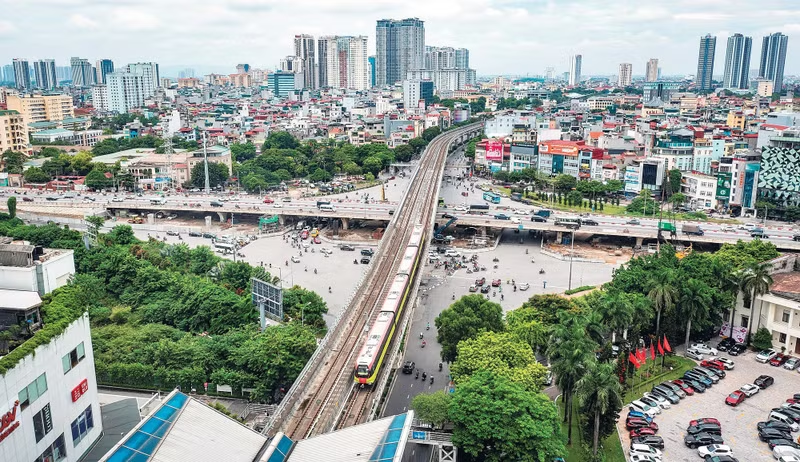
In the middle of the last century, Ha Noi covered nearly 100 sq km. By the end of the century, it was 1,000 sq km. After 2008, it expanded abruptly to more than 3,000 sq km. Construction and development have surged, spreading in all directions. The scale and architectural forms are appropriate to the era, yet between Ha Noi’s old core and new-built areas, contradictions have emerged, with traffic and spatial connectivity among them. These risks may gradually erode a defining quality of Ha Noi: inheritance and gentle transformation across history, across space, and across architectural form.
With sincerity and vision, drawing on the cultural foundations that define Ha Noi, the city can become more modern, more beautiful and more elegant, while still safeguarding and enriching what makes it uniquely its own.