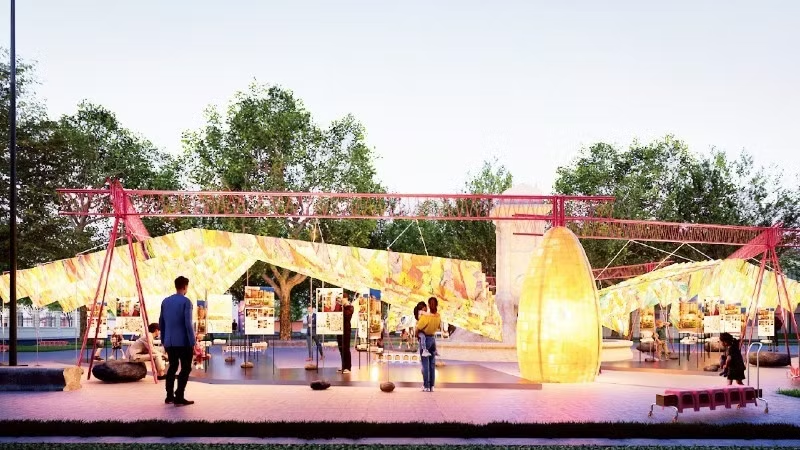
Not only beautifying streets and neighbourhoods, works appearing in squares, parks and pedestrian zones have also opened up dialogue between people and history, nature and the surrounding community, helping to create fresh appeal for the capital’s cultural and tourism life.
In 2025, public art activities and works in Ha Noi appeared more frequently and with steadily improving quality, marking a notable step forward in thinking about enhancing urban spaces through creativity.
Going beyond a purely decorative role, public art helps shape shared aesthetic values and provides added impetus for the development of tourism and services.
At weekends or during holidays, it is not hard to see residents and visitors stopping in public spaces around Ha Noi to admire an artwork, take photographs, chat and interact.
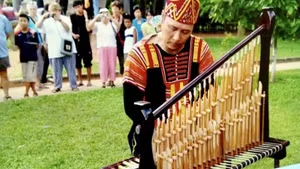
From outdoor performances to multi-form works, art can be seen weaving its way into urban life in an increasingly natural and accessible manner.
According to many architects and cultural researchers, for a city aspiring to creativity, open art spaces, where people can access and enjoy art throughout all four seasons, are considered indispensable.
The public art project “What Do Birds Tweet About?” launched in late September 2025 at Chuong Duong Riverside Forest Park in Ha Noi and Tao Dan Park in Ho Chi Minh City, is a striking example of initiatives that enrich lesser-noticed urban spaces.
Created by Vietnamese and foreign artists, the work takes the form of a colourful “tree house” combining AI technology with an online ornithological database, forming a “bird station” that invites visitors to listen to the sounds of hundreds of bird species present in the local ecosystem.
The art space thus becomes a place to pause, where people can reconnect with nature right in the heart of the city.
Earlier, at Co Tan Flower Garden, the public art work “Revival” by fashion designer Tia-Thuy Nguyen evoked strong emotions among the public. The artist and her collaborators transformed a century-old mahogany tree felled by Typhoon Yagi in 2024 into a large-scale artwork, using more than six tonnes of metal and completed after over 6,000 hours of labour.
The tree canopy was recreated with thousands of steel leaves and quartz flowers, both recalling the tree’s natural form and conveying a message of rebirth and nature’s capacity to recover after natural disasters.
Meanwhile, the artwork “Unity”, inaugurated in late October at the August 19 Garden, further demonstrates the trend of bringing art closer to everyday life rather than confining it to museums or galleries.
Dien Hong Garden, with its prime location beside the Hoan Kiem pedestrian area, has also become a regular venue for distinctive and impressive public art exhibitions.
In recent years, Ha Noi has witnessed the emergence of numerous public art projects, including the Phuc Tan Public Art Project carried out voluntarily by a group of 16 artists. In addition to its aesthetic value, the project incorporates environmental protection messages, uses recycled materials and encourages the participation of local residents.
The Tran Nhat Duat pedestrian bridge, linking the Phuc Tan project with the 22 Hang Buom Arts and Culture Centre, has likewise been awakened by artistic lighting installations, becoming a lively focal point at night.
On Phung Hung Street, old railway arches have been transformed into mural spaces that recreate memories of old Ha Noi and bring art closer to the community.

Alongside shifts in mindset, forms of public art have also become increasingly diverse. Whereas sculpture once dominated, installation art, light art and digital technologies are now more common. Works are no longer static displays but immersive experiences connected with space, time, light, sound and even weather conditions.
Artists are no longer solitary creators; instead, they act as facilitators, inviting community participation through workshops, from design to construction, thereby fostering shared responsibility for preserving living spaces.
However, according to architect Pham Thanh Tung of the Viet Nam Association of Architects, for a city of 10 million people like Ha Noi, the current number of public art spaces remains modest.
Many projects are event-based and short-lived, failing to meet people’s everyday cultural needs. Moreover, a number of installations deteriorate over time due to a lack of management mechanisms and stable maintenance funding.
This reality highlights the need for a long-term strategy, from planning and the selection of durable materials to strengthening community participation and a sense of ownership. When residents become part of the process of creating and protecting artworks, the aesthetic lifespan of public art can be extended.
As Ha Noi is a member of the UNESCO Creative Cities Network, the development of creative clusters and public art spaces is expected to continue gaining momentum in 2026.
With a large community of architects, artists and creative practitioners, together with positive shifts in management thinking, public art has the potential to become a driver of the creative economy while helping to promote the image of the capital in a new phase of development.