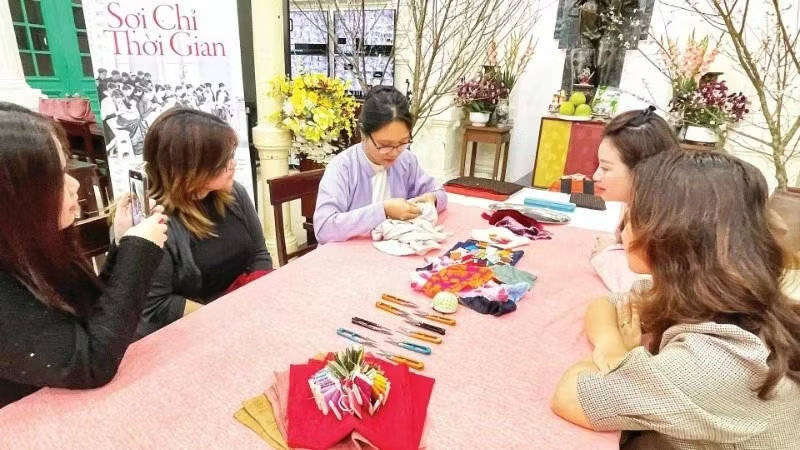
The community art project “Threads of Time,” initiated by embroidery artist Pham Ngoc Tram, has helped bring traditional Vietnamese hand embroidery back to life, making it more vibrant and accessible to younger generations.
As a graduate of the Viet Nam University of Fine Arts, Pham Ngoc Tram has spent more than 15 years researching and restoring traditional embroidery techniques as well as developing her own artistic practice. Her exploration of silk, thread, and natural dyes has expanded her expressive possibilities and helped shape a distinctive personal style.
Her works go beyond the value of craftsmanship, affirming hand embroidery as a form of visual art within contemporary artistic life. Alongside her individual practice, Tram has frequently organised embroidery workshops both in Viet Nam and abroad, contributing to the wider appreciation of traditional embroidery and gradually introducing these techniques into international creative spaces.
Drawing on her professional expertise and deep commitment to Vietnamese cultural heritage, Pham Ngoc Tram launched the “Threads of Time” project as a journey to collect and systematise memories of embroidery and mending in traditional Ha Noi households. The initiative is carried out in collaboration with the People’s Committee of Cua Nam Ward and Trung Vuong Secondary School. Through the medium of hand embroidery, the project encourages the community to share stories connected with urban memories and heritage, while also reviving the long-standing tradition of craft education for Ha Noi schoolgirls. It aims to gradually establish the Trung Vuong–Dong Khanh School as a cultural and heritage education hub.
The project’s opening activity took place at Trung Vuong Secondary School with a talk on embroidery during the Indochina period and stories related to the former Dong Khanh Girls’ School. The space of the traditional “female handicraft classroom” was recreated, allowing participants to directly experience embroidery and mending as part of the historical educational curriculum for girls.
Following the launch event, the project called on the public to share keepsakes and memories related to embroidery and sewing, laying the groundwork for the next stages. The items contributed have grown increasingly diverse: handkerchiefs, sewing boxes, patched garments, and pillowcases embroidered with pairs of birds — each reflecting diligence, care, and affection. These artifacts together form fragments of everyday life in Ha Noi across different historical periods.
Throughout the research and practice process, Pham Ngoc Tram has consistently emphasised community connection. As part of activities welcoming the Year of the Horse 2026, the programme “New Spring Colours for Old Clothes” attracted many young participants as well as mothers and grandmothers. For many children, it was their first time threading a needle, learning basic stitches, embroidery techniques, and how to mend wool sweaters under the guidance of the artist.
Through each simple stitch, memories of the subsidy period resurface with emotion. These intergenerational stories not only convey cultural values and family affection but also demonstrate the enduring vitality of traditional embroidery techniques in modern life.
Through these recollections, the role of women in educating younger generations, preserving family traditions and safeguarding urban memories becomes vividly apparent. At the same time, accessories creatively designed by young participants — such as scented sachets or embroidered handkerchiefs — reflect the adaptability of traditional embroidery in contemporary life. The practice session not only created a space for sharing memories of Ha Noi within families but also fostered awareness of repairing, recycling, reusing, and appreciating the value of everyday objects.
Hand embroidery is not merely a craft skill but also a means of emotional expression and intergenerational connection. Through each stitch, generations of Ha Noi women passed down to their children the skills of mending clothes, sewing handkerchiefs and maintaining household traditions — values that once seemed to belong only to memory but are now revived through the resilience of a single thread.
Artist Pham Ngoc Tram
Sharing about the “Threads of time” project, artist Pham Ngoc Tram noted that hand embroidery is not only a skill but also a way to express emotions and connect generations. Through each stitch, generations of Ha Noi women passed down to their children the skills of mending clothes, sewing handkerchiefs, and maintaining household traditions — values that once seemed to belong only to memory but are now revived through the resilience of a single thread.
Continuing the project’s journey, Pham Ngoc Tram will work with cultural researchers, artists, and educators to discuss ways of integrating art into heritage education and community engagement. The materials collected and contributed towards the “Threads of Time” project are edited and developed into content for a community exhibition at Trung Vuong Secondary School.
The exhibition space is showcasing embroidered objects, photographs, and documents shared by the community, along with accompanying images, stories and multimedia artworks. After the event, all data will be digitised to form an archive for research purposes and for presentation at cultural spaces both in Viet Nam and abroad. This initiative will broaden public access while reaffirming the place of traditional Vietnamese embroidery within contemporary cultural life.