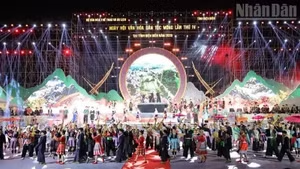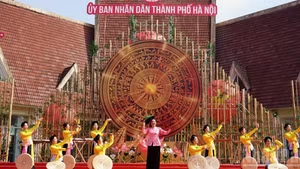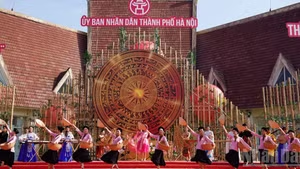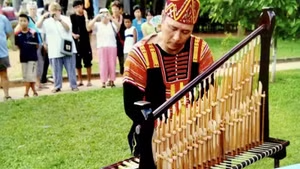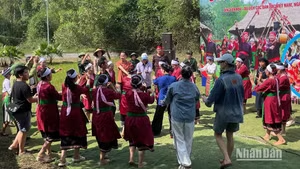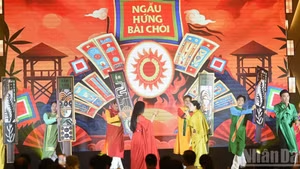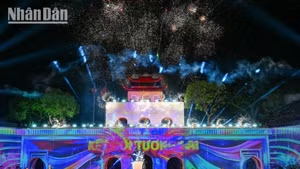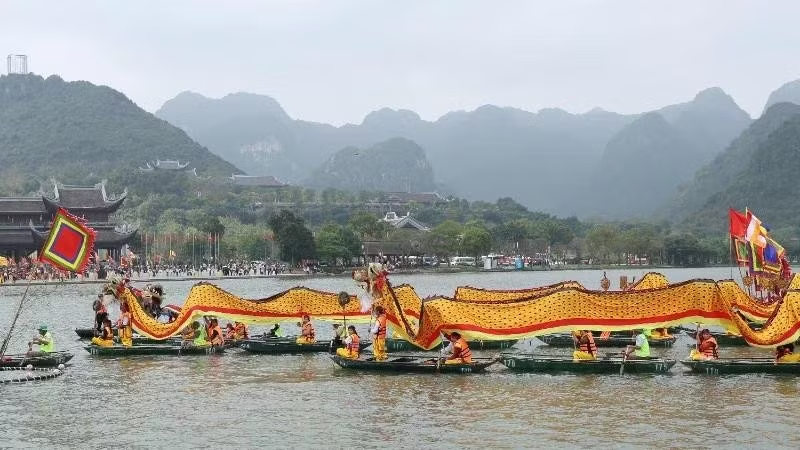
Continuing the flow of tradition, this year has seen a clearer trend of returning to folk elements as many localities focus on restoring traditional rituals, reviving folk games, honouring artisans, and expanding cultural experience spaces for residents and visitors.
At many post-Tet festivals, folk games such as tug of war, swinging contests, blindfolded goat catching, clay pot breaking, human chess, and wrestling have attracted large numbers of participants. In several places, ritual processions, offerings, folk singing, and folk dance performances have been revived. Some localities have also creatively introduced the historical values of relic sites and the meanings of rituals, even applying digital technology. These efforts aim to bring folk traditions back to the center of community cultural life rather than limiting them to illustrative performances. Renewing organisational methods and enhancing interactive experiences have helped boost attractiveness, promoting tourism and local economic development.
However, alongside these positive signs, public opinion has also raised concerns. In some places, the folk element appears to emphasise the “festival” aspect while neglecting the “ritual” part. Rituals have been simplified or excessively staged, and traditional games have been transformed into performances for spectators rather than activities that foster community bonding. When festivals are designed mainly as “event products,” the risk of losing cultural depth becomes a serious concern.
More notably, commercialisation is gradually infiltrating certain festivals. Sacred spaces in some locations are surrounded by dense rows of stalls; services such as small-denomination money exchange, hired offerings, and the sale of “good-luck” items at high prices appear openly. Arbitrary fees, aggressive solicitation of tourists, and even money-based games have yet to be thoroughly addressed.
In some cases, rituals have been arbitrarily altered, with inappropriate additions and excessive sound systems that undermine the solemnity of ceremonial parts. Such practices not only distort cultural values but also show signs of violating regulations on festival management and organisation, causing public dissatisfaction.
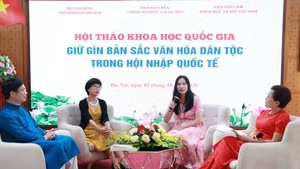
According to researchers of folklore culture, promoting heritage is essential. However, if festivals are viewed merely as tools to attract visitors and increase revenue, public trust will eventually be lost. Festivals should first and foremost serve as shared cultural spaces that foster connection and positive interaction within communities. The ritual component—honouring ancestors, reinforcing moral values, and strengthening communal solidarity—is the core value. If this essential value is overlooked, even the most lively festivities cannot remain sustainable.
Conversely, some argue that culture is constantly evolving. If festivals remain unchanged and fail to adapt to contemporary life, they may gradually lose relevance to the public, especially younger generations. Therefore, the key issue is not whether to innovate but how to innovate—on what foundation, within what limits, and under what control.
To preserve the folk essence during the festival season, a comprehensive set of solutions is needed. First, management must be strengthened with strict enforcement of regulations on festival organization, promptly rectifying and handling distortions, commercialisation, and the exploitation of beliefs for personal gain. The restoration of rituals and performances should be based on scientific research and involve experts and artisans who hold traditional knowledge. Service activities should also be properly planned to ensure civility without overwhelming sacred spaces.
At the same time, the role of communities must be enhanced, as they are the true creators and custodians of festivals. When local people genuinely participate in organising, supervising, and fairly benefiting from heritage, they become the most effective force in protecting it from deviations. Tourism development should go hand in hand with preservation, placing cultural values at its core rather than pursuing short-term gains. Preserving the folk essence in modern life means safeguarding the spiritual foundation of communities, so that each festival season is not only lively but also deeply meaningful with enduring humanistic values.