Hands revive heritage
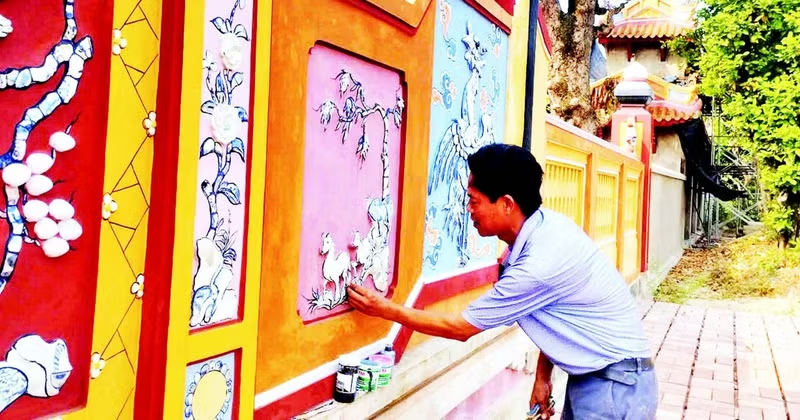
We arrived at a small workshop tucked away in a quiet alley on the outskirts of Hue. The faint scent of traditional lacquer lingered, while golden hues shimmered under the morning sun. There, craftsmen were quietly carrying out modest work that helps to preserve an essential part of the Nguyen dynasty’s heritage — the craft of vermilion lacquer and gilding.
The first to greet us was artisan Ngo Dinh Trong, who has been devoted to the craft for more than 25 years. His hands are calloused, covered with a fine layer of gold dust; his gaze is calm yet lights up whenever he speaks of each ancient decorative detail.
Trong recounted his early days after entering the trade, when as a young man he apprenticed under his predecessor, master Do Ky Hoang, former Rector of Hue University of Fine Arts. In those years, he had to learn how to distinguish each type of lacquer, how to treat wood, and how to apply gold so that the gold layer adheres firmly while retaining its natural lustre.
In his memory, his first participation in restoring a detail at a structure within the Nguyen dynasty relic complex was an unforgettable milestone. “At that time my hands trembled, because I knew this was not something new; I was touching history, the heritage of our forefathers,” Trong shared.
According to Trong, carving is the “skeleton”, while lacquer and gilding form the “skin”. For example, in the restoration of Thai Hoa Palace, one of the largest palaces in the Hue Imperial Citadel, all wooden column systems underwent numerous processes, from base coating and smoothing to sealing lacquer, hand painting, and gilding. Some dragon and phoenix motifs took weeks to complete. Notably, the “ray may” technique requires every carved line to be soft yet decisive, maintaining the artistic style of the Hue imperial court. “A single mistake means starting all over again,” Trong said.
Not far from Trong’s workshop, artisan Bui Van Trinh is also diligently working on intricate carvings. Trinh is well known in the field for his ability to restore ancient patterns almost to their original form. We found him bent over a horizontal lacquered board that had just been base-coated. Each carved line of a winding dragon gradually emerged beneath the jet-black lacquer, awaiting its layer of gold.
According to Trinh, every motif in Nguyen dynasty structures carries its own meaning, from dragons symbolising power and phoenixes representing nobility to floral patterns expressing philosophies about nature and humanity. Practitioners not only need technical skills but also cultural and historical understanding. On one occasion, when restoring a detail in a royal tomb, he spent nearly a week studying documents and comparing remaining samples before beginning work. “A tiny error could lead to major consequences,” Trinh said.
In the 1990s, the craft of lacquer and gilding in Hue remained quiet. Work was scarce and income unstable, yet Trinh persevered, as if by a choice that needed no explanation. Real opportunities came when the restoration of Hue’s relics began. One of the first projects he joined was the restoration of old palanquins at Dien Tho Palace. From scattered wooden pieces, he reconstructed each detail, applying each layer of lacquer and placing each sheet of gold with utmost care.
Upon completion, the old palanquin seemed to come back to life, its golden sheen subdued yet profound. Since then, his craftsmanship has appeared in many major works, such as Gia Long Tomb, Dong Khanh Tomb, Tu Duc Tomb, Thai Binh Lau, Trieu Mieu, and Duyet Thi Duong. Each place is a dialogue with the past. A memorable experience was when he crafted two chairs at Thai Binh Lau. After completion, no one could distinguish the new chairs from the old ones. Only when he turned them over to reveal a deliberately placed identifying mark did people realise the difference.
When golden splendour endures with time
In the stories of these craftsmen, artisan Dao Huu Khien is mentioned with respect. Belonging to the younger generation of artisans, Khien has quickly proven his skills through many major projects. He recounted days when he worked for hours just to complete a small detail. Yet it is precisely those details that create the overall splendour of a structure. “People see beauty, and that is enough; but we know how much effort lies behind it,” Khien said with a smile.
One of the most important principles in the work of these artisans is “restoration, not renewal”. This requires profound knowledge of history, art, and conservation philosophy.
According to artisan Ngo Dinh Trong, each structure bears the marks of time — cracks, faded colours, or even imperfections. That is history; if everything is erased, the structure will lose its value. After more than 25 years devoted to lacquer and gilding, Trong cannot remember how many projects he has restored. Yet every time he stands before an old palace, he still feels the same nervous excitement as the first time. “Every detail has its own story; it cannot be done carelessly,” he said.
The restoration of screens in the Hue Imperial Citadel is a clear example. These screens are not only functional partitions but also carry feng shui significance, reflecting the authority and aesthetics of the court. Artisan Khien shared: “Some details have been completely lost; we must search for materials, compare with contemporary structures, even consult paintings and old photographs to restore them.” This process is not only one of technical labour but also a journey of “decoding” history. Each motif and colour must reflect the spirit of the Nguyen dynasty. “We do not create based on our own ideas; we must respect what already exists,” Khien emphasised.
In the flow of modern life, traditional crafts such as lacquer and gilding, lacquerware, and carving face numerous challenges. Low income, demanding work and the need for perseverance make many young people hesitant. “Many come to learn for a while and then quit. They cannot endure the slow pace of the craft,” artisan Trinh reflected. However, there are encouraging signs. In recent years, restoration and conservation projects in Hue have been receiving increasing attention, creating conditions for artisans to continue practising and passing on their skills to future generations. “This craft cannot be kept to oneself. As long as the younger generation is dedicated, I am willing to teach,” Trong said.
“I do not work for fame. I only hope that when people look at it, they can still feel the spirit of old Hue,” Trong added. That belief has kept artisans like him devoted for many years, not for material gain, but for a conviction that heritage is not only the past, but a living part of the present and the future.
The layers of vermilion lacquer and gilding, reliefs, ceramic and porcelain inlays, etc., will inevitably fade over time. But thanks to those who tirelessly preserve the craft, the “golden soul” of the ancient capital will remain quiet and enduring, like the tranquil rhythm of Hue itself.