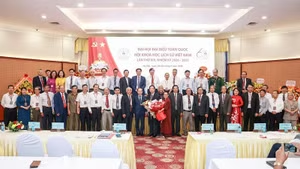
The 8th National Book Awards Ceremony recently held in Ha Noi attracted the participation of 46 out of 52 publishing houses nationwide with 397 book titles and book sets, corresponding to 512 volumes. The judging process was conducted through three levels: preliminary round, final round and the awards council. More than 70 professors, scientists and leading experts in various fields participated in the evaluation process. The works were assessed through multiple rounds of independent reading, peer review and secret voting.
From the results through the judging rounds, the organizing committee presented 52 awards to 50 books and book sets, including: 2 A prizes, 17 B prizes, 23 C prizes, 5 Encouragement prizes and 5 Reader’s Favorite Book prizes. The two A prizes this year were awarded to historical works, including “Illustrated History of Viet Nam” by Dong A Books in cooperation with the Publishing House of Ha Noi National University of Education and “The Story of Civilization” (authors Will and Ariel Durant, Social Sciences Publishing House and IRED Institute of Education), reflecting a balance between indigenous knowledge and international knowledge.
Along with the rapid development of intellectual life, communication technology and reading habits in modern society, the new award season has introduced certain innovations to adapt. One of the most noticeable changes is the adjustment of the award structure from five categories to four content areas.
According to the organizing committee, academic fields are increasingly experiencing strong intersection and interdisciplinarity, making overly detailed categorization difficult to align with reality. Streamlining helps the judging council evaluate works from a more comprehensive perspective. Books whose content overlaps among fields such as economics, social sciences, politics, education or innovation will not be restricted by rigid classification.
This reflects the current research trend, as knowledge is increasingly interdisciplinary and interconnected. In addition, the science book category has been expanded to include content related to education, innovation and the knowledge economy. This adjustment is meaningful in the context of Viet Nam promoting digital transformation and developing a knowledge-based economy.
Another notable innovation is the improvement of the evaluation criteria system toward greater clarity and transparency, especially for translated books. Previously, evaluating translated books faced difficulties because it required consideration of both the value of the original work and the quality of translation. The addition of separate criteria makes the assessment process more fair and scientific while properly recognizing the role of translators.
This year’s award season also expanded nomination sources. Along with publishing houses, readers, press agencies and social organizations can also nominate works for participation. The expansion contributes to increasing the socialization of the award while creating more opportunities for valuable books to be discovered.
Notably, the application of media data analysis in the selection process has also been implemented. For works proposed for high awards, the organizing committee cooperates with technology units to collect and analyze public opinion data from the press and media platforms. This approach demonstrates the award’s adaptation to the modern communication environment. This year, the Reader’s Favorite Book category continues to be maintained, combining public voting with professional evaluation.
Through the list of honored works, it can be seen that there is an increase in large-scale academic works, particularly in the fields of politics, history, economics and social sciences. Many book sets have substantial volumes and are carefully invested in both content and form, reflecting the efforts of publishing houses to improve book quality, not only meeting entertainment needs but also serving research, learning and long-term accumulation of knowledge. Domestic authors are increasingly affirming their roles in the academic field. Research works conducted by Vietnamese scholars have attracted significant attention, reflecting the maturity of the country’s intellectual and research community.
Through the list of honored works, it can be seen that there is an increase in large-scale academic works, particularly in the fields of politics, history, economics and social sciences. Many book sets have substantial volumes and are carefully invested in both content and form, reflecting the efforts of publishing houses to improve book quality, not only meeting entertainment needs but also serving research, learning and long-term accumulation of knowledge.
On the other hand, translated works also continue to play an important role in bringing world knowledge to Vietnamese readers. Many high-quality translations have contributed to enriching academic life and reading culture.
Despite many positive innovations, the National Book Awards still face certain challenges. First, the influence of the awards among the general public remains limited. While experts and the publishing sector pay considerable attention, for a large number of ordinary readers the list of award-winning works does not yet truly become a familiar reference source.
Another issue is the gap between academic books and the mass book market. Many award-winning books possess high research value but are difficult for young readers or general readers to access. This makes the dissemination of knowledge from the awards to society less effective than expected. In addition, although there has been progress in combining reader voting, participation has not yet been truly widespread. Voting mainly takes place on online platforms, while many other groups of readers have not had the conditions to access it.
A greater challenge lies in the changing reading habits in the digital era. As social networks, short videos and digital entertainment platforms develop strongly, maintaining the habit of reading long and in-depth books becomes more difficult, especially for younger generations.
From the innovations of the National Book Awards, it is possible to see a clear effort to improve the quality of evaluation and expand the influence of the awards. However, for these values to spread, more synchronized solutions are needed. First, communication about award-winning works should be strengthened. Instead of merely announcing the list, press agencies, publishing houses and library systems could organize book introduction programs, discussions with authors or community reading campaigns. Second, outstanding works should be brought closer to the education system. Many award-winning books possess high academic value and could become useful reference materials for students, pupils and teachers. Third, digital transformation in publishing should be promoted. E-book versions, audiobooks or online reading platforms will help works reach more groups of readers, especially young people.
In addition, the role of libraries and community reading spaces should be promoted. Displaying and introducing award-winning works at libraries, bookstores, book streets or cultural events will help readers access them more easily. At the same time, greater participation of readers in discovering and honoring good books should be encouraged.
The innovations demonstrate determination to improve the quality and influence of the National Book Awards. However, the journey to build a reading society remains long. Yet it is clear that the more good books are discovered, honored and disseminated, the stronger the foundation for reading culture to develop in modern society.