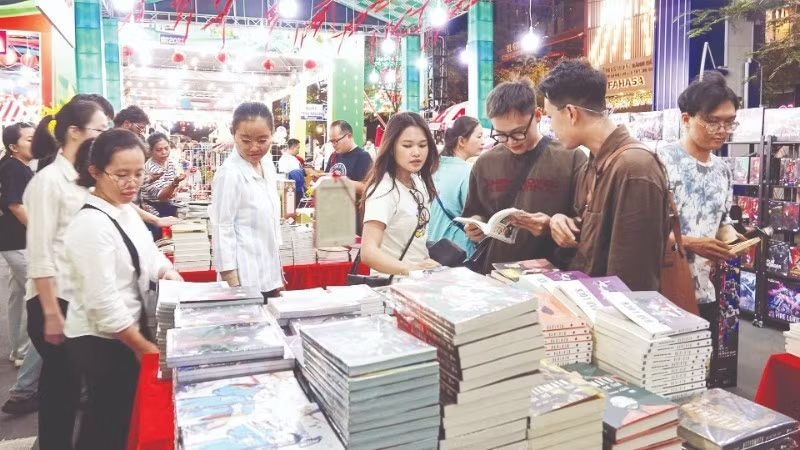
For more than a decade, the annual festival has stood as a distinctive cultural hallmark of the city, fostering and spreading a love of reading. With its core message of welcoming spring through knowledge and beginning the year with fresh perspectives, the event elevates traditional New Year outings into a journey that enriches enduring spiritual values.
This year marked the first time the festival expanded across three venues: the Le Loi Street axis in Sai Gon Ward, New City Park in Binh Duong Ward, and the Revolutionary Tradition House area in Vung Tau Ward. Covering more than 13,600 sq.m and involving 30 participating units, the expansion helped spread reading culture more widely within the community.
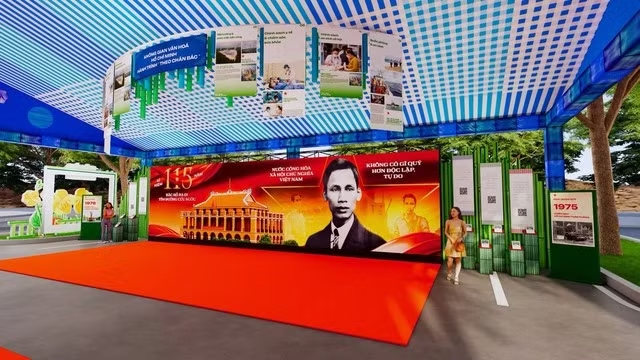
A notable feature of the 2026 edition was its blend of tradition and technology. The Ho Chi Minh Cultural Space, designed under the artistic concept “Bamboo Forest Telling Stories,” showcased 16 vertical banners quoting literary works about late President Ho Chi Minh, alongside eight large book pillars displaying thematic publications.
The festival’s success demonstrates that when books are placed within a creative ecosystem, supported by professional investment in content and space,
The festival also introduced technology-driven reading applications, including artificial intelligence (AI) and augmented reality (AR) books, as well as digital libraries, reflecting the publishing industry’s digital transformation. An international integration zone, themed “The Circle of Knowledge Exchange,” brought together foreign consulates and international publishers, featuring bilingual publications and cultural exchanges.
Book gifting activities were innovated with three formats: scanning QR codes to receive audiobooks, collecting books from automated vending machines, or receiving them directly at booths. Nearly 2,000 books, newspapers, and magazines were distributed.
Diversified experiences such as author meet-and-greets, book signings, workshops, seminars, and themed exhibitions transformed book buying into an engaging cultural activity rather than a purely commercial transaction.
The festival’s success demonstrates that when books are placed within a creative ecosystem, supported by professional investment in content and space, reading culture can attract a broad audience, particularly young people and family groups. Yet, many local book festivals still lack connectivity and uniform organisation quality.
In several localities, book fairs and new book streets remain small-scale and short-lived, often focused on discounted sales without experiential activities, academic exchanges, or technology applications. Mobilisation of social resources is limited, and coordination between cultural, educational, publishing sectors, and mass organisations remains loose. While major cities have built iconic book festival brands, many provinces continue to struggle with suitable models.
During this Lunar New Year, Ha Noi hosted the 2026 Spring Book Street under the theme “Books Open Spring Fortune – Welcoming a New Era,” attracting readers to visit, take photos, and enjoy the festive book space. Smaller fairs and cultural activities also created highlights for residents and tourists, though assessments suggest these remain under-invested and lack standout features.
Innovating book festivals must be integrated into a national reading culture development strategy, tailored to each region’s characteristics.
From this practice, innovating book festivals must be integrated into a national reading culture development strategy, tailored to each region’s characteristics. Nguyen Nguyen, Director of the Publishing, Printing and Issuance Department, emphasised that book festivals should be seen as comprehensive cultural spaces where books connect with performing arts, digital technology, skills education, and local tourism. He suggested each locality could choose its own theme, drawing on heritage, history, and notable figures to create a unique identity.
He also stressed the importance of accelerating technology applications in organisation and promotion through online platforms, audiobooks, QR codes, and cashless payments to expand reach amid digital transformation. Alongside this, greater socialisation is needed, encouraging participation from businesses, publishers, schools, and libraries, and forming networks between localities to share experience and resources.
The success of the 2026 Lunar New Year Book Street Festival in Ho Chi Minh City underscores the potential of the book festival model when properly invested in. The challenge now is to build a widespread, uniform, and sustainable “book festival map” to nurture reading habits, strengthen knowledge foundations, and foster a healthy cultural life across communities.