Flowers call photographers' steps
It is no coincidence that photographers jokingly refer to spring as the “season to open the shutter”. After a year of constant busyness, they do not rest but instead set off once more, carrying cameras and lenses, along with the excitement stirred by blossoms gradually awakening the earth and sky. About a month before Tet, creative energy is already buzzing across Ha Noi.
At the familiar destination of Nhat Tan peach garden, amid branches still dotted with tight buds, photographers arrive at dawn, testing the light, adjusting compositions, patiently waiting for a thin veil of mist or a passer-by whose silhouette might lend the image its soul. In Tay Tuu and Quang Ba in the days leading up to Tet, outdoor “studios” emerge amid roses, chrysanthemums, lilies, gladioli and dahlias in a riot of colour.
As Tet approaches at Hang Luoc flower market, beneath the characteristic spring drizzle of the capital, flower sellers and market-goers mingle; elderly people leisurely select peach branches, while young women gracefully display their ao dai. Together they create frames imbued with the unmistakable spirit of Tet.
For photographers, such subjects are a wellspring that never runs dry. Each year, the light shifts, the crowds change, and so too do the emotions of the person behind the lens. It is this subtle difference that draws them back, year after year.
Leaving the city behind, spring through the lens turns towards vast and open floral landscapes. Overnight journeys carry photographers to the northern mountains, where peach, plum, apricot and mustard blossoms transform the scenery into vibrant carpets of colour.
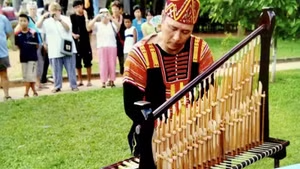
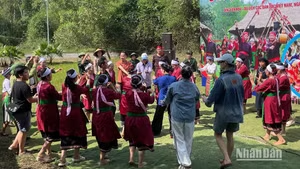
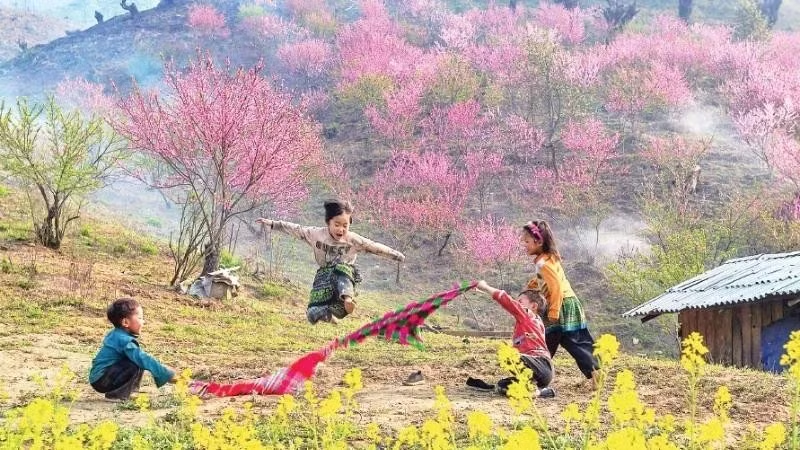
The plum valleys of Na Ka and Mu Nau (Son La) become rendezvous points for hundreds of photographers each spring. On peak days, the number of cameras in hand can triple or quadruple. Yet what holds them there is not only the blossoms, but also the rhythms of local life: highland markets, the sound of the Mong khen, Thai xo dance, pao (cloth ball) throwing games, and pounding banh day (round glutinous rice cake).
In Dong Van and Meo Vac Communes (Tuyen Quang Province), deep pink peach blossoms bloom dreamily along winding stone slopes, beside ancient rammed-earth houses, forming a backdrop for the colourful attire of Dao and Lo Lo ethnic women celebrating the new year.
For photographers in the south, the Tet flower season leads them to the bustling floating markets of Cai Rang and Chau Doc, or to villages of apricot, bougainvillea and chrysanthemums glowing beneath warm golden sunlight.
Each flower type carries its own rhythm and character, yet they share one common trait: blossoms never stand alone, but are always intertwined with people and with daily life. Flowers open the door to stories of identity and of tradition carried forward within the flow of modernity.
Thus, early-year flower-hunting journeys mean more than a distinctive artistic pursuit of photographers; they become a form of reportage told through images and emotion.
Thousands of works have been, and will continue to be, used to promote tourism, advertising, books and magazines at home and in international publications, helping to bring the image of Viet Nam to a wide audience.
Preserving spring by light
If “flower hunting” is a tradition, then the well-organised photo trips in recent years have opened up a new direction for photography linked to tourism and local culture.
At the end of January, the photo programme themed “Spring returns to the land of flowers” in Sa Dec Commune (Dong Thap Province) attracted more than 100 photographers from provinces and cities across the country.
Photographer Ngo Tran Hai An, a member of the organising committee, recalled the experience with emotion: “Hundreds of photographers, carrying cameras and lenses of every kind, queued for our press passes before sunrise.
“Some lay flat on the ground to capture dew on petals; others stood in the middle of pathways politely asking people to ‘move aside a little’ to preserve a fleeting moment; some swapped lenses as swiftly as magicians. Memory cards began to ‘cry for help’ not because they were overloaded, but because emotions were overflowing.”
Yet, he noted, even more impressive than the charming flower village scenery was the enthusiastic participation of the community—from the Sa Dec Ward People’s Committee, the Women’s Union, the Youth Union and the heritage management board to local farmers—all striving to create an inspiring creative space.
At the ancient house of Dr Nguyen Thanh Giung, residents recreated a traditional southern Tet setting: wrapping banh tet, lighting the stove and preparing festive trays. In the afternoon, at the Huynh Thuy Le ancient house, golden sunlight spilled across tiled floors as the soft movement of a ba ba (a blouse worn by southerners), producing frames rich in cinematic quality.
The photographs born from such moments are not solely for exhibition or competition, but valuable visual archives of a vibrant spring.
Photographer Nguyen Bao (Dong Nai) shared that his greatest joy lies in discovering novelty within what appears familiar. In early 2026, travelling to Da Lat (Lam Dong) to photograph cherry apricot blossoms before returning to Phu Son bougainvillea village (Vinh Long), he captured not only flowers but also the anxieties and hopes of growers on the eve of the Lunar New Year.
Whether blossoms bloom early or late, whether the harvest is abundant or prices fall—all is reflected in the farmers’ eyes, those quiet individuals who create spring for millions of households. Rising at 4 am on a cold January morning, photographers from the Lao Cai Literature and Arts Association prepare their equipment and journey across the roads of Mu Cang Chai, Tram Tau and Y Ty. Spring flower hunting is increasingly becoming part of a cultural–tourism–creative value chain.
Many travel companies now cooperate with photographers to organise photo tours for domestic and international visitors eager to experience Viet Nam’s nature and culture through a lens.
After the traditional Tet holiday, spring continues with pear blossoms in Tuyen Quang, son tra (wild apple) blossoms in Son La, and ban flowers in Dien Bien, all associated with early-year festivals rich in identity. This continuity not only sustains creative inspiration for photographers but also enables localities to extend their tourism seasons.
Numerous flower festivals, community-based tourism models, homestays and cultural experience services have grown from these very blossom seasons.
Time may pass and never return, but the colours of spring captured in photographs will endure. They depict a nation in renewal, resilient working people, and lands where flowers bloom in succession across the country.
For those devoted to photography, a rendezvous with spring blossoms is not merely an appointment with nature, but an opportunity to deepen experience and love for life—continuing to “tell” the story of Viet Nam in their own distinctive way.