The documents of the 14th National Party Congress clearly affirm the need to make technology and digital transformation powerful tools for modernising national governance, improving productivity, strengthening strategic autonomy and creating new added value.
In this transformative process, the industry and trade sector, as a vital artery of production, energy and the circulation of goods, is taking the lead in transformation, demonstrating that harnessing the combined strength of stakeholders across the entire ecosystem is key to unlocking new spaces for growth.
A multi-stakeholder operating structure
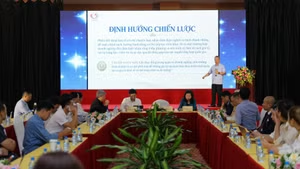
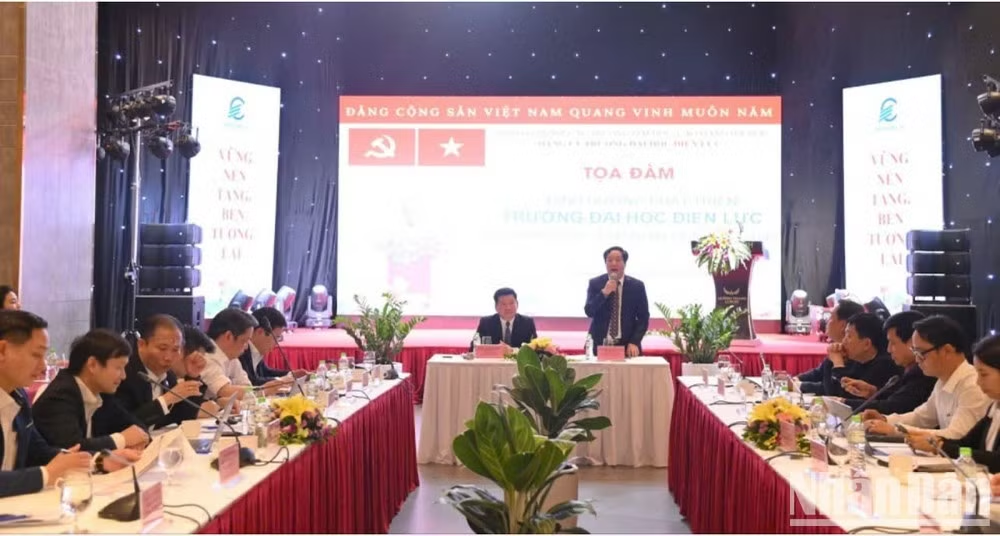
The development of science, technology, innovation and digital transformation is inherently a complex, interdisciplinary and multi-stakeholder process. Analysing this operating structure, Associate Professor Dr Vu Trong Lam, Member of the Party Committee of Central Party Agencies, Secretary of the Party Committee, Director and Editor-in-Chief of the Su That (Truth) National Political Publishing House, noted that within this system, each stakeholder has a distinct mission, together creating the combined strength of the entire nation.
First and foremost, the Party exercises comprehensive leadership and provides long-term strategic direction. The Party’s thinking has continuously evolved through successive National Party Congresses—from identifying science and technology as a “top national policy” at the 12th National Party Congress and promoting the application of the Fourth Industrial Revolution at the 13th Congress, to the fundamental breakthrough marked by the Politburo’s Resolution No.57-NQ/TW, dated December 22, 2024, on breakthroughs in science, technology, innovation and national digital transformation.
After 18 months of implementing Resolution No.57-NQ/TW, Viet Nam has specifically identified 10 strategic technologies associated with 30 strategic technology products and 20 major national challenges.
Alongside the Party’s strategic direction, the State has made a decisive shift towards a development-enabling model, providing leadership through concrete action. The 2021–2025 period witnessed remarkable legislative efforts, with the National Assembly adopting 28 laws directly related to these fields, thereby strengthening the “four-stakeholder” linkage model comprising the State, educational institutions, scientists and businesses.
By the end of 2025, 5G coverage had reached nearly 59% of the population, while the proportion of fully online administrative dossiers stood at 36.8%. In 2024, Viet Nam’s Digital Transformation Index (DTI) reached 0.7955 points, up 8.6%. Its UN-assessed E-Government Development Index (EGDI) stood at 0.7709, ranking 71st among 193 countries, up 15 places from 2022, and placing Viet Nam among countries with a “very high” level of e-government development.
At the centre of this ecosystem, businesses serve as the testing ground where knowledge is translated into economic value. By mid-2025, Viet Nam had more than 75,000 digital technology enterprises, nearly 940 science and technology enterprises, and around 4,000 innovative start-ups.
In 2024, Viet Nam ranked 44th among 133 countries in the Global Innovation Index (GII) and was recognised by the World Intellectual Property Organization (WIPO) as one of eight middle-income economies that had made the most sustained improvements in their GII rankings since 2013.
In 2025, industrial property rights registration saw remarkable growth, with 183,700 applications received, up 20.4%; 249,854 applications processed, up 74.4%; and 83,000 protection titles granted, an increase of 54.6%.
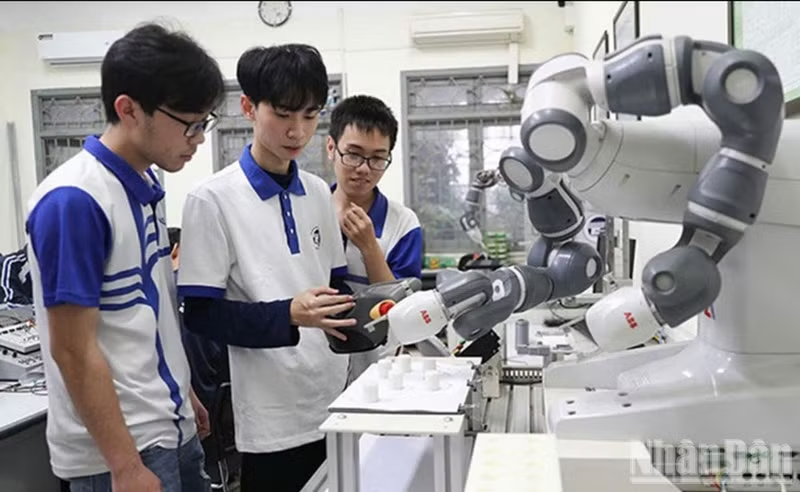
Research institutes, universities and intellectuals form the bedrock of knowledge creation. Emphasising the close relationship between research and practical production, Meritorious Teacher, Associate Professor Dr Vu Dinh Ngo, Secretary of the Party Committee and Chairman of the Council of Electric Power University, said: “Scientific research only creates substantive value when it is closely linked to the market and helps improve the operational efficiency of businesses.
Bringing the results of applied research back into the classroom not only enables students to gain hands-on experience with new technologies, but also demonstrates Viet Nam’s power sector’s capacity to master design, technical standards and technological solutions in the new era. In line with Resolution No.57-NQ/TW, Electric Power University has focused on developing strong research groups and digital laboratories, while applying artificial intelligence and smart dispatch models to address core challenges in renewable energy integration, power electronics and power system optimisation.”
Importantly, the people are both the primary beneficiaries and co-creators of this process. By the end of 2025, Viet Nam had 85.6 million Internet users, equivalent to 84.2% of the population, and 79 million social media accounts, equivalent to 77.6%.
In 2025, the National Data Exchange Platform handled 1.2 billion transactions, while 83.9% of public services generated online applications. A total of 57.45 million digital signature certificates were issued, equivalent to 76.6% of the adult population.
In 2024, Viet Nam recorded 17.7 billion cashless payment transactions with a total value of 295 quadrillion VND, while QR-code payments increased by 104%. In the first quarter of 2025 alone, more than 5.5 billion transactions were recorded, of which digital channels accounted for 4.5 billion transactions worth approximately 40 quadrillion VND.
By September 2025, the VNeID system had processed more than 2.1 billion transactions, including nearly 30 million connections to the National Public Service Portal, 11 million to VssID and more than two million to eTax.
However, the digital landscape can only be truly sustainable if information security risks are comprehensively addressed. In 2024, nearly 40,000 new security vulnerabilities were detected, 47% of which were classified as high-risk or critical. Ransomware attacks encrypted 10 terabytes of data, causing losses of 11 million USD. Meanwhile, 14.5 million accounts were compromised, alongside more than 4,000 fraudulent domain names and 1,200 fake websites. Ensuring data security is therefore a prerequisite for maintaining society’s digital trust.

Removing bottlenecks through fundamental policy measures
A candid assessment of the current situation shows that the “four-stakeholder” linkage model remains largely superficial in many places; small and medium-sized enterprises face major barriers in accessing capital and technology; financial mechanisms remain restrictive; and there is still a shortage of highly skilled digital human resources.
To address these bottlenecks, Associate Professor Dr Vu Trong Lam outlined four key requirements: decisively abandoning the growth model based on raw-resource exploitation and cheap labour, with productivity and innovation content instead serving as key measures of performance; eliminating siloed thinking and ensuring interconnected data infrastructure from the central to local levels; putting people at the centre and businesses at the foundation while accepting reasonable time lags and risks in scientific research; and organically integrating science and technology with digital transformation to comprehensively restructure national governance and production and business processes.
On that basis, a comprehensive and coordinated set of solutions must be implemented resolutely. The foremost priority is to translate the orientations of the 14th National Party Congress and Resolution No.57-NQ/TW into quantifiable targets, while directly linking the accountability of heads of Party committees, agencies and organisations to digital transformation outcomes.
In terms of institutions, the State should urgently introduce controlled regulatory sandbox frameworks, apply tax incentives, allow maximum deductions for research and development expenditure, and open up public data repositories.
Elaborating on measures to leverage market forces, Associate Professor Dr Nguyen Ba Chien, Director of the Academy of Public Administration and Governance, said: “The State needs to move away from broad-based support towards commissioning solutions to strategic challenges and creating markets for new solutions. Public procurement should be used as an instrument for promoting technology, allowing pilot implementation of unprecedented products and services that have the potential to create public value. At the same time, testing platforms, policy laboratories and open innovation centres should be developed so that state agencies, businesses, research institutes, universities and citizens can jointly design and evaluate solutions.”
Sharing the view that the institutional framework needs to be strengthened, Dr Truong Quoc Viet, Deputy Dean of the Faculty of Administrative Sciences at the Academy of Public Administration and Governance, stressed that mechanisms governing intellectual property, benefit-sharing and the commercialisation of research outcomes must be clearly defined. Access to public data, computing infrastructure and financial resources should be provided through transparent and competitive mechanisms, with priority given to initiatives capable of generating broad spillover effects.
For their part, businesses need to proactively allocate resources to research and development, strive to master core technologies, and accelerate smart manufacturing. Research institutes and universities should regard practical commercialisation potential as the foremost criterion for evaluating and approving research projects. Training programmes should be fundamentally reformed in line with international standards, while STEM education and advanced digital reskilling should be strengthened.
At the same time, building a digital society must go hand in hand with expanding digital skills to remote and disadvantaged areas and resolutely strengthening cybersecurity. The entire system needs to operate as an integrated chain of “direction – resources – tasks – products – impact”, while developing regional innovation clusters linked to economic regions and proactively advancing international cooperation.
Action-driven progress in the industry and trade sector
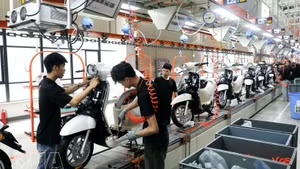
In the broader economic landscape, digital transformation and green transition are two inseparable links. Presenting a thematic report entitled “Policies to Promote Green Transition and Smart Manufacturing in Viet Nam through 2030”, Nguyen Thi Lam Giang, Director General of the Agency for Innovation, Green Transition and Industry Promotion under the Ministry of Industry and Trade, said that the industry and trade sector has implemented numerous programmes on environmental protection, cleaner production and the circular economy in recent years, but these initiatives have remained fragmented and insufficiently interconnected.
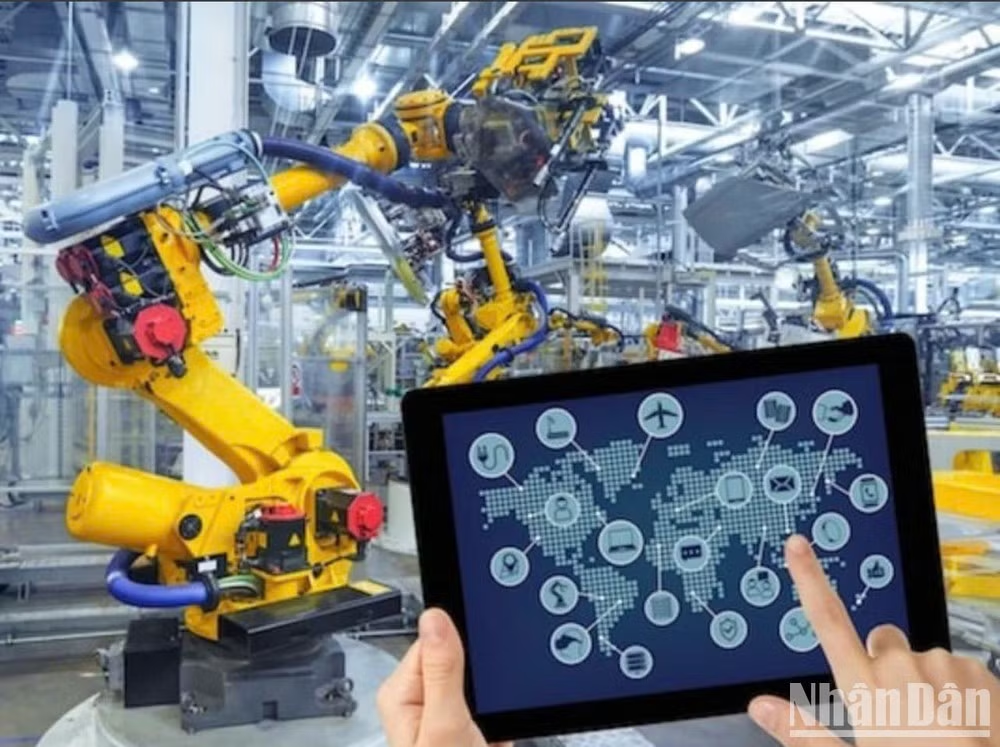
In the spirit of Resolution No. 57-NQ/TW, the Ministry of Industry and Trade issued Decision No. 2708/QD-BCT in 2025 on the Programme to Promote Smart Manufacturing and Digital Transformation in the Industrial, Energy and Commercial Sectors. The programme regards smart manufacturing as a key instrument for linking digital transformation with green transition, helping businesses enhance their competitiveness and contributing towards the goal of double-digit economic growth.

According to Nguyen Thi Lam Giang, businesses must be placed at the centre of the transformation process, while the State should play an enabling role by formulating policies, creating a level playing field, connecting the ecosystem, and providing support tailored to the actual needs and level of digital maturity of each enterprise.
The programme is being implemented in two clearly defined phases. By 2030, it will focus on laying the foundations for smart manufacturing by providing training for businesses, standardising consultants, and developing assessment indices, standards, technical regulations and reference architectures. By 2035, the programme’s scale will be continue to expanded and the adoption of smart manufacturing across the sector will be deepened.
The programme also focuses on four key groups of tasks: improving institutions, standards and architectures for smart manufacturing; developing human resources and fostering a digital culture within businesses; building an ecosystem and strengthening international cooperation to connect research institutes, universities and businesses; and developing technologies, infrastructure and data connectivity to support production and business activities.
The development of science, technology, innovation and digital transformation is akin to a symphony requiring close coordination among all stakeholders: the Party providing clear-sighted leadership, the State effectively enabling development, businesses taking the pioneering role, research institutes and universities driving knowledge creation, and the people participating with unity and commitment.
When these strengths are brought together and the industry and trade sector successfully achieves its smart manufacturing goals, Viet Nam will generate powerful new momentum for breakthroughs and advance confidently into a new era of development.