A profound sense of pride and responsibility
According to Assoc Prof, Dr Ha Minh Hong of the Ho Chi Minh City Historical Science Association, on July 2, 1976, during the first session of the sixth National Assembly, lawmakers officially approved the resolution to rename Sai Gon–Gia Dinh as Ho Chi Minh City. However, he noted that many years before the decision, local people had already proudly referred to their city by that name.
He explained that Cuu Quoc (National Salvation) Newspaper, issue No. 329 published on Tuesday, August 27, 1946, carried an article describing a gathering organised by the Southern Department of the Party Central Committee in Ha Noi on August 25, 1946. At the meeting, physician Tran Huu Nghiep proposed that Saigon be renamed Ho Chi Minh City in recognition of President Ho Chi Minh's immense contributions. The proposal received unanimous support from those present, who jointly signed a petition to the National Assembly and the government.
Deep in their hearts, people naturally came to call Sai Gon Ho Chi Minh City. Soldiers who served in Battlefield B later recalled that they could no longer remember when the name first became part of their consciousness. They only knew that the city had long been known by that name before national reunification,” Associate Professor Dr Ha Minh Hong said.
Reflecting on the honour of the city bearing President Ho Chi Minh's name, Assoc Prof, Dr Nguyen Van Hiep, former Rector of Thu Dau Mot University, said the decision carries profound political, historical, and humanitarian significance. It embodies the boundless gratitude, deep affection and unwavering loyalty of the Party, the people, and the armed forces towards the great leader of the Vietnamese nation.
The president's name being associated with the largest urban centre in southern Viet Nam is not only a prestigious honour and a fitting tribute to a resilient land, but, more importantly, it marked the beginning of a proud historical mission for the city in the cause of national development, construction, and defence in a new era.
He added that, from the perspective of social dynamics, the name Ho Chi Minh City has evolved into a powerful source of internal motivation, inspiring profound pride and a strong sense of responsibility among people from all walks of life. The symbolic significance of the name places a positive obligation upon the city's Party organisation, authorities, and people: to live, work, and contribute in a manner worthy of President Ho Chi Minh's name, while continually maintaining the city's role as a national pioneer, an economic model, and a driving force for the country's comprehensive development.
Maintaining its pioneering role
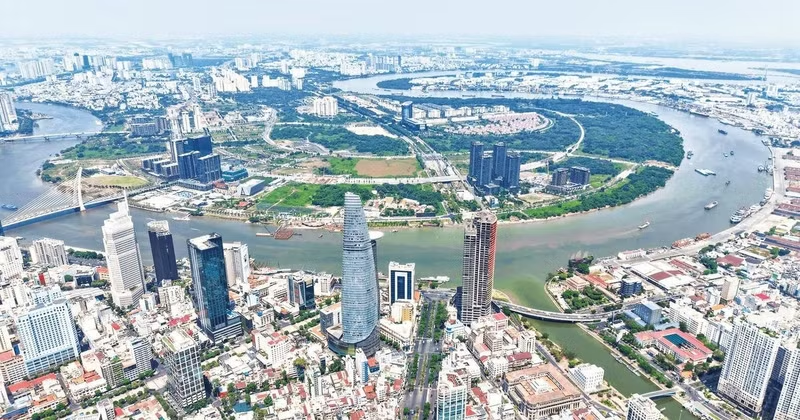
Proud to bear President Ho Chi Minh's name, Ho Chi Minh City has continuously strived for progress over the past 50 years, achieving remarkable accomplishments while firmly establishing itself as the country's leading economic centre and making substantial contributions to national development. In 2025, the city's economy was valued at approximately 3 quadrillion VND, accounting for nearly 24% of the country's gross domestic product (GDP) and generating around one-third of total state budget revenue.
Dr Tran Du Lich, former Director of the Ho Chi Minh City Institute for Development Studies, said that beyond measurable contributions such as GDP, state budget revenue and other economic indicators, one of the city's most significant achievements has been its contribution to the formation and refinement of Viet Nam's economic institutions.
He noted that during the 1979–1986 period, several state-owned industrial enterprises in the city, including Sai Gon Beer Factory, Thanh Cong Textile Company, and Thang Loi Textile Company, launched self-rescue initiatives by expanding production beyond centrally assigned plans. These experiments enabled many enterprises to restore production, improve workers' livelihoods, and increase the supply of goods for the retail distribution network. Drawing on these practical experiences, the government issued Decision No. 25/CP on January 21, 1981, granting state-owned enterprises greater autonomy in production, business operations, and financial management.
Over the past four decades, since the launch of the Doi Moi (Renewal) reforms in 1986, the city has also made important contributions to the development of policies and operational mechanisms underpinning Viet Nam's socialist-oriented market economy. Many pilot initiatives later became nationwide institutions and policies, including the establishment of the Tan Thuan Export Processing Zone, the “land-for-infrastructure” model applied to Nguyen Van Linh Boulevard, pilot equitisation of state-owned enterprises, proposals to establish the country's securities trading centre, and poverty reduction policies.
Sharing a similar view, Dr Nguyen Van Hiep said that throughout the past five decades, the city has functioned effectively as a dynamic real-world laboratory for the nation, courageously confronting complex economic challenges while exploring innovative governance approaches. These practical experiences have provided the Central Government with valuable evidence to gradually formulate and refine the country's reform policies at each stage of development.
Most recently, the Politburo issued Resolution No. 09-NQ/TW on the construction and development of Ho Chi Minh City in the new era. The resolution emphasises that, in this new phase of national development, the city must fully realise its role as a special municipality by pioneering new development models, institutional reforms, and modern governance methods, generating strong spillover effects, and making ever greater contributions to the country's rapid and sustainable development.
Under the resolution's specific targets, the city is expected to achieve average annual GRDP growth of 10% over the next 20 years. By 2075, it is envisioned to become a globally connected, smart, and modern metropolis with comprehensive development on a par with leading cities worldwide, characterised by green and sustainable growth, a high quality of life, strong climate resilience and average per capita income reaching 100,000 USD.
With its considerable potential and strengths, its long-standing tradition of dynamism and innovation, the favourable institutional mechanisms granted by the Party Central Committee and the state, and the strong aspirations of more than 14 million residents, Ho Chi Minh City is well positioned to continue developing rapidly and sustainably. In doing so, it will remain worthy of the trust placed in it by the Party, the state, and people across the country, and of the profound honour of bearing the name of President Ho Chi Minh.