Upgrading urban areas along canals
Following the direction of the municipal authorities, over the past nearly two months, the Hiep Binh Ward People's Committee has mobilised the entire political system and called on households to hand over their land early for construction of the project to expand National Highway 13, which is one of four projects aimed at easing traffic flows along the city's “gateway” routes, invested in under the build-operate-transfer (BOT) model, with investment capital of around 21 trillion VND.
Having handed over their land to the local authorities last week, the family of Nguyen Minh Tri took the opportunity to renovate the frontage of their house so they could continue their ornamental plant business. “The project has been delayed for 20 years, but the city is now determined to implement it, so our family fully supports it; we made arrangements to hand over the land and help the local authorities secure a cleared site so construction can begin soon,” Tri said enthusiastically. According to the Hiep Binh Ward People's Committee, by the end of July, all of the more than 1,000 dossiers involving land acquisition had completed procedures for notices of land acquisition, measurement, and inventory. The local authorities had directly paid compensation for 731 dossiers, amounting to nearly 5.065 trillion VND, accounting for around 80.65% of the total compensation cost, while 31.1 hectares had been acquired, equivalent to 78.65% of the project's total area. The ward authorities have also committed to the city to strive to complete compensation and site clearance for the project in the third quarter of 2026.
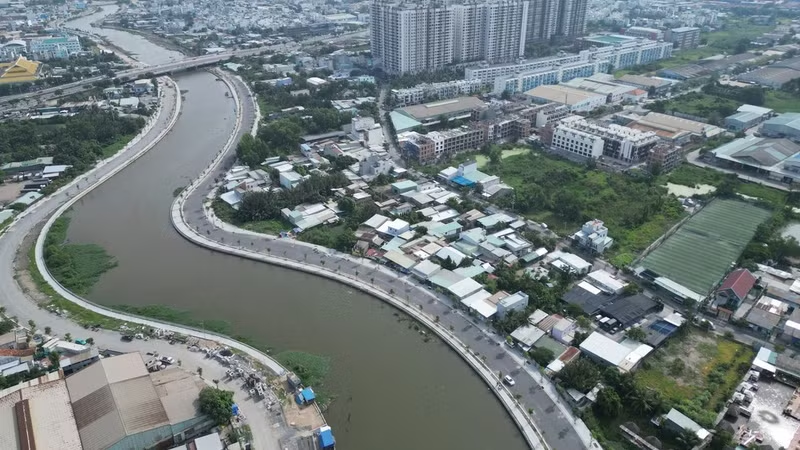
As the city's largest project to clear houses along canals, improve the environment and upgrade urban areas, the Xuyen Tam Canal dredging and renovation project, stretching from the Nhieu Loc-Thi Nghe Canal to the Vam Thuat River, has completed land handover for all 2,910 affected cases. Along the 6-km canal, which passes through four localities, thousands of old, ramshackle houses once stood along a polluted canal surrounded by waste year-round. Today, the area has become a cleared site, with contractors beginning to build embankments, roads, and parallel infrastructure.
Under the strong direction of city leaders, the ward completed compensation payments to residents and handed over the entire site to the investor in June. Once completed, the project is expected to comprehensively improve the urban landscape in the northeastern part of the city and eliminate the temporary housing that has developed along canals.
Vu Ngoc Tuat
Secretary of the Binh Thanh Ward Party Committee
Vu Ngoc Tuat, Secretary of the Binh Thanh Ward Party Committee, said that under the strong direction of city leaders, the ward completed compensation payments to residents and handed over the entire site to the investor in June. Upon completion, the project is expected to comprehensively improve the urban landscape in the northeastern part of the city and eliminate temporary housing that has developed along canals.
Accordingly, the Tham Luong-Ben Cat-Rach Nuoc Len canal renovation project has taken shape after more than three years of construction. The area along both sides of the nearly 64-km-long canal, which was previously characterised by stagnant water, narrow paths, mud, and poor conditions, has now undergone a “complete transformation.” Dozens of kilometres of solid embankments have been built, while spacious and well-maintained roads along the canal have been asphalted and lined with greenery. Waste collection has also helped improve the living environment of thousands of households along the canal from day to day.
Fundamentally improving the living environment
Urban redevelopment has brought significant changes to infrastructure, particularly in areas that had been major “bottlenecks” for many years. In 2026, Ho Chi Minh City began construction of numerous key projects and works. Infrastructure projects spanning transport, technical infrastructure, and seaports have received a total investment of more than 253 trillion VND, helping transform the urban landscape, expand new development space, and realise the city's goal of double-digit growth.
According to the Department of Construction, in the first six months of 2026, the city commenced 18 strategic infrastructure projects, with total investment exceeding 770 trillion VND (around 29 billion USD), while the growth rate reached more than 8%. These projects represent strategic components of the city's overall infrastructure development, serving its goal of achieving a breakthrough in development. Among them, the Ho Tram-Long Thanh Expressway, the Can Gio-Vung Tau sea-crossing road, Binh Tien Bridge and Road, and interchanges along the Ben Luc-Long Thanh Expressway have substantially addressed inner-city traffic bottlenecks, opened new development space towards the sea, and strengthened connections between the city, the southern key economic region, and Long Thanh International Airport.
Director of the Department of Construction Tran Quang Lam said that alongside infrastructure development projects, the city plans to clear around 41,500 houses on and along canals by 2030, fundamentally improving the urban landscape and providing a civilised, modern living environment for tens of thousands of households. Following the direction of General Secretary and President To Lam, Ho Chi Minh City aims to relocate at least 50% of houses on and along canals by the end of 2030. Phase 1 will implement 54 projects involving nearly 20,000 houses, with a total investment of more than 149.510 trillion VND. Phase 2 comprises 63 projects affecting around 21,600 houses, with expected total investment of more than 232.887 trillion VND.
The urban upgrading project for residential areas on and along canals is a major policy of profound humanitarian significance. It will contribute to improving people's quality of life, enhancing the environment, and building a civilised, modern urban landscape.
Nguyen Van Duoc
Chairman of the Ho Chi Minh City People's Committee
Nguyen Van Duoc, Chairman of the Ho Chi Minh City People's Committee, stressed that the urban upgrading project for residential areas on and along canals is a major policy of profound humanitarian significance. It will contribute to improving people's quality of life, enhancing the environment, and building a civilised, modern urban landscape. Based on this policy, the city has asked departments, sectors, and localities to urgently complete investment preparation procedures and accelerate compensation and site clearance so that projects can soon be implemented; decentralise and delegate authority during implementation; and simplify administrative procedures to shorten the time required to prepare, appraise, and approve dossiers. The city will maximise the mobilisation of social resources and complete procedures for selecting investors for projects using non-state budget capital; proactively review and develop social housing and resettlement housing funds, creating conditions for residents to have choices regarding their new places of residence.





![[Video] Renewal and growth milestones of Ha Noi through the lens](https://en-cdn.nhandan.vn/images/1XgBTSIw0KyfD4abQsg-hd4ly6fBUHXC7_OAKyN4YwPfAhBw0Xs6rVX3rF0up9Tr6rLNn30Muc4bzp90E7yOqg/10-10-hanoi-cover.jpg.avif)