Opportunities for breakthroughs
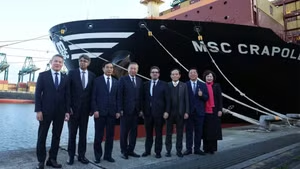
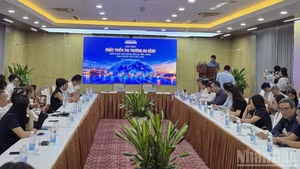
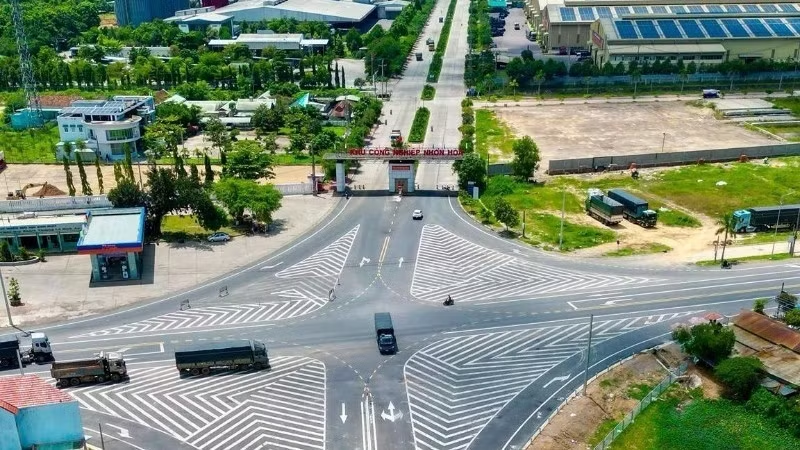
In the modern economic landscape, ESG has transcended the concept of voluntary social responsibility to become a mandatory operational imperative, especially in the context of major export markets such as the European Union (EU) imposing strict green technical barriers, such as the Carbon Border Adjustment Mechanism (CBAM) or requirements for comprehensive supply chain transparency.
Under this pressure, the Government has issued a decision approving the Sustainable Business Support Programme for the 2026–2030 period. The goal is to support approximately 25,000 businesses, households, and cooperatives in achieving sustainable business practices. For Vietnamese businesses in general, and those in Gia Lai in particular, if they fail to proactively decarbonise their production processes, it will precipitate a tangible risk of being excluded from the global supply chains of multinational corporations. Conversely, those that adopt ESG early will have superior competitiveness, easily access demanding markets, and sustainably increase brand value.
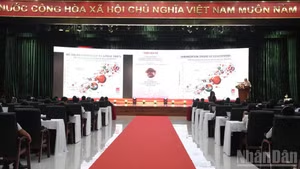
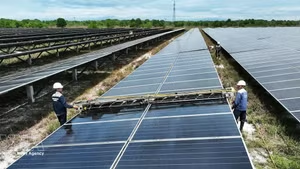
Nguyen Thanh Long, General Director of Houselink Joint Stock Company, affirmed that green transformation is no longer an option, but a survival condition for Vietnamese manufacturing businesses to retain export orders. By 2026, international legal barriers will have tightened in practice, such as the EU's CBAM imposing fees of up to 75 USD per tonne of emissions, while large corporations like Apple and Samsung require their supply chains to use 100% clean electricity and transparent ESG data. Faced with this pressure, businesses need to abandon the reactive mindset of "buying certificates to beautify their profiles." Instead, industrial parks must shift from leasing land to providing readily available green infrastructure (clean electricity, recirculating water), helping businesses shape their production and operations through four steps: identifying the pressure; digitising data; accessing clean electricity; and standardising occupational safety.
The current trend of international capital flows prioritises localities with sustainable production ecosystems, low emissions, and transparent governance. Promoting ESG practices now will help Gia Lai's business community attract high-quality investment capital, driving strong local economic breakthroughs without sacrificing the environment.
According to Nguyen Huu Que, Vice Chairman of the Gia Lai Provincial People's Committee, with its strong advantages in agriculture, forestry, and renewable energy, the province possesses a tremendous opportunity to become a green destination on the investment attraction map. The current trend of international capital flows prioritises localities with sustainable production ecosystems, low emissions, and transparent governance. Promoting ESG practices now will help Gia Lai's business community attract high-quality investment capital, driving strong local economic breakthroughs without sacrificing the environment.
A long journey requires partnership
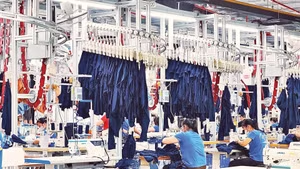
In the context of the "extraction-production-disposal" economic model reaching its limits, the circular economy model for textiles is emerging. In Gia Lai, the circular textile movement has begun to shift from theory to practice with a project to build a large-capacity textile recycling plant, committed to operating on 100% renewable energy to minimise the "carbon footprint" right from the raw material processing stage.
Nguyen Mai Hanh, Senior External Relations Manager in Viet Nam, representing Syre Impact AB, pointed out that textile and garment businesses are grappling with the cost challenges of applying ESG standards and need to start by meeting energy efficiency standards, managing raw materials effectively, and reducing waste. These actions not only improve their environmental profile to retain international brands but also have the immediate effect of cutting production costs, bringing direct economic benefits to businesses.
From a research and policy advisory perspective, Assoc. Prof. Dr. Nguyen Hong Quan, Director of the Institute for Circular Economy Development (ICED) at the Viet Nam National University Ho Chi Minh City, noted that innovative models like the one in Gia Lai are confronting myriad institutional bottlenecks, slowing down business investment. He analysed that the biggest challenge at the macro level is sustainable development, which is highly interdisciplinary, but coordination among ministries and agencies to issue implementing guidelines is proving difficult. The lack of this legal framework leaves local authorities adrift and without specific guidelines. Therefore, even though the State Bank of Viet Nam has regulations on green classification, businesses still struggle and cannot access green financing sources or innovation funds.
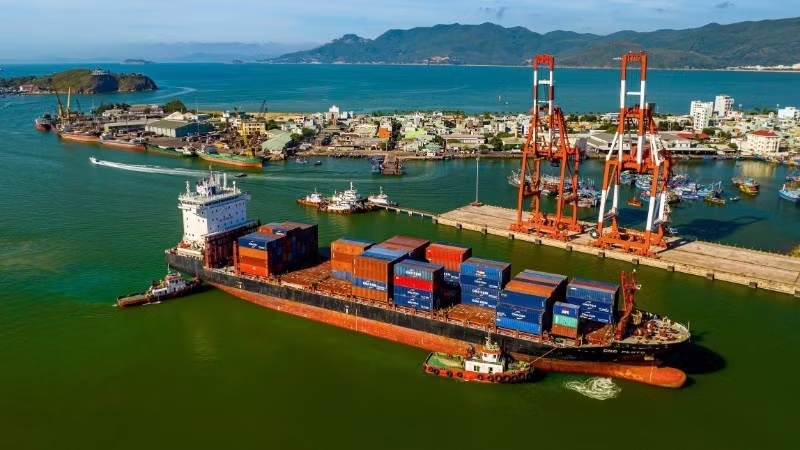
Pham Anh Tuan, Chairman of the Gia Lai Provincial People's Committee, emphasised that major markets such as the EU and the US are currently imposing heavy traceability and carbon taxes on agricultural and forestry products. If local businesses do not change their mindset and transition to a circular economy, costs will increase significantly, and the risk of bankruptcy is imminent. Therefore, Gia Lai Province will propose that the banking system withhold loans to businesses without a green roadmap, and will also prepare a plan to halt production for units that waste resources and generate large emissions.
To pave the way for large-scale businesses to invest, Gia Lai Provincial is committed to creating a comprehensive ecosystem based on a three-pillar strategy: green energy; clean data; and green technology and social welfare.
Pham Anh Tuan
Chairman of the Gia Lai Provincial People's Committee
Currently, Gia Lai is building a comprehensive campaign to implement and conduct on-site reviews to monetise waste. For the construction sector alone, 100% of concrete mixing plants are required to recycle water and thoroughly recycle waste materials, with no disposal; proposals for the installation of three recycling lines for rubble from demolition sites are being considered for quick approval; and quarries must have a roadmap for installing recycling lines to convert excess stone into artificial sand. The province aims to prioritise the use of artificial sand for public investment projects to protect natural resources. Along with that, it will apply a circular technology that "wastes nothing" and convert all by-products into economically valuable raw materials.
“To pave the way for large-scale businesses to invest, Gia Lai Province is committed to creating a comprehensive ecosystem based on a three-pillar strategy: green energy; clean data; and green technology and social welfare. We will use advanced technology to thoroughly tackle the environmental challenges of the recycling industry. At the same time, the authorities will focus public investment on social housing infrastructure and social welfare facilities in industrial parks to support workers' lives and help businesses confidently develop production,” Tuan affirmed.