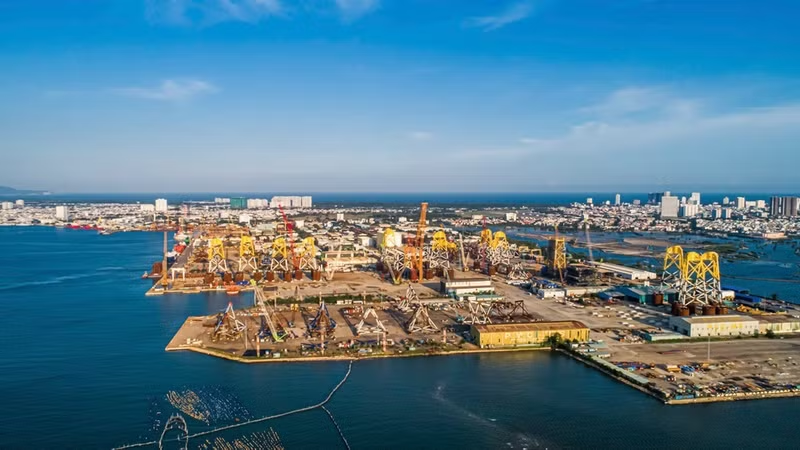
Within that framework, offshore wind is expected to become a new growth driver, laying the foundations for a modern marine industry and helping to realise the goal of making Viet Nam a strong and prosperous nation built on its maritime economy.
Yet decisive steps remain necessary to turn potential into reality by removing bottlenecks in policy, infrastructure, and the investment environment.
Driving the industrial chain
Resolution No. 36 NQ/TW stipulates that sustainable maritime economic development must be based on science, technology, innovation, and green growth; it prioritises modern, high-value, and environmentally friendly marine industries. In this orientation, offshore wind is seen as a sector fully capable of creating new development space for Viet Nam’s maritime economy.
With more than 3,260 km of coastline and sea areas with stable wind speeds, particularly along the South-Central Coast and the Mekong Delta, international studies estimate Viet Nam’s technical offshore wind potential at around 600 GW.
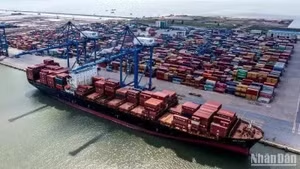
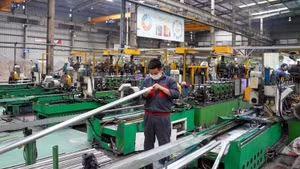
However, viewing offshore wind merely as an additional power source for the national grid fails to capture the sector’s full value. Each project drives development across an entire industrial chain: surveying, design, equipment manufacturing, steel structures, marine works, port services, logistics, operation, and maintenance. These are high-technology fields that generate significant added value and spill over into other economic sectors.
Experience abroad shows that long-term revenues from supply chains and supporting services often exceed the direct value of electricity produced. Offshore wind is therefore increasingly regarded as an industrial development engine rather than simply another form of renewable energy.
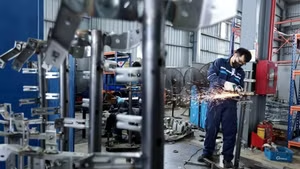
For Viet Nam, this opportunity is clearer because many domestic firms already have foundations in shipbuilding, steel structures, mechanical fabrication, marine engineering, and offshore oil and gas services. Integrated into the offshore wind value chain, these firms can not only participate in construction but also progressively upgrade technological capabilities and deepen their role in the regional supply chain.
Offshore wind is therefore not simply a new energy source but an opportunity to convert natural advantages into industrial strengths and catalyse the industrialisation of the maritime economy.
Purvin Patel, Regional President for Asia-Pacific at Vestas — a global leader in wind energy — notes that Viet Nam has many advantages for the development of an offshore wind supply chain thanks to its existing industrial base, favourable geography, and skilled engineering workforce.
What international groups seek is not only market scale but also policy stability and a long-term project pipeline. When the market is suitably large and predictable, companies will invest in manufacturing plants, technology transfer, and establishing supply chains in Viet Nam.
That perspective aligns with Resolution No. 36 NQ/TW’s objective: maritime economic development should not rest on resource extraction alone but must build modern marine industries with international competitiveness. Offshore wind is therefore not simply a new energy source but an opportunity to convert natural advantages into industrial strengths and catalyse the industrialisation of the maritime economy.
Institutions to pave the way for a new industry
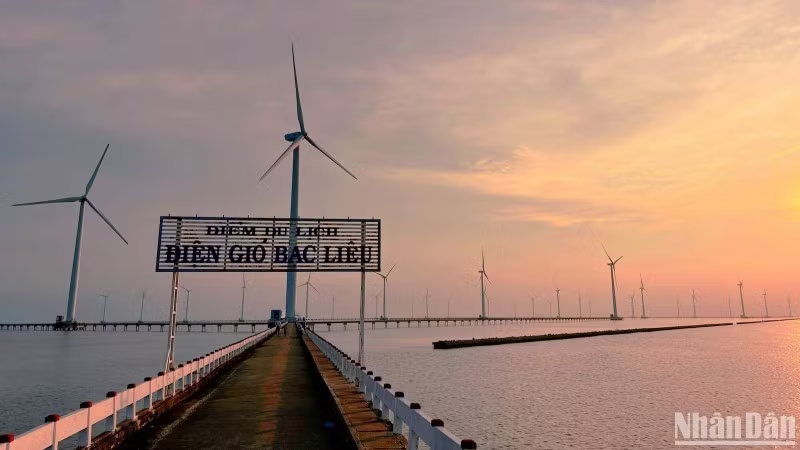
If potential is the necessary condition, institutions determine the speed of offshore wind development. This sector differs from other renewables because projects require multi-billion-dollar investment, long lead times, and involve marine spatial planning, transmission infrastructure, ports, environmental issues, and mechanisms for mobilising international finance. A single missing link can stall the entire deployment process.
Speaking at the APAC Wind Energy Summit 2026, Deputy Minister of Industry and Trade Nguyen Hoang Long said the Ministry is coordinating with other relevant ministries and agencies to finalise the legal corridor and development mechanisms for offshore wind, while promoting localisation of mechanical components, towers, subsea cables, and technical services.
The aim is not only to add more clean power but also to progressively form a domestic supply chain, upgrade port infrastructure, and create more high-skilled jobs.
Positive signals from adjustments to the National Power Development Plan VIII, which guides the development of power plants and grids between 2021 and 2030, and the issuance of implementation guidance under the Electricity Law are creating an important legal basis for the market.
Resolution No. 36 NQ/TW sets a clear vision for maritime economic development, but the institutionalisation of new fields such as offshore wind has yet to keep pace with practical needs. This delays investment preparation, raises costs, and reduces market attractiveness.
Dr Nguyen Quoc Thap, Chairman of the Viet Nam Petroleum Association
However, maintaining policy stability and predictability is crucial. With projects that last decades, investors pay particular attention to current mechanisms and consistency in implementation — from investor selection and sea area allocation to power purchase agreements and transmission grid investment.
According to Dr Nguyen Quoc Thap, Chairman of the Viet Nam Petroleum Association, the biggest bottleneck today is translating high-level policy into concrete legal regulations. Resolution No. 36 NQ/TW sets a clear vision for maritime economic development, but the institutionalisation of new fields such as offshore wind has yet to keep pace with practical needs. This delays investment preparation, raises costs, and reduces market attractiveness.
“We need to change the approach to offshore wind development: rather than treating projects individually, regard this as building a new industry. Choosing investors, surveying resources, investing in infrastructure, and developing supply chains must be considered holistically from the outset. Only with sufficiently open and stable mechanisms will enterprises dare to make long-term investments in manufacturing equipment, marine works, and high-value technical services,” Thap emphasised.
Developing offshore wind also aims at the larger objective of forming modern marine industries, enhancing technological mastery, and increasing localisation rates. Each successful project creates opportunities for domestic firms in sectors such as mechanical engineering, shipbuilding, and logistics to participate more deeply in global value chains.
Once institutional, infrastructural and implementation barriers are removed, offshore wind will open a new development space for Viet Nam’s marine industry.