Central and local budget balances maintained
According to the Ministry of Finance, as of June 30, 2026, state budget revenue reached 1,568.2 trillion VND (59.64 billion USD), equivalent to 62% of the annual target and up 17.4% year on year. Of this, domestic revenue reached 61.5% of the target; crude oil revenue reached 72.4% of the target, up 26.1% year on year; and revenue from import-export activities reached 66% of the target, up 22.9% year on year.
These results ensured sufficient funding for both budgeted expenditure and additional spending requirements that arose during the year.
For revenue collection to exceed targets, the Ministry of Finance submitted to the competent authorities a range of tax and fee measures to ease difficulties facing production and business activities.
Most notably, it proposed a law amending several tax laws, under which changes to the special consumption tax are expected to reduce annual budget revenue by around 10 trillion VND (380.3 million USD) in order to support people and businesses.
Revenue collection also benefited from strengthened controls over value-added tax (VAT) refunds, accelerated digital transformation, and enhanced efforts to prevent revenue losses in high-risk sectors such as real estate and e-commerce.
On state budget expenditure, spending has been kept within approved estimates, while recurrent expenditure has been significantly reduced to concentrate resources on development investment and social welfare.
As of the end of June, state budget expenditure is estimated at 1,149.1 trillion VND (43.7 billion USD), equivalent to 36.4% of the annual target and up 0.1% year on year.
As a result, both the central budget and local government budgets have remained balanced, ensuring adequate funding for spending obligations in line with approved estimates.

By the end of June, the government had issued 182.6 trillion VND (6.9 billion USD) worth of government bonds with an average maturity of 9.36 years and an average interest rate of 4.11% per annum, ensuring sufficient funds for the timely repayment of central government debt as it falls due.
In addition, total government borrowing in the first half of the year reached approximately 454.7 trillion VND (17.3 billion USD), equivalent to 46.9% of the annual plan.
Thanks to effective macroeconomic management, Moody’s maintained Viet Nam’s Ba2 rating while upgrading its outlook to positive, making Viet Nam the only country in the Asia-Pacific region to receive such an upgrade at the time of the announcement.
State budget resources to be directed towards key priorities
Despite these positive outcomes, fiscal policy management continues to face several challenges. Although GDP growth reached 8.18% in the first half of the year, it still fell short of the target, placing greater pressure on growth in the remaining quarters.
Inflationary pressures also remain significant and are expected to intensify. The average consumer price index (CPI) for the first six months of the year rose by 4.38% year on year, approaching the 4.5% ceiling for the full year and increasing pressure on policy management during the remainder of the year.
State budget revenue may therefore be affected in the coming months by tax exemption and reduction policies, as well as by the impact of the armed conflict in the Middle East on domestic production and business activities.
Against the backdrop of increasingly complex global and regional developments, several issues and bottlenecks remain unresolved and will require focused efforts during the final six months of the year to ensure the set targets are achieved.
For the second half of 2026, the Ministry of Finance plans to pursue an appropriately expansionary fiscal policy focused on key priorities in an effort to support sustainable growth, provide buffers against risks, and strengthen the country’s capacity to respond to emerging challenges.
On revenue management, the Ministry of Finance will intensify efforts to achieve budget collection targets, aiming for state budget revenue in 2026 to exceed the target and increase by 10% year on year.
It will also strengthen oversight of corporate revenue sources, ensure the full and timely collection of revenue, and closely monitor the establishment and use of development investment funds and retained profits of state-owned enterprises.
On the expenditure side, the ministry will continue to enforce strict savings in recurrent expenditure. Government agencies will be required to cut spending on conferences, seminars and official travel by 10%, while seeking to cut overall recurrent expenditure by a further 5% to free up resources for social welfare programmes and key infrastructure projects.
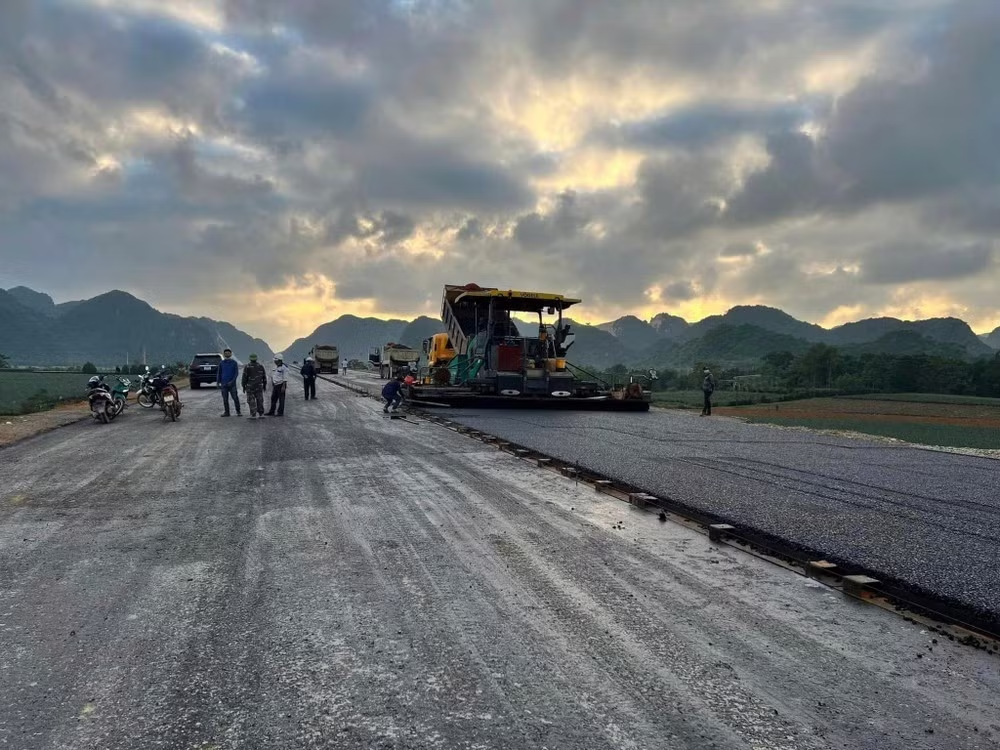
At the same time, priority will be given to infrastructure investment. A further 5% saving on development investment expenditure will be achieved at the initial allocation stage, providing additional funding for the Lao Cai-Ha Noi-Hai Phong Railway project.
If major projects fail to proceed according to schedule, their allocated budgets will be reduced or cancelled in order to contain the budget deficit.
The ministry will also study new financing mechanisms to ensure sufficient capital for development investment while maintaining strict control over public and external debt.
In addition, it will proactively manage the maturity profile, issuance volume, and interest rates of government bonds in line with market conditions, taking advantage of favourable opportunities to raise capital.
Another key priority will be accelerating public investment. The Ministry of Finance will continue to speed up the disbursement of public investment funds, particularly for nationally important projects and strategic infrastructure, thereby reinforcing the role of public investment as “seed capital” for the wider economy.
At the same time, it will improve coordination between public and private investment, while refining public procurement mechanisms and public-private partnership (PPP) models.