Refining the legal framework – opportunities for tokenised assets
In recent years, Viet Nam has gradually refined its legal framework for cybersecurity, information security, and data protection. Notable measures include Politburo Resolution No. 57-NQ/TW on breakthroughs in the development of science and technology, innovation, and national digital transformation; the 2025 Law on Cybersecurity; the 2023 Law on Electronic Transactions; the 2024 Law on Data; and the 2025 Law on the Digital Technology Industry, together with decrees and circulars guiding the protection of information systems, digital signatures, civil cryptography, and personal data.
In particular, the Law on the Digital Technology Industry has established an vital legal foundation for promoting the development of the digital technology industry, encouraging research, development, and mastery of digital technologies, while strengthening requirements for cybersecurity, data security, and the development of a safe and trusted digital ecosystem. This provides an important basis for the coordinated implementation of measures to protect digital assets across state agencies, organisations and businesses.
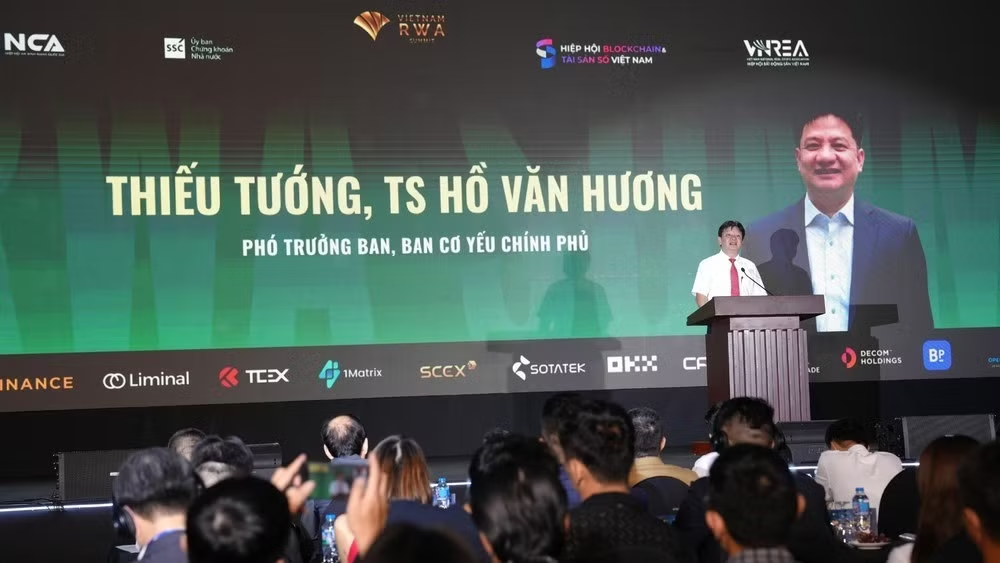
According to Major General, Dr Ho Van Huong, Deputy Head of the Government Cipher Committee, in recent years many ministries, sectors, and localities have expedited the development of digital government, online public services, national databases, and digital platforms serving citizens and businesses. However, the risks of cybersecurity and information security breaches, cyberattacks, data leaks, fraudulent electronic transactions, and attacks targeting critical digital infrastructure are also increasing, with ever more sophisticated methods and tactics. This underscores the need to strengthen authentication, encryption, and data protection measures, enhance information system security monitoring, and build digital trust across society.
As the National Cryptography Authority, the Government Cipher Committee is responsible for assisting the Minister of National Defence in the state management of cipher activities, while organising the development, management, and operation of cryptographic technical systems to protect state secrets. In the field of civil cryptography, the committee performs state management in accordance with the law; conducts research, development, testing, and evaluation of civil cryptographic products and services; provides and guides the deployment of cryptographic solutions and specialised digital signatures; and coordinates with ministries and sectors to enhance the protection of information, data and digital assets.
To date, the public key infrastructure and specialised digital signature system for official use have been widely deployed across Party and state agencies, helping ensure the confidentiality, authenticity, integrity, and non-repudiation of electronic documents.
State management of civil cryptography has gradually been refined. The testing and security assessment of cryptographic products and services have become increasingly standardised. Many cryptographic solutions have been applied effectively in critical information systems, national databases, and digital platforms, helping protect digital assets, improve the security of electronic transactions, and strengthen digital trust.
Security and cryptography as the core protective layer
Moving forward, the Government Cipher Committee will forge closer coordination with ministries, sectors, localities, businesses, and research organisations to build a coordinated, modern, secure, and trusted digital asset security ecosystem. This concerted effort will safeguard national digital sovereignty, fortify national security, spur innovation, and creating a solid foundation for the development of digital government, the digital economy, and digital society in the new period.
Major General, Dr Ho Van Huong stated that the Government Cipher Committee would continue advising and assisting the Minister of National Defence in refining institutions, policies, technical standards, and regulations for digital asset protection. The committee will effectively implement the provisions of the Law on Data, the Law on the Digital Technology Industry, and related implementing documents; carry out two projects approved by the Prime Minister, namely Decision No. 125/QD-TTg approving the project on “Developing a post-quantum cryptography system for the 2026-2035 period” and Decision No. 1226/QD-TTg approving the project on “Encouraging the socialisation of research and development of civil cryptography applications for the 2026-2030 period, with orientations to 2035”.
It will also promote the application of cryptographic technologies in data protection, electronic authentication, and digital transactions; strengthen monitoring, inspection, and assessment of the security of deployed cryptographic solutions; and study and evaluate the impact of new technologies.
In addition, it will develop an appropriate technology transition roadmap in line with advances in modern cryptography, including post-quantum cryptography for information systems in the long term; develop high-quality human resources in information security and cryptography; and promote the research, development, and mastery of “Make in Viet Nam” cryptographic products and solutions that meet data protection requirements in the digital environment.
At the recently held Viet Nam Real-World Asset Summit 2026, Major General, Dr Ho Van Huong stressed that developing real-world asset tokenisation is not merely a matter of technology or finance, but a process of creating a new ecosystem. Within this ecosystem, the state must act as an enabler by refining institutional architectures, while businesses propel innovation. Financial institutions must bridge resources and services, keeping investors squarely in the epicentre — shielded by robust legal and technological safeguards.
From a professional perspective, the Major General affirmed that the decisive factor in the survival and development of the tokenised asset market is not merely the ability to digitise assets, but also the capacity to ensure accurate authentication, secure transactions, and the reliable identification of participants. The development of the real-world asset and digital asset markets cannot rely solely on digitising assets or moving transactions into the digital environment. The market’s foundation also lies in the ability to authenticate assets, protect transactions, and reliably identify participating entities.
To promote the development of a secure digital asset ecosystem, Major General, Dr Ho Van Huong proposed four measures. First, a system of technical standards and a common language for blockchain platforms and asset tokenisation should be established soon. Second, sufficiently reliable digital identification and authentication infrastructure should be developed to protect property rights, ensure accountability, and strengthen regulators’ oversight capacity. Third, security, cryptography, and key management should be regarded as the core protective layer of the entire ecosystem. Fourth, data quality and interoperability between platforms must be ensured. This is particularly important because blockchain can protect data after it has been recorded, but cannot by itself guarantee the accuracy of the input data.