Over 600 million USD in crypto traded daily in Viet Nam
According to a recent report by Chainalysis, the value of on-chain crypto transactions in Viet Nam is estimated at around 220–230 billion USD between July 2024 and June 2025. On average, more than 600 million USD (nearly 16.3 trillion VND) worth of crypto assets are traded each day.
The Viet Nam Corporate Governance Forum 2025 (VCG Forum 2025), themed “Unlocking the Potential of Digital Assets”, was held as the Government had just promulgated Resolution No. 05/2025/NQ-CP on piloting the crypto-asset market. This move is regarded as a significant step, laying the institutional foundation for a new sector within the digital economy and raising expectations of new growth drivers taking shape.
At the forum, Nguyen Duc Thuan, Chairman of the Viet Nam Association of Corporate Directors, noted that corporate thinking on digital assets has changed markedly. A survey by the association shows that more than half of enterprises believe finance and accounting will be the sector that applies digital assets most effectively, followed by asset management and ownership. Businesses no longer view digital assets as speculative products, but rather as tools for cash-flow transparency and the digitisation of real assets.
According to Thuan, a number of pioneering enterprises have already identified clear pathways. However, many others are still waiting for a fully developed legal framework and remain concerned about human resource risks and cybersecurity. What businesses need, he stressed, is not protection or preferential treatment, but a transparent environment that enables fair competition.
Digital assets – a solution to capital flow bottlenecks
From a capital-flow perspective, experts argue that digital assets hold the key to resolving long-standing bottlenecks in the physical economy. Nguyen Phu Dung, co-founder of the PILA Group, noted that Viet Nam’s capital turnover rate is currently only one-third of that of Singapore. While a unit of capital in Singapore can circulate three times, in Viet Nam it typically turns over only once.
The root cause lies in capital being locked up in collateral assets, primarily real estate, along with the lack of mechanisms to support capital flows for innovation. Dung argued that Viet Nam’s transition towards a digital economy requires trust to be built on data. Such trust, he stressed, should not rest on personal relationships, but on even the smallest pieces of evidence within the digital system. He added that the Internet and data technologies provide a pathway for Viet Nam to achieve sustainable growth, as digital assets are shaped into a core component of the future economy.
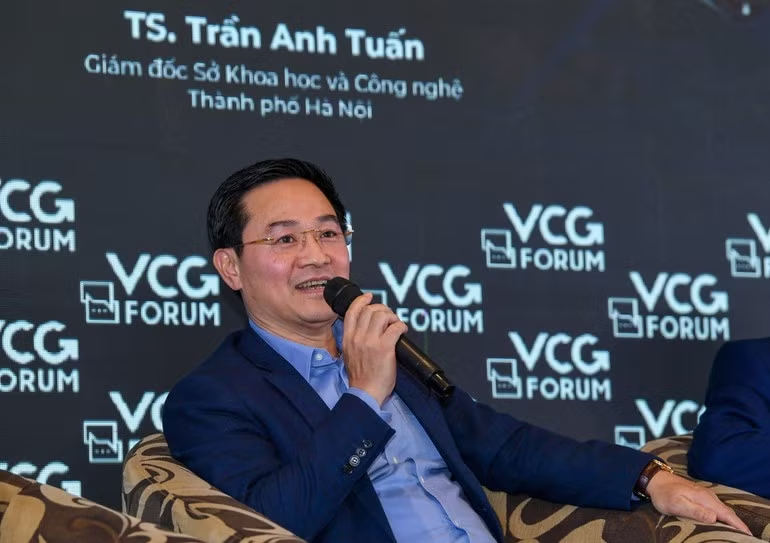
In discussions on the development of an international financial centre, experts stressed that such a model cannot be separated from the digital asset ecosystem. Although Ha Noi has yet to establish an official international financial centre, it continues to play a leading role. However, according to Dr Tran Anh Tuan, Director of the Ha Noi Department of Science and Technology, the city is facing a paradox: despite its considerable potential, it is losing high-quality human resources to other economic centres.
Tuan said Ha Noi aspires to become a leading investment destination, attracting talent and capital that have flowed elsewhere over many years. To achieve this, the digital asset ecosystem is seen as a crucial component of the city’s broader strategy.
Creating a crypto-asset market to attract foreign capital
At the forum, experts also discussed the potential to mobilise international capital through the crypto-asset market. Nguyen The Vinh, Co-founder of Ninety Eight, identified three key factors shaping foreign investors’ perspectives: the legal framework, macroeconomic fundamentals, and market attractiveness.
Vinh assessed that Viet Nam is moving in the right direction by prioritising the development of a legal framework. The country’s upgrade from Frontier Market to Emerging Market status demonstrates that macroeconomic fundamentals are being strengthened. This is a positive signal for attracting capital flows not only in traditional sectors but also in blockchain technology and crypto assets.
The final factor is the appeal of a relatively new market, offering abundant investment opportunities. Investors are particularly interested in areas linked to real-world assets, carbon credits, and technology start-up stories.

From a corporate perspective, Ha Trung Kien, Vice Chairman of G-Group, argued that for the crypto-asset market to develop sustainably, three fundamental factors must be assessed: market potential, team quality, and proven success cases. Viet Nam is currently among the countries with large crypto-asset trading volumes, yet remains at an early stage of development. The critical question, he said, is whether the forthcoming legal framework will be robust enough to instil confidence among professional investors.
Many experts agreed that attracting international capital will be decisive for the development of Viet Nam’s digital asset market. A transparent market, underpinned by data and fully codified in law, would provide the foundation for digital assets to become a new capital mobilisation channel for the economy.
Digital assets, crypto assets and virtual assets are related concepts, but they differ in terms of design, function, and scope.
Digital assets generally refer to any type of asset that exists entirely in digital or electronic form, with no physical manifestation. According to the International Capital Market Association (ICMA), a digital asset is a digital instrument issued or represented through the use of distributed ledger technology or similar systems. This category does not include digital representations of fiat currency.
Crypto assets are a type of digital asset that uses cryptographic techniques for security. They are typically decentralised and operate on blockchain or distributed ledger platforms. According to ICMA, crypto assets are private assets whose value depends primarily on cryptography and distributed ledger technology or similar systems; they are also commonly referred to as cryptocurrencies. The EU’s Markets in Crypto-Assets Regulation (MiCA) proposes a broader definition, describing crypto assets as “a digital representation of value or rights which may be transferred and stored electronically, using distributed ledger technology or similar technology”. Bitcoin, Ether, and Tether fall into this category.
Virtual assets are another form of digital asset, usually controlled by their creators and used or accepted among members of a specific online community or ecosystem. They are often not convertible into fiat currency and tend to have lower levels of security and transparency compared with digital assets.

![[Infographic] GRDP growth scenarios for 34 provinces and cities in fourth quarter of 2026](https://en-cdn.nhandan.vn/images/nyM650OGFWrOVWc-xajqN-rTZ68Rlmc1fiGJOhBRYHFSa4DhrHNDxEFdnz313Vk5dNJuxdkHglPA3rLeaPeiaUheNuCI723k2lNssd-YLJuKR58epWq7s21lV5WjM-HR2-Qpbi4MwAzqt9wRjL4WjGkfEz7RO9qhcwg8o8LQFK8/grdp-growth-scenarios-for-34-provinces-and-cities-in-q42026-anh-dai-dien.jpg.avif)