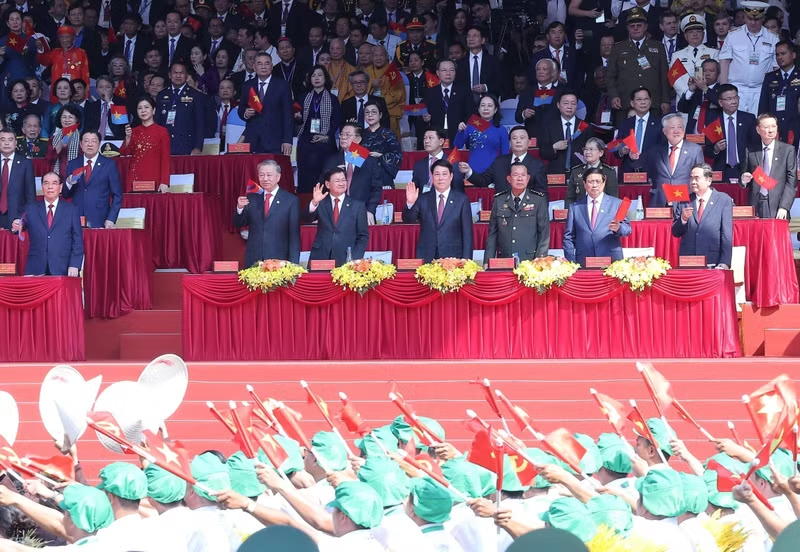
Widely shared assessments suggest that, overall, the defining feature of the global landscape in 2025 was volatility and instability — at the highest level since the COVID-19 pandemic. Major powers adjusted policies beyond traditional frameworks and stepped up unilateral actions and protectionism, creating disadvantages for small and medium-sized countries.
Sharp fluctuations in inter-state relations led to a “vacuum” in international leadership, while multilateral cooperation weakened. The Asia-Pacific and the Indo-Pacific faced growing risks of losing strategic balance and a traditionally stable environment. ASEAN’s central role in the regional architecture was challenged by major-power competition and a number of internal issues.
Meanwhile, conflicts increased and tended to erupt unexpectedly, with greater intensity. Global security risks mounted amid an increasingly visible arms race. Falling into a “three-low” trough — low growth, low trade and low investment — the world economy entered a prolonged period of uncertainty and heightened risk. Technology became the main driver of growth and also the focal point of fierce competition. Non-traditional security factors such as climate change, food security, migration crises and cyber security grew more complex, amplifying their global impact as well as their effects on individual countries.
Against a backdrop of complex global turbulence that has made the strategic environment more challenging, Viet Nam’s external affairs work in 2025 continued to be implemented in a coordinated and effective manner, delivering important, breakthrough achievements and leaving a strong imprint.
Described as a “diplomatic magnet”, Viet Nam experienced a vibrant diplomatic year, receiving nearly 40 delegations of leaders from countries and international organisations; particularly during the commemorations of the 50th anniversary of the Liberation of the South and National Reunification and the 80th anniversary of the National Day of the Socialist Republic of Viet Nam. Party and State leaders carried out more than 70 external activities, nearly 1.5 times compared to the 2024 level, from state visits and official visits, to bilateral engagements across continents, as well as attendance at regional and international conferences and events.
With the establishment of diplomatic relations with Tuvalu, Viet Nam raised the total number of countries with which it has diplomatic ties to 194. High-level external activities delivered a step change in both quality and quantity, enhancing the strategic and long-term importance of ties with partners.
The year also witnessed agreements upgrading partnerships, including stronger “strategic connectivity” with traditional friends, alongside six new Comprehensive Strategic Partnerships, nine Strategic Partnerships and two Comprehensive Partnerships — bringing the number of countries with partnership-level relations to 42, including all permanent members of the UN Security Council and members of the Group of Seven (G7).
Beyond strongly affirming its role as a “regional diplomatic hub”, Viet Nam also left a deep imprint in multilateral diplomacy — continuing to play the leadership and agenda-setting role, contributing to the building of “rules of the game” across many multilateral forums, and becoming an important “link” in global governance.
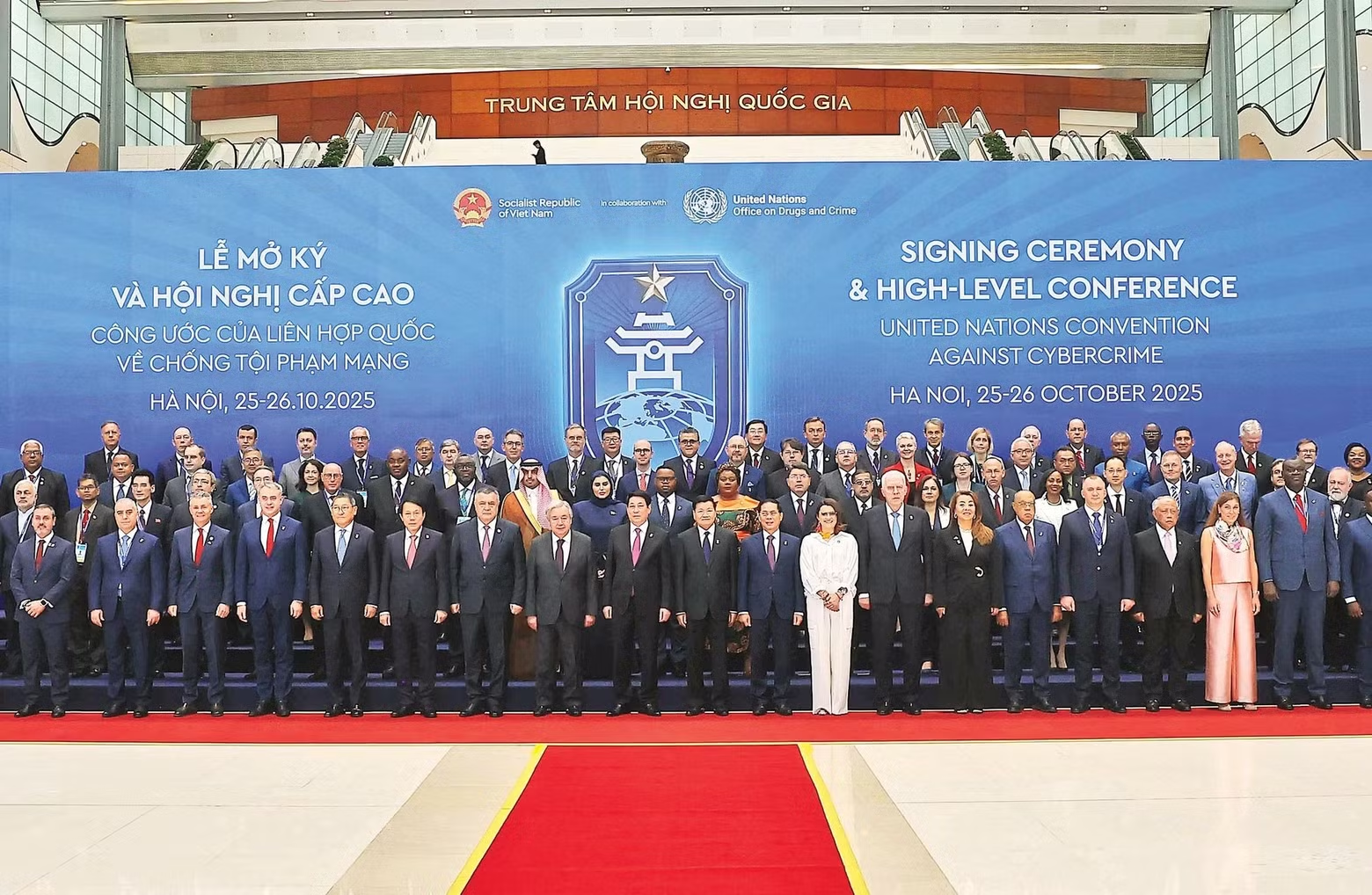
Demonstrating a pioneering position in shaping the digital order, Viet Nam’s successful hosting of the opening for signature of the UN Convention against Cybercrime (the Ha Noi Convention) underscored that Viet Nam is not merely a participant, but also plays a leading role and serves as a global bridge in forming an international legal framework for cyber security. The opening ceremony was described by many countries as a “historic moment” closely associated with Viet Nam’s international prestige.
At the same time, Viet Nam continued to reinforce its role as a destination for global multilateral events by hosting a series of major regional and international conferences: the second ASEAN Future Forum (AFF 2025), contributing to shaping the regional vision; the fourth Partnership for Green Growth and the Global Goals 2030 (P4G) Summit, advancing shared aspirations for a sustainable, people-centred green transition; the International Conference on Artificial Intelligence and Semiconductors (AISC 2025), positioning Viet Nam as an emerging technology hub in the region; and other events that left a strong impression, such as the FIATA World Congress 2025 on logistics and the International Digital Week 2025 focusing on AI.
Marking 30 years of participation and contribution to ASEAN, Viet Nam continued to be recognised as a core actor and an important factor in maintaining the association’s unity and central role amid intense strategic competition. ASEAN’s organisational expansion with the admission of Timor-Leste also bears Viet Nam’s imprint.
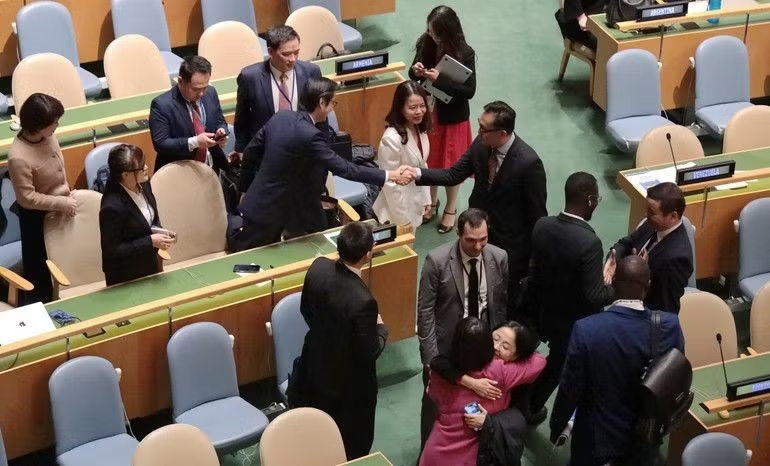
At the United Nations, Viet Nam continued to be viewed as a “model of a reliable partner”. Having successfully served as a member of the Human Rights Council for the 2023–2025 term, Viet Nam went on to win re-election for the 2026–2028 term with a high vote (180/188). Viet Nam is also holding positions in six of UNESCO’s seven key mechanisms and continues to campaign for election to other important multilateral bodies.
In 2025, Viet Nam reaffirmed that it is not only a dynamic developing country, but also a strategic partner that countries cannot afford to overlook. By proactively contributing and helping lead new cooperation mechanisms, Viet Nam has shifted from a nation participating in integration to a truly shaping actor, becoming a point of convergence for global diplomatic currents.
These outstanding external relations results stand as a vivid proof of Viet Nam’s independent, self-reliant foreign policy of multilateralisation and diversification, and of its role as a friend, a reliable partner and an active, responsible member of the international community. They have also added important momentum for development as the country moves into a new era.