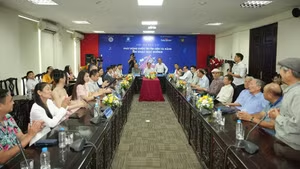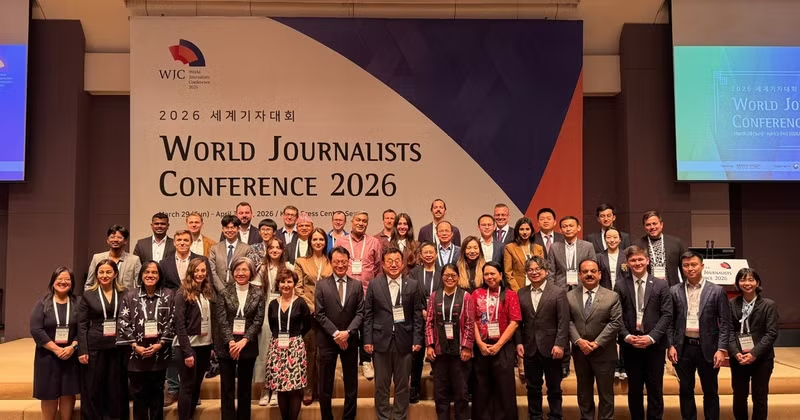
The event, organised by the Journalists Association of Korea, has been held annually over the past 14 years under the auspices of the Ministry of Culture, Sports and Tourism, the Ministry of Foreign Affairs, and the Korea Press Foundation.
Themed “Democracy and Journalism at a Crossroads: The Role of the Media in Times of Crisis” and “AI in the Newsroom: From Practice to the Next Phases,” the conference addressed a wide range of critical issues concerning the impact and future of global journalism. In particular, the ongoing conflict in the Middle East was highlighted as continuing to place many sectors, including journalism, under considerable strain.
Speaking at the opening ceremony, Lee Kyu Youn, senior presidential secretary for public relations of the RoK, stressed that the conference not only served as an occasion for exchanges but also an essential forum for proposing solutions to pressing contemporary challenges.
The shadow of war continues to loom large, while misinformation and hate speech are spreading worldwide, confronting journalists with profound challenges, yet journalism must reaffirm its role in serving the public, he said.
This view was agreed by many speakers, despite challenges arising not only from geopolitical and economic crises, but also from transformations within the media industry. Journalist Felix Lil, the author of several globally focused studies, cited notable data from Germany showing that influencers are increasingly challenging the “power” of traditional journalism. Many online personalities now command larger followings than leading news organisations, while younger audiences tend to consume news via short videos on social media rather than through mainstream outlets.
This trend is also evident in many countries, including the RoK, where the “creator economy” is expanding rapidly. Lee Kyu Youn also noted that journalists may live in environments with different languages, cultures, religions and beliefs. However, their commitment to truth and shared dedication to peace and stability remain unchanged, he added.
In his closing remarks, Park Jong Hyun, President of the Journalists Association of Korea, recalled the words of a renowned journalist that the news is a signal, while objective truth is the light and that light guides journalists in their mission to serve the people. This has also been the guiding objective of the organisers since launching the annual conference in 2012, which has so far brought together hundreds of journalists from 100 countries and territories.
Regarding the theme of AI in newsrooms, speakers from Bulgaria (Nova TV), China (Xinhua News Agency), Poland (Newsweek Polska) and the RoK (Yonhap News Agency) presented a range of innovations in applying AI to reporting and news production, highlighting the growing trend of AI agents.
A wide range of perspectives and in-depth presentations on journalistic ethics and the boundaries of AI use in content creation were discussed candidly, offering valuable lessons for newsrooms in the context that media cannot turn away from the widespread trend of AI adoption across sectors.
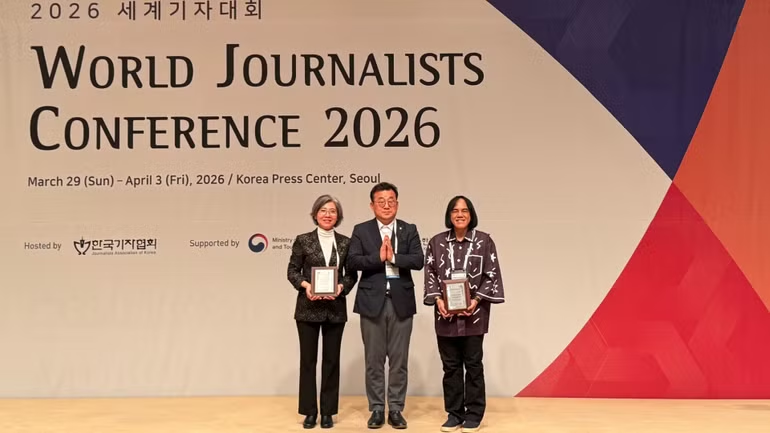
At the conference, the Journalists Association of Korea also awarded commemorative medals to journalist Tran Khanh Van, Head of the Vietnam News Agency’s representative office in Seoul, and journalist Jonathan Hicap from the Manila Bulletin for their contributions to the development and cooperation among journalists associations worldwide.
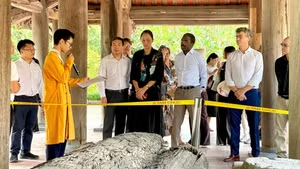
On this occasion, the host country also organised tours showcasing its economic achievements and strategies for developing its “billion-US dollar” cultural industries, fostering exchanges and mutual understanding among participating media organisations.