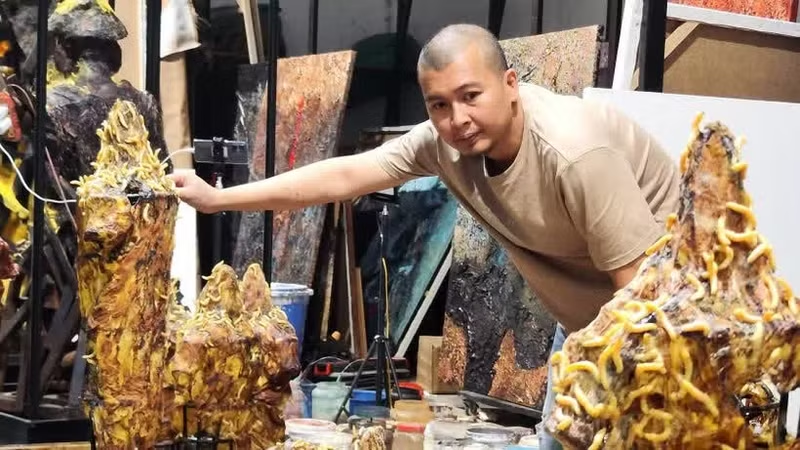
The 61st Venice Art Biennale marks an important milestone for Vietnamese fine arts, as Viet Nam will, for the first time, have an official National Pavilion under the theme “Viet Nam: Art in Global Flow” in Venice — one of the world’s largest centres of contemporary art. The exhibition space is located at Ca’ Faccanon — a historic architectural building in the heart of Venice.
Within this context, Le Huu Hieu stands out as one of the representative artists of a generation striving to connect tradition with contemporary artistic language. His creative journey is not a series of instant successes, but a long-term accumulation built on in-depth research into history, heritage, and Vietnamese cultural materials.
Before participating in the 61st Venice Biennale, Le Huu Hieu had already made several international impressions, from joining the 11th Florence Biennale, appearing at Miami Art Fair Week, to exhibiting at Tesa 99 Arsenale Nord (Venice) in 2021. In 2025, he was honoured as a “Pioneering Artist in the UNESCO Heritage Journey” — marking a recognition of his contributions to bringing cultural heritage into contemporary art.
Le Huu Hieu becoming the only Vietnamese artist to hold a solo exhibition at the 61st Venice Biennale is not only a personal milestone but also sets an important precedent. It lays a foundation for future Vietnamese artists to access international art spaces in a more structured and sustainable way.
Within the Vietnamese Pavilion at the 61st Venice Biennale, the installation series “Tam” by artist Le Huu Hieu plays a central role, both visually and conceptually. The work will be on display from May 9 to November 22, presented as a multi-layered artistic structure where elements of tradition, history, and contemporary life are intricately interwoven.
The uniqueness of “Tam” lies in its approach: instead of directly addressing war memories, Le Huu Hieu turns his attention to everyday life, to cultural and spiritual practices that have nourished the national spirit over thousands of years.
The installation space is organised as an experiential journey. Viewers do not follow a fixed linear path but move through multiple spatial layers: from clusters of deity statues to a Bagua formation, then returning to the centre — the House — before concluding at a large-scale lacquer painting.
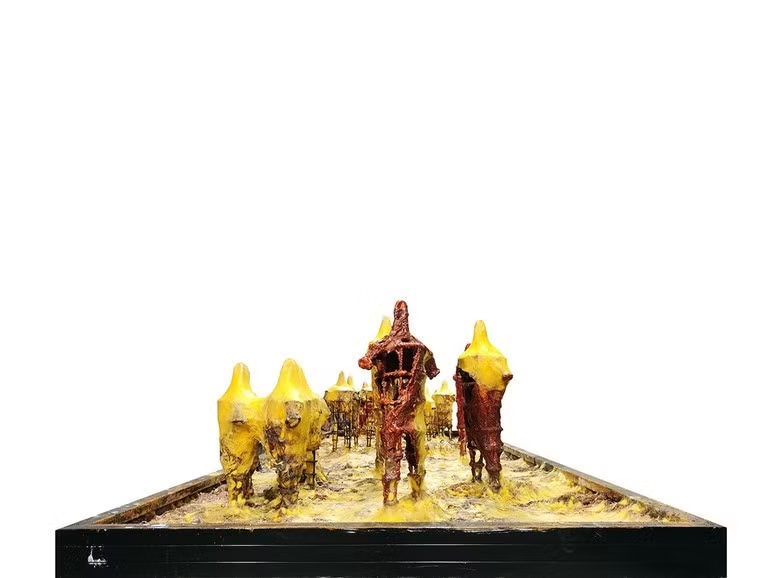
A system of 12 statues titled “Guardian Deities” appears throughout the space, representing the five elements and forces associated with agricultural life. They do not bear specific identities but symbolise anonymous individuals — ordinary people who have contributed to shaping history. This offers a humanistic perspective: history does not belong only to named heroes, it is also the result of the silent accumulation of many generations.
One of the key highlights of the work is the image of the silkworm. Its life cycle — from birth, growth, spinning silk, forming a cocoon, to becoming a moth — is used as a metaphor for the human life cycle. It represents a journey of contribution, of leaving value for future generations before quietly departing.
Notably, Le Huu Hieu does not only use the silkworm as a symbol but also raises silkworms directly on the artwork. This turns “Tam” into a living entity, where processes of growth, transformation and ending continuously take place. In this case, art is no longer a static object but becomes a dynamic process — a flow of life.
In addition, the use of traditional materials such as jackfruit wood, silk, lacquer, gold leaf, and eggshells carries not only aesthetic value but also reflects cultural depth. The "hom dat" technique — a traditional wood treatment method — is applied as a symbol of the philosophy of yin-yang balance, where seemingly opposing elements can harmonise to create stability.
The journey concludes with a large-scale lacquer painting (6.5m x 4m), where symbols of origin — such as the image of a hundred eggs in the Au Co legend — are recreated using eggshell material. This is not merely a material choice, but also a metaphor for creation, dissolution, and rebirth — an endless cycle associated with the five elements: Wood, Fire, Earth, Metal, and Water. Screens installed at the exhibition will present 3D clips for international audiences to experience.
Sharing his feelings about participating in the 61st Venice Biennale for the first time and presenting his only solo exhibition, Le Huu Hieu chose a very special word: “rebirth”.
“It is not only the joy of reaching an important milestone, but also a release after nearly a decade of pursuing what once seemed like a distant dream. That journey was not easy, with many challenges in terms of finance, time, and mental pressure. There were times when even those closest to me questioned my choice,” Le Huu Hieu expressed.
The installation exhibition “Tam” is the result of nearly 10 years of research, experimentation, and selection. From his visit to the Venice Biennale in 2017, Le Huu Hieu began developing the idea, continuously adjusting, eliminating, and restructuring to find the most suitable form.
Alongside his creative work is an extensive research process: from studying traditional craft villages, surveying cultural relics, to reading historical and philosophical materials. All of this serves a single goal: to reach the deepest layers of Vietnamese culture.
Art critic Vittorio Sgarbi (former Deputy Minister of Culture of Italy) commented on the solo exhibition “Tam” by artist Le Huu Hieu that the installation “Tam” creates a fictional space that is both deeply rooted in life and imbued with the mystical colours of legends, beliefs and folk culture. Vietnamese history is associated with many great resistance wars, but Le Huu Hieu chooses not to expose the wounds of war; instead, he offers a narrative approach to the everyday life of Vietnamese people in labour and spiritual practices, which form the foundation of a nation that has never retreated.