Heritage must not be drained for short-term gain
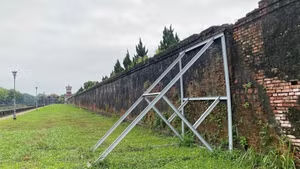
In recent years, together with the strong growth of tourism and the creative economy, many historical sites, scenic spots and traditional festivals have become vibrant destinations. However, reality has also revealed worrying consequences. Quite a few heritage sites have been “restored” in ways that effectively make them new, using modern materials and intervening deeply in their original structure.
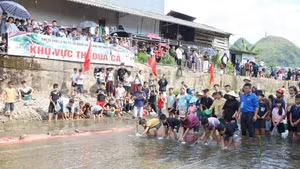
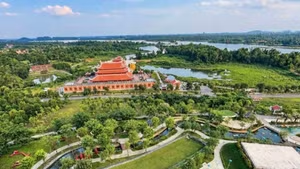
Some festivals have been excessively commercialised, leaning more towards performance and entertainment while drifting away from the core values of the communities that created them. In some craft villages, products have been simplified in both technique and traditional spirit to cater to short-term tastes, leading to a loss of identity. Many heritage assets are now at risk of exceeding their carrying capacity. Most recently, during the Lunar New Year 2026, amid a sudden surge in visitors on the fourth day of Tet (February 20), the Trang An Scenic Landscape Complex in Ninh Binh had to temporarily stop receiving additional visitors in order to ensure safety and maintain the quality of the visitor experience. When visitor numbers rise beyond acceptable limits, tighter control by management authorities becomes necessary.
Dr Tran Huu Son has stressed that a sustainable heritage economy can never be about “draining” heritage for short-term profit. The key is to strike a balance between conservation and exploitation, with conservation regarded as the foundation and a prerequisite for development. If conservation is undervalued, any economic gains will be short-lived and achieved at the cost of long-term degradation.
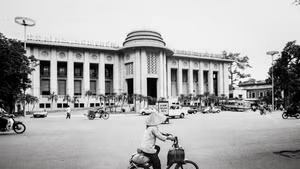
Prof, Architect Ngo Viet Nam Son, who has more than 35 years of international experience in design consultancy, planning, and architecture, has warned of a strategic mistake that is becoming increasingly visible: many localities focus only on protecting individual monuments, while lacking integrated solutions for historic urban centres and their surrounding landscapes. When high-rise buildings, transport infrastructure or commercial projects spring up without effective control, heritage can be indirectly encroached upon, reducing its spatial value and integrity, both of which are key factors in international conservation standards.
New requirements for heritage governance
Current realities demand a shift from a reactive mindset after problems arise to a proactive preventive approach. Instead of waiting until heritage sites become overcrowded before tightening controls or abruptly “closing the gates”, localities need to build scientific data systems on the carrying capacity of each monument and each heritage area, regularly assess environmental and social impacts, and establish early warning mechanisms.
Greater application of digital technology in visitor control, online booking, time-slot allocation, and digitalisation of monument records can both improve visitor experiences and serve as effective governance tools. Many countries have shown that data transparency and evidence-based management help to reduce conflicts between conservation and exploitation while building public consensus.
The direction for heritage governance has been clearly set out in the Party’s and the state’s policy framework. The 2024 Law on Cultural Heritage affirms that the management, protection, and promotion of heritage values are the shared rights, obligations, and responsibilities of all agencies, organisations, communities, and individuals. It also requires that heritage protection be integrated into strategies, plans, and planning frameworks for socio-economic development
Politburo Resolution No. 80-NQ/TW on building and developing Vietnamese culture in the new period continues to emphasise placing cultural heritage at the centre, viewing digital cultural resources as a strength, and investing in the preservation, restoration, and promotion of heritage values in connection with sustainable development and community livelihoods. It also calls for the formation of a number of heritage cities and the development of the heritage economy as part of the cultural ecosystem.
The consistent spirit of these documents is that conservation must not be separated from development, nor should culture be sacrificed for growth alone. Heritage is regarded as a strategic resource for the future, but one of a special kind that cannot be regenerated once destroyed.
On that basis, heritage governance in the new period requires a dual-evaluation framework: one that measures not only economic contributions, but also the extent of conservation, the level of community participation and satisfaction, environmental impacts, and the preservation of cultural values. It is no longer sufficient to look only at visitor numbers or revenue. At the same time, revenue allocation mechanisms need to be improved to ensure investment in conservation and the enhancement of local community livelihoods.
The heritage economy lies at the intersection of economics, culture, society, and the environment. The risks do not lie only in the physical deterioration of monuments or the distortion of festivals, but also in the erosion of social trust and the national brand that has been built on that very heritage. Once an original structure is broken or spiritual values are lost, heritage cannot be “reproduced” like an ordinary market product. For that reason, heritage governance is not an option, it is an imperative.
A coordinated effort is needed
Assoc Prof, Dr Le Thi Thu Hien, Director General of the Department of Cultural Heritage under the Ministry of Culture, Sports and Tourism, stressed that conservation and development are not opposing forces, but two mutually supportive elements serving the goal of sustainability. Accordingly, the legal system on cultural heritage is being improved in a way that removes bottlenecks and ensures consistency with laws on investment and construction. The new regulations clarify authority, procedures, and processes for giving opinions on projects implemented inside and outside protected monument zones and the buffer zones of world heritage sites.
Notably, following recommendations from UNESCO and ICOMOS, the heritage impact assessment mechanism has been codified into domestic law. Provisions on impact assessment for world heritage sites in the Law and its guiding decrees require all investment and resource exploitation projects within heritage areas and their buffer zones to strictly comply with environmental protection requirements and control impact factors in accordance with international standards.
This represents a significant step forward, bringing Viet Nam’s heritage governance in line with international practices. At the same time, institutional improvements have gone hand in hand with better appraisal of planning schemes and conservation projects, while inspection and enforcement have been strengthened to swiftly detect and handle violations against heritage sites.
On March 25, 2025, the Ministry of Culture, Sports and Tourism issued Official Dispatch No. 1218/BVHTTDL-DSVH on strengthening the management of heritage sites and activities related to the preservation, restoration, and rehabilitation of historical-cultural relics and scenic sites. The document calls on localities to enhance the roles and responsibilities of management agencies and communities, tighten control over inventorying and ranking procedures, and strictly comply with legal provisions on investment and construction when carrying out restoration projects, regardless of funding sources. These moves show a determination to tighten discipline and bring heritage governance into a more orderly framework.
Ultimately, heritage governance is about managing the balance of interests among the state, businesses, and communities. Without transparent mechanisms and fair distribution, conflicts will arise and undermine the social foundations of conservation. Conversely, when communities are involved in decision-making and benefit from tourism and services linked to heritage, they become the most effective custodians of it.
On the path towards sustainable development, heritage is not only an asset of the past, but also precious capital for the future. Yet that capital can generate lasting value only when it is governed with responsibility, knowledge, and respect for original values. That is also a measure of the cultural maturity of a nation developing in an era of deep integration.