From Party documents to governance practices in many localities, the term “heritage economy” has appeared with increasing frequency, reflecting a fundamental shift in development thinking: bringing heritage into socio-economic life on the basis of preserving its core values.
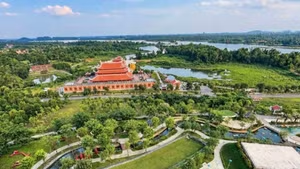
The appeal of Ha Long Bay, the Dong Van Karst Plateau, Phong Nha-Ke Bang National Park, Hoi An Ancient Town, and the Gong Cultural Space in the Central Highlands shows a clear reality: if managed in the right way, heritage can become an abundant resource for the tourism industry, cultural industries, and creative service sectors.
A proper understanding of the heritage economy
According to the Ministry of Culture, Sports and Tourism’s 2025 year-end report, many localities with UNESCO-recognised heritage recorded tourism growth above the national average. For example, Quang Ninh’s total tourism revenue in 2025 was estimated at 57.084 trillion VND, up 22.6% compared with 2024. Ninh Binh welcomed more than 19.4 million visitors, up 27% year on year, with estimated revenue of more than 21.238 trillion VND, up 37%. Hue City received an estimated 6.3 million visitors, up 61.5% from 2024, while tourism revenue exceeded 13 trillion VND, up 64.4%. Cao Bang also made a strong mark with rapid growth. In 2025, the province welcomed 2.5 million visitors, up about 40.5% year on year, while total tourism revenue was estimated at more than 2.4 trillion VND, up 78%.
These figures partly show that when heritage is “awakened” through the right approach, it can generate a far-reaching value chain, from transport, accommodation and cuisine to handicrafts, artistic performances, and digital media. The key issue is to properly understand the nature of the heritage economy so that it can be operated in the right way. Experts agree that the heritage economy is not the same as commercialising heritage, nor is it simply about pursuing visitor numbers or short-term revenue. Rather, it is about building economic value chains around heritage resources, with the preservation of core values as the overriding principle.
Dr Nguyen Van Doan, Director of the National Museum of Vietnamese History, stressed that cultural heritage is not merely an imprint of the past, but also a strategic resource for the future, embodying the nation’s identity, intellect and creativity. In his view, developing the heritage economy is a practical way to realise the policy of building an advanced Vietnamese culture with rich national identity and turning culture into an endogenous driver of rapid and sustainable development.
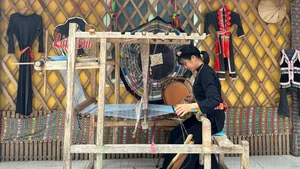
For his part, Dr Tran Huu Son, Director of the Institute for Applied Research on Culture and Tourism, described the heritage economy as a new economic sector that spans heritage tourism, OCOP products rooted in indigenous knowledge, cultural industries inspired by heritage symbols, traditional cuisine, and handicrafts. Its three core pillars, he said, are heritage tourism, heritage-based cultural industries, and the systems of products and services formed from traditional knowledge. This way of thinking signals a fundamental shift: heritage is no longer treated as a “cost” of the cultural sector, but as a development resource.
In practice, the heritage economy brings multi-dimensional benefits. It generates direct economic returns through higher tourism revenue, expanded markets for local products and stronger investment inflows. It also delivers social gains by creating jobs, reducing labour migration, and strengthening sustainable livelihoods in rural and mountainous areas. On the cultural front, once heritage becomes part of economic life, communities have greater motivation to preserve, pass on, and creatively build on tradition. Beyond that, it enhances national soft power, which is becoming ever more important in a context of deeper international integration.
Heritage within principles of sustainable development
However, heritage has its own unique characteristics, unlike other resources that can be depleted and replaced. Once it suffers serious damage, the chances of recovery are extremely limited. For that reason, the heritage economy can only be meaningful if it follows the principle of sustainability: use within carrying limits, reinvestment in conservation, and fair benefit-sharing among all stakeholders.
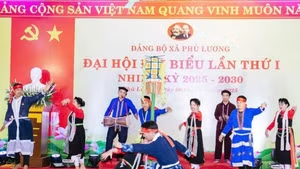
For intangible heritage, the Cultural Space of the Gong in the Central Highlands provides an example of the link between preservation and livelihoods. When gong teams take part in community tourism tours, the income generated is channelled back into teaching younger generations, purchasing musical instruments, and organising cultural activities. In that way, heritage is not “boxed in” within festivals but continues to be practised in everyday life and retains its natural vitality.
Even so, it is impossible to ignore the real risks posed by the “hot growth” of the heritage economy, which could exhaust heritage carrying capacity and erode cultural identity. This makes it urgent to improve the legal framework and overall planning for heritage economy development.
According to Dr Tran Huu Son, the immediate priority is to continue refining the relevant legal system, particularly by clarifying the role of communities as the creators and custodians of heritage in the process of economic exploitation. Communities should not merely serve tourism, but must have their legitimate rights protected, be involved in decision-making, and receive a fair share of the benefits. This should go hand in hand with heritage economy planning by region and by type, defining carrying-capacity thresholds, building data systems, and applying digital technologies in management.
Dr Nguyen Van Doan suggested that heritage development objectives should be incorporated into regional development strategies, cultural tourism, and creative industries. Heritage, he noted, cannot be treated separately from urban, transport, and environmental planning. At the same time, there is a need to improve the quality of human resources as a foundation for long-term development. Another key issue is financial mechanisms. Revenue generated from heritage use should be reinvested in a meaningful way into conservation, restoration, artisan training, and community support. Public-private partnership arrangements in heritage preservation and use must be transparent and ensure a fair balance of interests among the state, businesses, and the people.
As Viet Nam accelerates the development of cultural industries under the strategy to 2030, the heritage economy takes on even greater strategic significance. Heritage is not only a tourism destination but also a source of inspiration for cinema, fine arts, design, fashion, video games, and creative souvenirs. When integrated into the value chain of cultural industries, heritage can create higher added value and help promote the national image.
The shift from preserving heritage in its original state to promoting its value for sustainable development reflects the objective demands of a new stage. But for heritage truly to become an endogenous resource, the decisive factor remains correct awareness followed by consistent action. When heritage is recognised as a common national asset, a resource for the future rather than merely a relic of the past, the heritage economy can develop sustainably and make a worthy contribution to the goal of building a prosperous and happy country. Awakening heritage is not only about unlocking a special resource, but also about awakening the pride, resilience, and creativity of communities, laying the foundation for heritage to become a driver of the country’s new development journey.
Experience in Ha Long Bay, Quang Ninh Province, shows that when a locality tightens control over the number of tourist boats, establishes strictly protected zones, strengthens waste management, and invests in environmentally friendly infrastructure, landscape values are better preserved while service quality is improved. In Hoi An, Da Nang City, limiting motor vehicles in the central area and organising pedestrian streets and a night-time cultural space not only helps protect the structure of the ancient urban area, but also creates a distinctive visitor experience and increases tourist spending.