Bringing heritage into contemporary life
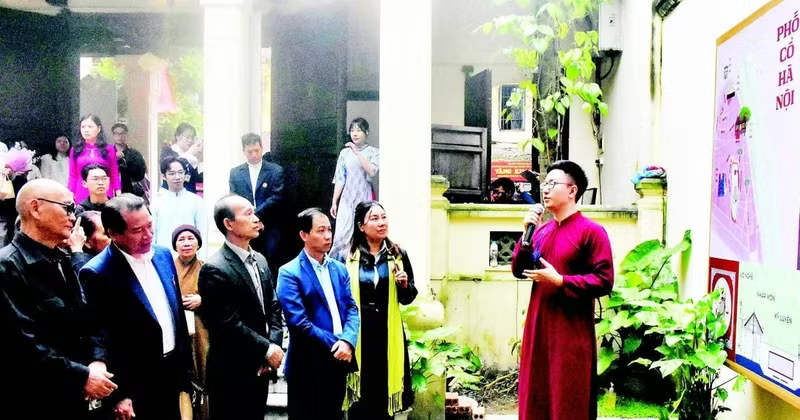
The Management Board of Hoan Kiem Lake and Ha Noi’s Old Quarter has recently, in coordination with specialised partners, launched the project “The storytelling space of Kim Ngan Communal House” at 42–44 Hang Bac Street. This represents an important pilot step in synchronising design language, cultural values, and operational approaches towards the concept of “living heritage”.
Kim Ngan Communal House is a nationally recognised architectural and artistic relic, and a spiritual symbol of Thang Long’s gold and silversmiths. Over the centuries, it has preserved its traditional architectural structure along with an elaborate system of patterns and carvings deeply marked by professional identity. As the place dedicated to the worship of the craft’s founding ancestors, the communal house was also once the centre of guild activities, silver casting, currency exchange, and the transmission of professional ethics.
At the heart of the project is the creation of a unified visual language, rooted in the distinctive motifs of the communal house itself. From images of mythical creatures and floral designs to silver-engraving lines, the project team conducted surveys, digitisation, analysis, and creative reinterpretation to form a coherent graphic system spanning exhibition spaces, signage, objects, and cultural products.
The interior is organised to simulate the developmental journey of Thang Long silversmiths’ craftsmanship. Passing through the gate, visitors enter the “threshold of the craft” — a space for fundamental training. This is followed by a creative experimentation area, where large-scale graphic works narrate stories of entering the trade and establishing one’s livelihood.
At the deepest level lies a space which honours professional excellence through the display of outstanding works and the re-enactment of guild initiation rituals. Alongside exhibitions are experiential activities such as silver casting, ancient currency exchange, engraving practice, and handicraft making, enabling the public to literally “touch” the craft.
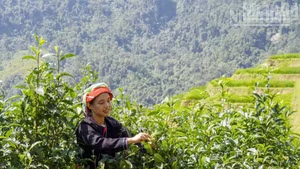
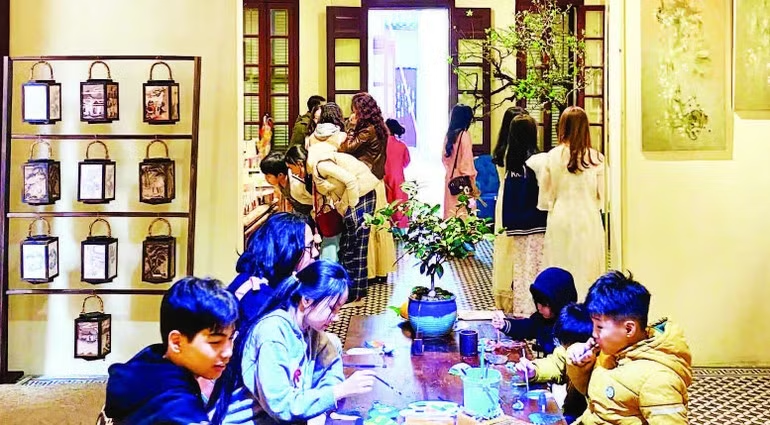
Similar to Kim Ngan Communal House, the Arts and Culture Centre at 22 Hang Buom Street is opening up heritage spaces in its own distinctive way. Here, Bodhi leaf embroidery, Vietnamese ceramics, Vietnamese tea, and traditional herbal medicine are presented within a multisensory experiential setting. A series of workshops — drawing, printing, and embroidery on Bodhi leaves, tea brewing, ceramic painting, and making natural herbal products — is helping to transform a heritage into living activity. Participants are encouraged to slow down, understand the crafts, and take home personal memories. This space also serves as a meeting point for artisans, artists, and international visitors, fostering a creative community centred on heritage.
From the very first days of experimenting with the new space at 22 Hang Buom Street, a group of contemporary artists proactively joined in with an open and creative spirit. After careful discussions on how best to honour heritage, artists Vu Thuy Mai and Tran Cuong, and several young artists selected suitable works and personally hung them on the old walls to create a “memory gallery” for the Old Quarter.
During public opening sessions, the artists and artisans themselves become storytellers. Sitting together, brewing tea, and conversing, they share insights into each line, idea, and emotion behind the works with both domestic and international visitors, helping audiences better understand the spirit of Ha Noi that lies beneath the artworks. As a result, the space becomes infused with lived experience and the inner worlds of its creators, giving heritage a truly breathing presence.
The need to elevate heritage storytelling
From Kim Ngan Communal House and the 22 Hang Buom Arts and Culture Centre to several other sites currently under study to further disseminate cultural values, the Old Quarter has gradually taken shape as a network of heritage storytelling spaces. When synchronised in terms of design language, cultural narratives, and modes of operation, these spaces can become a central axis for Ha Noi’s cultural and creative tourism.
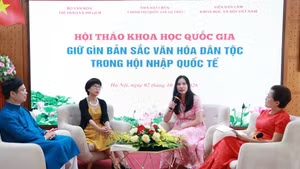
Painter Nguyen Manh Duc, who is currently advising on content for several cultural spaces in the Old Quarter, believes that the greatest challenge lies not in creating visually appealing spaces, but in preserving their rhythm of life and soul so that they can develop a life of their own. To achieve this, he argues, it is not enough to display artefacts; there must also be people and living crafts, evolving from small stories and fragments of everyday memory that are patiently nurtured over time. According to him, visitors are no longer satisfied with merely observing; they want to listen, learn, try doing something themselves, and take home a memory that inspires them to return.
Inviting artists, artisans, and practitioners to participate directly in these spaces is a way to prevent heritage from being “frozen”. When they work on-site, converse with visitors, offer guidance, and share their experiences, heritage becomes a living, flowing process. The spirit of heritage conservation and preservation, he emphasises, lies in maintaining this vitality — helping people see that they have a place, a role, and a story to tell. Only then can heritage truly have a future and become a form of soft power for sustainable urban development.
Nguyen Duc Binh, Head of the Vietnamese Village Communal House Club and a heritage researcher, stressed: “Each site carries with it professional memories, ways of life, and individual destinies that have been intertwined with the Old Quarter over generations, and these need to be told in an appropriate language. We, along with many other organisations, have made efforts to share part of these stories, but this is only a beginning. There must be many more storytelling approaches — through the press, film, exhibitions, experiential tours, social media, and especially through the voices of the people who are living in the Old Quarter today.”
Sharing the same view, Dr Tran Doan Lam, an active member of the club, notes that to do this effectively, heritage must be seen as an ongoing flow. Therefore, storytelling should encompass not only values from the past but also what is happening today, so that audiences can feel that heritage is very close to them and worthy of respect and preservation.
Speaking about this direction, Ngo Thi Thuy Duong, Head of the Management Board of Hoan Kiem Lake and Ha Noi’s Old Quarter, remarked that this is an encouraging signal reflecting the efforts of many stakeholders. However, the journey to bring heritage back into everyday life remains fraught with challenges. The greatest difficulty, as specialists have pointed out, lies in the very nature of heritage itself. Communal houses, temples, buildings, and artefacts are often hundreds of years old, meaning that even the smallest intervention must be carefully considered.
Meanwhile, not all partner organisations are adequately prepared or have a suitable approach. In some cases, heritage spaces are still treated merely as exhibition venues, with an excessive focus on form, lighting, and visual appeal, without sufficient understanding of the structure, materials, and load-bearing limits of historic buildings. Some interventions, though well-intentioned, can pose risks to the integrity and original spirit of the heritage if undertaken without proper professional consultation.
“For this reason,” Ms Duong said, “establishing a close coordination process between site management bodies, researchers, conservation architects, artists, and social organisations is essential. This will help prevent unintended impacts, while also creating a pathway for heritage spaces to open up safely and sustainably — welcoming new and creative values, but always in a spirit that honours the core and foundational values built up over generations.”
According to experts, one of the key factors determining the long-term vitality of heritage is the elevation of storytelling. This requires telling stories not only with what has existed and continues to exist, but more importantly through the language of space, people, experiences, and tangible products. When stories are sufficiently profound, sincere, and innovative, heritage can continue to resonate and spread, becoming a vital resource for creative and sustainable urban development.