In response to the requirement of building the Party as “ethical and civilised”, as set out in the draft documents of the 14th National Congress of the Party, the study and following of Uncle Ho demands greater depth, stronger political determination and closer linkage with the Party’s governing responsibility.
Regular practice, a driving force for development
Looking back at the process of implementing the study and following of Ho Chi Minh’s thought, ethics and style, a significant shift in both awareness and action can be clearly seen. From a stage that mainly emphasised study, dissemination and communication, the requirement of “following” has now been placed at the centre, becoming a criterion for evaluating the quality of Party activities, the effectiveness of public duty performance, and the credibility of cadres and Party members.
In many Party committees and Party organisations, the study and following of Uncle Ho has been closely linked with the performance of political tasks, Party building and rectification work, and the resolution of practical issues arising at local and grassroots levels.
It is precisely this linkage that has gradually helped the study and following of Uncle Ho overcome formalism and slogans, step by step creating changes that can be clearly identified through concrete results.
Ho Chi Minh’s thought and ethics represent a selective absorption of traditional Vietnamese moral values and the quintessence of human culture, forming a system of standards that is both close to life and reflective of the spirit of the times.
(Associate Professor, Doctor Bui Dinh Phong)
According to Associate Professor, Doctor Bui Dinh Phong, Ho Chi Minh’s thought and ethics represent a selective absorption of traditional Vietnamese moral values and the quintessence of human culture, forming a system of standards that is both close to life and reflective of the spirit of the times. Ethics is not only a matter of personal self-cultivation but also the core foundation for building a clean and strong Party. Therefore, moral training must be carried out through concrete and practical actions, first and foremost through the exemplary role of cadres and Party members.
Many Party organisations and Party members, especially those in leadership positions, have proactively identified and fought against manifestations of degradation in political ideology, ethics and lifestyle; rectified working styles; and enhanced discipline and order in the performance of duties. Concrete actions such as self-examination and self-correction, staying close to the people and working alongside them in production and daily life, and assisting the people have become intrinsic requirements.
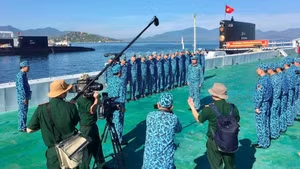
It is also from this practical process that the people’s trust in the Party has been nurtured, and the close bond between the Party and the people has continued to be strengthened. In the Viet Nam People’s Army, the study and following of Uncle Ho has become an important source of spiritual motivation, contributing to building a politically strong army that is absolutely loyal to the Party, the Fatherland and the people.
Images of cadres and soldiers ready to take the lead in disaster prevention, search and rescue, and in helping people stabilise their lives are vivid evidence of the practical value of Ho Chi Minh’s thought, ethics and style in today’s life.
Over 10 years of implementation, the entire army has developed more than 1,030 new, creative and effective models and approaches in studying and following Uncle Ho, notably models such as “Following responsibilities, setting an example through action”, “Leaders set exemplary standards, subordinates actively follow”, “Self-examination and self-correction”, “Party members mentoring the masses”, “Uncle Ho’s teachings on this day in past years”, “One answer per week, one project per month”, “The 100-dong house”, “Rice jars for the poor”, “Supporting children’s schooling”, “Hearts for children”, and “Adopted children of border guard posts”…
Beyond its significance for Party building, the study and following of Ho Chi Minh’s thought, ethics and style has also created an important driving force for socio-economic development.
Models of studying and following Uncle Ho continue to be expanded; many exemplary individuals have been identified and commended, contributing to the dissemination of the values of Ho Chi Minh’s thought, ethics and style, and reinforcing trust and aspirations for national development.
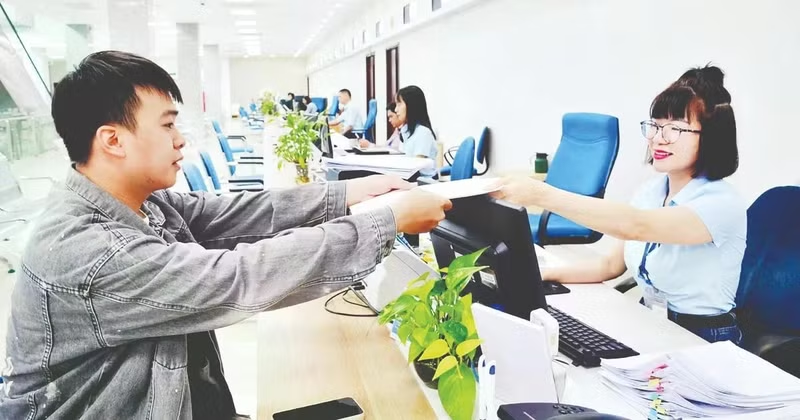
Many localities have linked the study of Uncle Ho with specific policies such as administrative reform, digital transformation and improving the quality of public services. Quang Ninh is among the leading provinces in studying and following Uncle Ho, with creative models and strong spillover effects, notably linking the study of Uncle Ho with the responsibility of leaders to set an example and with a “rapid” spirit in socio-economic development.
Over nearly 10 years of implementing Directive No. 05-CT/TW, Quang Ninh Province has developed more than 1,660 effective models. Models on administrative reform, improving citizens’ satisfaction indices, supporting digital transformation for the people, along with “effective mass mobilisation” models in wards such as Ha Long and Hiep Hoa, have both improved people’s living standards and strengthened public trust.
Alongside Quang Ninh, other localities nationwide have also created many effective models and innovative approaches suited to practical conditions in studying Uncle Ho, such as the “socialist model” of Lao Cai Province; the “5+1” model and “telling stories of Ho Chi Minh’s moral examples under the flag” in Tay Ninh Province; and the “QR code scanning for border communication” model in Lang Son Province, all contributing to the widespread dissemination of the values of Ho Chi Minh’s thought, ethics and style.
New standards in studying and following Uncle Ho
The study and following of Ho Chi Minh’s thought, ethics and style has become a solid routine in political and social life, making an important contribution to Party building and national development. However, this routine only truly has meaning and depth when it is continuously elevated through higher standards, more stringent requirements and clearer political responsibility.
The draft documents submitted to the 14th National Congress of the Party emphasise the requirement of building the Party as “ethical and civilised”. This is not only an inheritance of Ho Chi Minh’s thought but also an inevitable demand of reality, as the country enters a new stage of deep integration, rapid and sustainable development. Within the overall requirement of building the Party as “ethical and civilised”, the study and following of Ho Chi Minh’s thought, ethics and style plays the role of a spiritual pillar, ensuring sustainable Party building and rectification.
Associate Professor, Doctor Lam Quoc Tuan, Director of the Party Building Institute of the Ho Chi Minh National Academy of Politics, stated that Regulation No. 144-QD/TW dated May 9, 2024, issued by the Politburo on revolutionary moral standards for cadres and Party members in the new period, represents an inheritance and refinement of the moral requirements and standards previously articulated by President Ho Chi Minh. It not only meets the revolutionary requirements of the new stage but is also an important, necessary, regular and long-term task for cadres and Party members.
It is necessary to ensure that the regulation truly takes root in practice, becoming a self-conscious way of life of self-cultivation, training and “self-examination and self-correction”, while also serving as a basis for Party committees and organisations to evaluate, classify and screen cadres.
Associate Professor, Doctor Nguyen Trong Phuc, former Director of the Institute of Party History, affirmed that ethics is the core foundation in Ho Chi Minh’s thought. Revolutionary ethics does not arise naturally but must be persistently and regularly cultivated, like “jade that becomes brighter the more it is polished”.
Ethics is the core foundation in Ho Chi Minh’s thought. Revolutionary ethics does not arise naturally but must be persistently and regularly cultivated, like “jade that becomes brighter the more it is polished”.
(Associate Professor, Doctor Nguyen Trong Phuc, former Director of the Institute of Party History)
In the new context, the study and following of Uncle Ho needs to be elevated into a criterion for assessing leadership capacity and the fighting strength of Party organisations, and into a measure of the credibility of cadres and Party members, rather than remaining merely a movement or campaign. This requires each Party organisation and each cadre and Party member to consciously study Uncle Ho in thought and action, turning revolutionary moral standards into daily practice through concrete actions and substantive results.
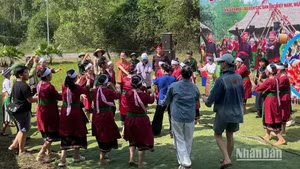
The Secretary of the Party Cell of Nam Luc Village, Luc Lu Seo Nuong Commune (Coc Lau Commune, Lao Cai Province), has for many years been an advanced example in studying and following Ho Chi Minh’s thought, ethics and style. He shared: Studying Uncle Ho first and foremost means self-discipline. Before every task or issue, I always ask myself and am determined to act in accordance with the revolutionary moral qualities of “diligence, thrift, integrity and righteousness” that Uncle Ho taught.
Within the Party cell, especially during difficult times, comrade Lu Seo Nuong always encourages Party members to think of Uncle Ho and of the great sacrifices he devoted entirely to the nation.
With determination and unity, the Party cell has successfully fulfilled its tasks, gradually stabilising the people’s lives. In 2025, the Nam Luc Village Party Cell was honoured as an exemplary and advanced collective in studying and following Uncle Ho. Exemplary grassroots figures such as the Secretary of the Nam Luc Village Party Cell show that studying and following Uncle Ho does not involve grand actions, but begins with simple deeds, with self-examination and self-discipline, stemming from a sense of responsibility towards assigned work and towards the people.
From these ordinary individuals, Ho Chi Minh’s thought is realised in daily life, spreading persistently and becoming a firm spiritual anchor. The Party identifies the study and following of Ho Chi Minh’s thought, ethics and style as a top requirement in Party building and rectification.
Studying and following Uncle Ho in the new period requires stronger political determination and more coherent implementation mechanisms, so that revolutionary ethics truly becomes a measure of cadres’ credibility and a criterion for evaluating Party organisations.
This is the most practical way to realise the requirement of building the Party as “ethical and civilised”, enabling the Party to be strong in organisation, strict in discipline and exemplary in ethics, worthy of the people’s trust and expectations in the country’s new stage of development.