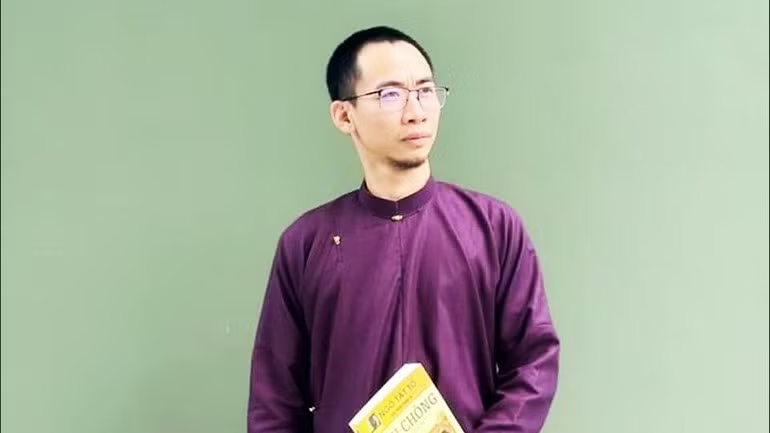
Vu Trung Duc, Director of the Sinh Duoc Cooperative in Ninh Binh Province, brought the products to Ha Noi and spoke to a Nhan Dan Newspaper reporter about the thinking behind the initiative.
Q: What drove you and your colleagues to choose Ha Noi Old Quarter for a traditional handicraft “ecosystem” experience model?
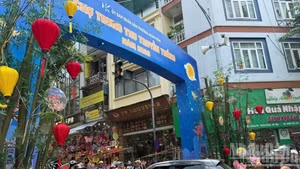
A: We do not see this as a commercial decision, but as a journey back to a place where old crafts once blended into everyday life. Ha Noi Old Quarter holds an entire landscape of occupational memory — once home to craft guilds and lineages that kept their trades alive through familiar ways of living. In that space, craftsmanship helped build homes and encouraged people to live diligently and decently.
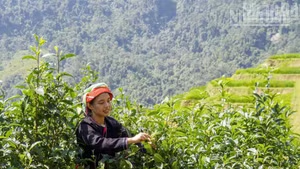
Bodhi leaves, ceramics, tea, and herbal products — these come from forests and mountains, temples, villages, and kitchens. We want to place them in a living setting, with everyday conversations, so that the spirit of these crafts can spread. Anyone who steps in can become part of the story.
Q: Do you feel you were being “bold” with that decision?
A: I think anyone who enters a cultural-heritage space with a serious mindset must accept a degree of “boldness”. It is not recklessness in the impulsive sense, but a bold move made with preparation and a clear sense of responsibility. The Old Quarter is a very special space — one small intervention made without understanding can cause damage, both materially and to the spirit of heritage. Our “boldness” lies in not choosing a purely commercial path or an overly safe one, but in opening experiences — and of course, that work cannot bring immediate material returns.
Q: If you do not put commerce first, what sustains the model’s operation?
A: We do not deny the role of material, but we certainly do not place them at the centre. To sustain this space, the first thing is to build a shared value system — among artisans, artists, craftspeople, and those who directly guide visitors. When this is seen as a place to practise a craft in its true sense, with “spiritual capital”, inner capacities and strength will emerge and create value.
Second is sharing and resonance. The space does not operate in isolation; it is built as an open community. For example, artisans do not simply bring products to sell; more importantly, they also bring knowledge, stories, and emotions. When visitors stay longer, return, and tell others about it, they become ambassadors in their own right and are willing to “support” the space. Alongside that, we are building a diverse cultural-economy model with products for those who want to buy, workshops for deeper experiences, and a system for items and artworks.
Q: What are the practical difficulties, in your view?
A: The space itself comes with many constraints: limited area, strict conservation rules, high operating costs, and fierce competition from entertainment and commercial models that are quick, easy, and profitable. Yet from those constraints, we also see advantages such as dense layers of memory and above all, empathy. Those who come to us bring a spirit of listening, a need to understand. They become part of the operating chain, with a natural ripple effect.
Q: Against the backdrop of globalisation, urbanisation and growing pressure for tourism growth, what should be kept in mind in heritage preservation and governance?
A: We can think more deeply about the idea of nurturing a heritage ecosystem. In many developed countries, heritage is placed within a cultural–economic–social ecosystem that can regenerate value. Beyond restoration, licensing, ticket sales, and control, we need to create an environment where heritage continues to move and continues to deliver real-world value.
This requires structural solutions, such as standardising policy frameworks in line with international practice; shifting the focus from visitor numbers to the quality of impact; and building a network of living heritage spaces connected internationally. When we treat heritage as a living relationship between people and memory, livelihoods, and the future, we can develop modern cities without trading away cultural “identity”.
Reporter: Thank you for the conversation.
Sculptor Nguyen Kim Xuan: I was genuinely happy to step into the space and see many works by colleagues and former students displayed respectfully and completely free for the public. I was born and grew up in Ha Noi Old Quarter, so I deeply understand the value of this heritage space. When I see a place that preserves the Old Quarter’s spirit while opening room for young creativity, I feel a responsibility to support and accompany it. If needed, I am ready to sit here at the potter’s wheel, shaping clay and talking with people directly, to create life and memories for the space.
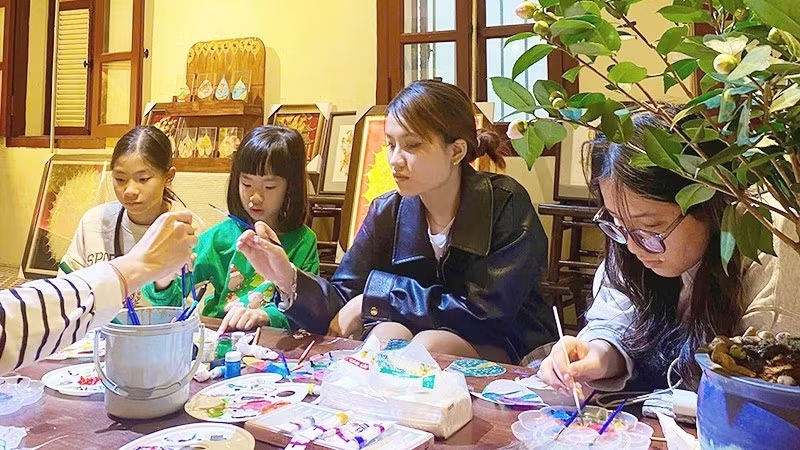
Nong Tu Linh, a student at Cao Ba Quat Secondary School (Thuan An, Ha Noi): Before, when I painted, I only imagined white paper, coloured pencils, and familiar images. But the experience of painting on Bodhi leaves at the heritage space at 22 Hang Buom gave me a very different feeling. At times I felt awkward because I was afraid of ruining the leaf, but the artists always encouraged me to stay calm and trust my feelings. When I left, I could take home the artwork I had made — a small gift I was truly proud of. I hope there will be more spaces like this, so we can experience, relax, and learn more.