Early signals
In recent years, cultural life in Hue has seen a clear expansion in both scale and form. The Hue Festival has been maintained as a major integrated cultural event, while its content has gradually been renewed through a combination of traditional and contemporary arts.
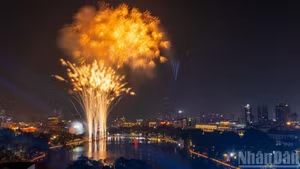
At the end of 2024, the “Hue Symphony” programme held along the Huong River attracted strong public interest, particularly from young audiences and tourists. Alongside this, large-scale music and fashion performances such as Mega Booming Hue and Hello Cosmo From Viet Nam (second season) have demonstrated Hue’s capacity to absorb new entertainment products within the context of a heritage city.
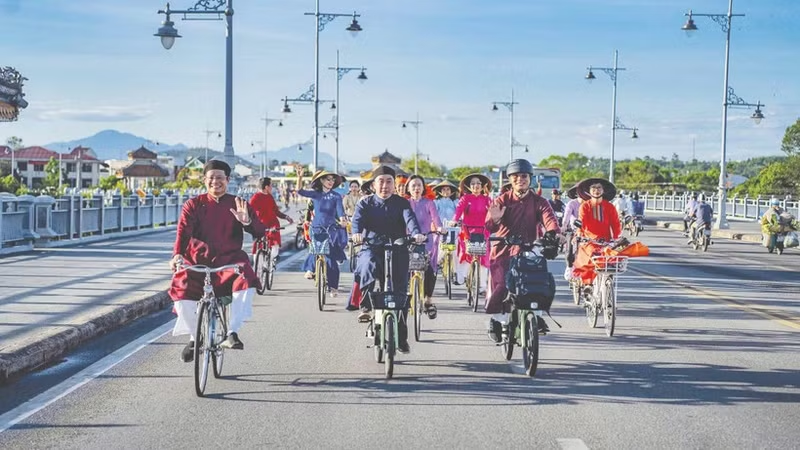
Notably, Hue has recently revitalised the ao dai space. Traditional loose-fitting Ao dai styles associated with royal court life have been revived within heritage sites.
Many young people and visitors now come to Hue to buy or rent Ao dai for photo shoots against old walls and along ancient walkways. The Ao dai has gradually become a cultural product linked to tourism experiences, rather than appearing only at ceremonial occasions or on performance stages.
This represents a positive outcome in integrating intangible heritage into the creative economy. In the field of traditional crafts, the efforts of the late painter Than Van Huy contributed to elevating Thanh Tien paper flowers.
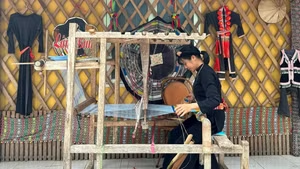
Originally produced mainly for worship, Thanh Tien paper flowers have gradually entered creative spaces, art exhibitions and contemporary life in more refined forms. This approach demonstrates that, with the guidance of creative thinking, traditional craft villages can fully become part of the cultural industries.
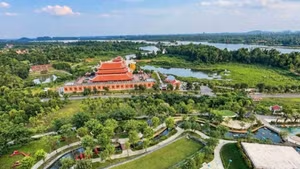
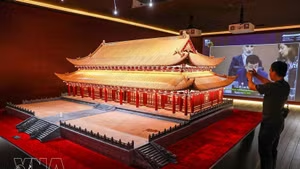
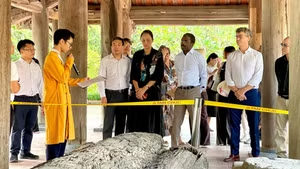
Hue’s architectural heritage is also gradually moving beyond a static mode of existence. Heritage structures are not only preserved but are increasingly used as spaces for artistic performances, offering the public new perspectives and opening up possibilities for harnessing creative value from heritage spaces.
However, creative cultural activities in Hue are currently still carried out largely through separate programmes and individual events. The absence of a coherent value chain means that the economic efficiency and spillover effects of cultural industries have yet to be fully realised, in line with the potential of a heritage city.
The issue is not a lack of heritage or creative ideas, but rather the absence of sufficiently flexible mechanisms to organise, coordinate and connect cultural resources. Cultural industries require an approach different from that of managing isolated events, encompassing creative space planning, appropriate heritage exploitation mechanisms, and policies that encourage the participation of businesses, artists and communities. Without coherent integration of these elements, heritage struggles to become an economic resource that operates on a regular and sustainable basis.
Leveraging unique advantages
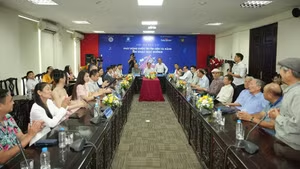
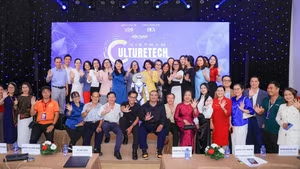
At the International Conference on Cultural Industries organised by the Ministry of Culture, Sports and Tourism in Hue, many experts noted that heritage-rich cities such as Hue possess unique advantages if they can reorganise resources and approaches effectively.
Associate Professor Dr Bui Hoai Son, Standing Member of the National Assembly's Committee for Culture and Education, shared that the Government’s strategy for developing cultural industries to 2030 has created an important policy framework, but its effectiveness depends on implementation at the local level.
For Hue, the advantage lies not only in the number of heritage assets, but in cultural depth and the ability to tell heritage stories in ways that resonate with contemporary audiences. Conference presentations emphasised that cultural industry products must deliver economic value while preserving identity.
Accordingly, heritage truly comes alive only when placed within a continuous creative flow through performing arts, design, fashion, cuisine and new experiential formats.
These analyses show that Hue brings together many distinctive advantages, including the imperial citadel complex, a rich system of festivals, traditional craft villages, and a slow-paced urban rhythm imbued with cultural depth. These form a foundation for developing sectors such as performing arts, handicrafts, ao dai fashion, cuisine and cultural tourism.
Alongside these strengths, experts also highlighted several bottlenecks. Cultural industries have yet to be fully recognised as an independent economic sector; most activities still rely on state budgets, with limited deep engagement from the private sector. Creative human resources and infrastructure supporting cultural industries remain constrained, while craft villages lack connections with designers and modern markets.
Sharing development orientations, Nguyen Thanh Binh, Vice Chairman of the Hue City People’s Committee, affirmed that Hue remains steadfast in rejecting a model of overheated growth, identifying identity as an asset. The city is focused on transforming this asset into growth pillars through a heritage-based, creative and integrated approach.
Accordingly, Hue is positioning three major brands: a festival city, a culinary capital and an Ao dai capital, while also setting the goal of joining UNESCO’s Creative Cities Network in the field of gastronomy.
By 2030, Hue aims to welcome 12 million visitors, generate 30 trillion VND in tourism revenue, and focus on developing high value-added creative products such as the night-time economy, live performance art and heritage digitisation.
From both practice and orientation, it is evident that cultural industries are being placed at the centre of Hue’s long-term development strategy. What remains is effective implementation and the creation of sufficiently strong mechanisms so that heritage is not only preserved, but becomes a driving force for growth in a heritage city seeking to go further by relying on its own distinctive identity.