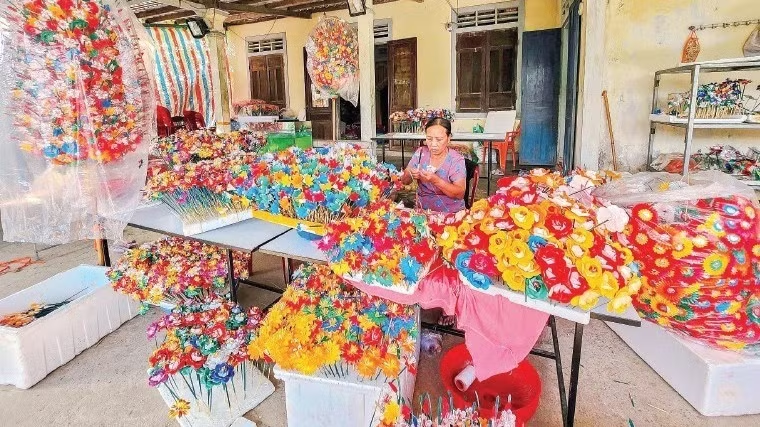
The work area is separate, elevated, and spacious enough for a few people to sit together, making flowers as they chat. Few would imagine that a flood-season livelihood has evolved into Thanh Tien paper flowers, a creative craft now seen in a wide range of settings.
It is a telling story of how a traditional craft village has found its own path in the modern era.
Thanh Tien lies along the Perfume River on low-lying land. For generations, local people lived on agriculture and grew flowers for Tet worship rituals. Yet that very location meant the village often faced late-year floods. Fresh flowers could be swept away before they even bloomed, and an entire season’s effort would be lost.
A livelihood born of storms and floods
Living with frequent floods, Thanh Tien people turned to a different path: making paper flowers. Light, durable, and resistant to wind and rain, they could also be produced during the agricultural off-season.
The craft dates back to the Nguyen Dynasty around 300 years ago—an organic form of adaptation by lowland communities facing harsh weather.
Nguyen Hoa, an artisan in Thanh Tien, recalled that paper flowers were not originally made for decoration, let alone artistic display. They served worship needs and were closely tied to Hue’s spiritual life. From paper, bamboo, and natural dyes, Thanh Tien artisans created enduring branches of flowers that appeared on family altars whenever Tet arrived.
There was a time when the whole village glowed red with coloured paper in the twelfth lunar month.
At one point, village mandarins even presented Thanh Tien paper flowers to the royal court, marking them as a product of the imperial capital region. But like many craft villages, the paper-flower trade could not escape cycles of boom and decline.
Over time, as plastic flowers and cheap imports flooded the market with diverse designs, traditional paper flowers gradually lost ground. Products became harder to sell, incomes fell, and many left the trade.
For a period, only five or six households persevered with the craft mostly out of habit and an unwillingness to let it go. The risk of a broken line of transmission was real. Against that backdrop, the return of artist Than Van Huy, a son of the village, marked an important turning point.
If once someone brought Thanh Tien paper flowers to the king, in modern times he was the one who helped paper flowers step out of the familiar worship space and into contemporary life. Instead of opting for preservation in its original state, he engaged with paper flowers through the lens of an artist.
Building on traditional techniques, he revived and improved dyeing methods and paper treatment so paper lotus flowers took on shapes and shades closer to real blooms.
Notably, he created five-colour paper lotuses inspired by Buddhist philosophy, expanding the function of paper flowers from worship offerings to decoration, souvenirs, and artistic display.
Paper flowers, as a result, were no longer only ritual objects. They appeared in homes, hotels, cultural spaces, and exhibitions. The materials and hands remained the same, but a new creative mindset opened a different door for the craft village. Alongside the development of the “Lien Hoa Thanh Tinh Vien” experience space in Thanh Tien itself, the late painter Than Van Huy helped connect paper flowers with cultural tourism.
Visitors now come not only to buy flowers, but also to watch, to make them, and to hear the story of the craft. He has been recognised as a living treasure of the village — someone who reconnected a tradition that was at risk of being broken.
Paper flowers in contemporary life
Alongside the craft’s own evolution and local support, Thanh Tien paper flowers have appeared more frequently at Hue Festival and traditional craft festivals.
Orders have gradually returned. Villagers no longer make flowers only seasonally; step by step, they become artisans who can demonstrate the process and guide visitors through hands-on experiences.
Many schools in Hue now bring students to the paper-flower village as an extracurricular activity. The children learn how to fold petals and dye colours, while also understanding how a flood-prone rural community has sustained a craft for centuries.
From a farming village that made flowers, Thanh Tien has gradually become a living cultural space. The change is visible in the economic lives of those who make the flowers.
Artisan Nguyen Hoa built a new house on a higher foundation; in flood season, water no longer pours in. The flower-making area is now arranged separately, with storage space — replacing the makeshift conditions of the past.
In Thanh Tien, paper flowers are now made year-round. During the peak season before Tet, many households call in additional hands from within the village to work together. Paper flowers, once a side occupation, have become a steady income for many families. Beyond the traditional craft, Thanh Tien paper flowers are also entering the realm of the cultural industries.
One notable example is Maypaperflower, a creative enterprise founded by Hue locals. Rather than producing traditional worship flowers, Maypaperflower treats Thanh Tien paper flowers as a kind of open-source code.
Core values such as the shaping techniques, the ritual sensibility, and the village’s meticulous standards are passed down intact. Building on that base, the company has created distinct product ranges designed for modern interiors. Phan Ngoc Hieu, the founder of Maypaperflower, recalled: “I left my job at a bank, and by chance I encountered Thanh Tien paper flowers.”
Thanh Tien paper flowers, she said, taught them reverence in every detail. That folk technique and spirit became the foundation for creativity. New products may differ in form, but still retain Hue’s essence.
From traditional roots, Maypaperflower has developed more than 200 modern paper-flower designs — mainly floral paintings and decorative flowers —crafted by more than 20 artisans who began as farmers.
The paper flower is imported to meet the demanding requirements of the European market. These products exist alongside the village’s traditional flower lines; they do not replace them, but complement them.
Today, Maypaperflower’s products have been officially exported and are available in many shops in the UK, the US, Switzerland, the Republic of Korea, Italy, and Dubai.
Thanh Tien’s story today is not one of replacement — old giving way to new — but of coexistence. From paper-flower branches once seen only on family altars at Tet, this flower village by the Perfume River has now moved into many different living spaces, across Viet Nam and beyond.