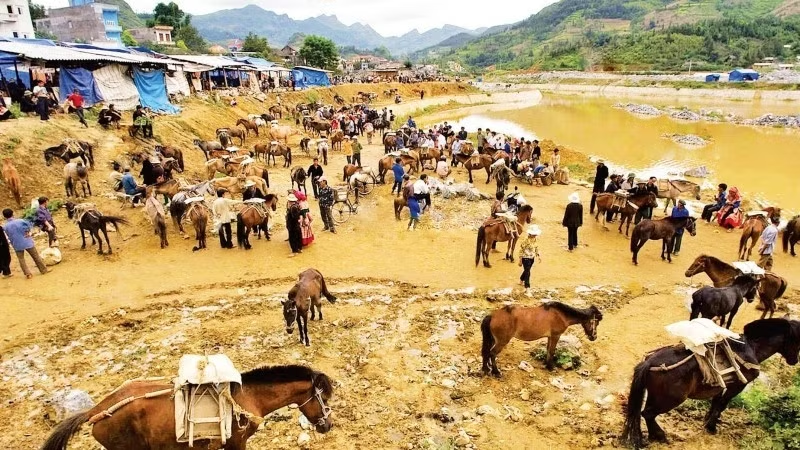
For highland communities, horses were once a prized asset for many households, a means of crossing steep rocky slopes and narrow winding trails. Today, concrete roads have brought motorbikes and cars to villages, yet the sight of locals, dressed for the market, leading horses to the markets — or riding down from the hills on spring outings — still carries a raw, rustic beauty that continues to inspire literature, music and the visual arts.
Famed for its scale and cultural colour, the Bac Ha market (Bac Ha Commune, Lao Cai) sits more than 1,000 metres above sea level, on what is often called the “white plateau”, named for the pure plum blossoms that blanket the mountains each spring. The Bac Ha livestock market takes place every Saturday, drawing crowds of visitors for its lively atmosphere—especially the animal-trading area, where thousands of buffaloes, cattle, Bac Ha dogs and pack horses are brought in. With many fine-looking purebred horses in the area, Bac Ha has become a familiar stop for horse traders with common prices ranging from 20 to 40 million VND per animal, rising to 50–70 million VND for racehorses and white horses.
At dawn on market day, people from H’Mong, Tay, Nung, Phu La and Dao villages shoulder their goods and lead their horses to town. From distant slopes, the sound of neighing carries through the morning mist. The livestock section is always charged with energy — calls to one another, bargaining voices, and the clatter of hooves on hard ground. Young men even race on horseback to see who reaches the market first; the winner is treated to a drink as a friendly prize and a way to make new friends. In recent years, the Bac Ha White Plateau Festival, featuring a horse race each June, has attracted tens of thousands of visitors, helping preserve a traditional sport while creating a distinctive tourism product.
Elsewhere in Lao Cai, other markets such as Can Cau, Coc Ly and Y Ti also maintain horse-trading areas, carrying on long-established routines. What makes these highland horse markets distinctive is the way buying and selling is shaped by local knowledge and cultural practice. Experienced hands check the teeth to estimate a horse’s age; observe the sheen of the coat to gauge health; watch its stance, the steadiness of its legs, and its responsiveness when led for a trial walk across the ground.
Bargaining happens naturally and unhurriedly, sometimes stretching over an entire market morning. In many cases, a buyer may attend several markets before choosing a horse that feels right; a seller, too, might take the same horse from market to market, waiting for the right match. That patience reflects how highland people value horses, not simply as a commodity, but as a long-term companion in daily life.
On the Meo Vac rocky plateau (Tuyen Quang), the Meo Vac market is held every Sunday. Traders bring horses to sell, but just as importantly, the market is a place to socialise and build connections with partners and visitors. Sometimes, it takes a shared cup of liquor before the buying and selling truly begins. Horses raised by H’Mong communities in Tuyen Quang are tall, lean-bellied, strong-legged, and seemingly tireless on mountain roads. For the H’Mong, horses also carry deep spiritual meaning: they are sacred in belief practices, and are believed to carry the souls of the deceased to the eternal realm. Horses appear in folk songs and proverbs, and in highland cuisine as well — including rich horse thang co. They are also embedded in place names such as Ma Pi Leng Pass and Tham Ma Slope.
In the north-east, the Tra Linh market (Tra Linh Commune, Cao Bang) meets on the 4th, 9th, 14th, 19th, 24th and 29th days of the lunar month, divided into three areas: local produce, food and household goods, and livestock. The area is known for valuable white horses, used for pulling carts and carrying goods, as well as for food and cooking traditional cao (horse-bone gelatine).
Winters in Tra Linh are often bitterly cold, so horse owners take careful measures, from wind shields to blankets for warmth. Grilled horse meat is eaten with upland sticky rice, marinated with distinctive forest leaves of Tay, Nung and Dao communities. White-horse gelatine is cooked with great care and is believed to offer health benefits. For many locals, bringing a fine horse to market is not only about selling — it is also a point of pride. The image of white horses grazing on stony slopes, appearing and disappearing among buckwheat blossoms or chestnut flowers, has become a distinctive beauty of the borderlands.
Today, the number of traders bringing horses to periodic markets has been gradually declining, driven by mechanisation, wider access to transport, and the convenience of online transactions. Yet the growth of cultural tourism and traditional festivals is opening up new pathways.
In Mu Cang Chai, Sa Pa (Lao Cai), Lung Cu (Tuyen Quang), Si Pa Phin (Dien Bien), Trung Khanh (Cao Bang) and elsewhere, riding services and horse rentals for tourism are increasingly popular, helping visitors experience local life, while creating additional income for ethnic communities. A spring journey to a mountain market engages all the senses — from peach and plum blossoms to the taste of corn liquor and thang co, and the mingled scents of forest leaves and livestock —details that make for an unforgettable experience.
In the Tet atmosphere, as the horse motif returns to cultural life, these markets evoke the enduring vitality of tradition. Through many changes, horse markets still survive as a “living museum” of communal memory where people patiently choose, care for and bond with a strong, loyal animal that accompanies them through all seasons, rain or shine.