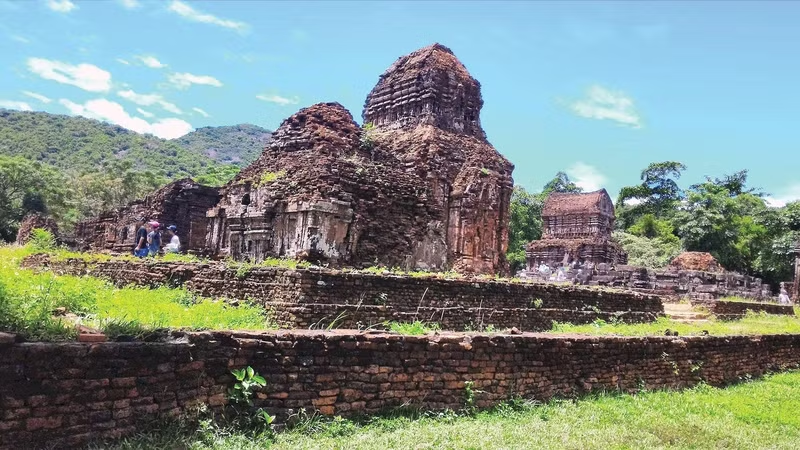
Leading heritage destination
For the heritage-loving community, the four “precious gems” of global stature in different categories recognized by the United Nations Educational, Scientific and Cultural Organization (UNESCO) in 2025 became a special milestone, as all were associated with memorable “firsts.”
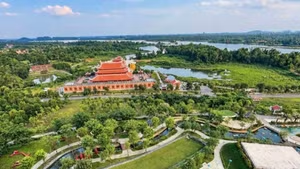
For the first time, we have a “serial heritage site” stretching across three provinces and cities (the Yen Tu–Vinh Nghiem–Con Son, Kiep Bac Complex of Monuments and Landscapes), and a “transboundary heritage site” between Viet Nam and Laos (Phong Nha–Ke Bang National Park and Hin Nam No National Park).
It is also the first time that a private collection (of musician Hoang Van) has entered the “Memory of the World” Register, and a traditional craft (Dong Ho folk painting) has been inscribed on the List of Intangible Cultural Heritage in Need of Urgent Safeguarding.
Thanks to this, the list of humanity’s treasured heritage to which we are honored to contribute continues to grow, with 9 natural and cultural heritage sites, 17 intangible cultural heritage elements, and 11 documentary heritages under the “Memory of the World” program. In addition, with 143 special national relics, 3,677 national relics, and 498 national intangible cultural heritage elements, Viet Nam has become a land possessing a gold mine of heritage with one of the richest reserves in the region.
This does not yet include 9 World Biosphere Reserves, 5 Global Geoparks, 9 RAMSAR sites, and 12 ASEAN Heritage Parks generously bestowed by “Mother Nature.”
Moreover, 6 member names in the “Global Learning Network” and 5 “Best Tourism Villages in the World” have further enriched and diversified the proud table of international titles.
That gold mine contributes significantly to the impressive growth figures of Viet Nam’s tourism industry, which welcomed more than 21 million international visitors and generated tourism and travel revenue estimated at nearly 94 trillion VND (both increasing by more than 20% compared to 2024).
This also explains the pair of parallel awards that the country’s smokeless industry has frequently received in recent World Travel Awards ceremonies, when the title “Destination” has consistently been accompanied by “Asia’s/World’s Leading Heritage Destination.”
We even seem to hold a dominant position in these two prestigious categories, having won the global “Leading Heritage Destination” title six times and the “Asia’s Leading Destination” title seven times.
These convincing double victories are regarded as recognition by friends across five continents of the tireless efforts in developing diverse tourism products alongside preserving and effectively promoting heritage values. It can be said that heritage has become an effective launch pad helping “Viet Nam become a bright spot on the global tourism map”, as affirmed by Graham Cooke, President and Founder of the award considered the “Oscar of the travel industry.”
In the Documents of the 14th National Party Congress, the concept of the “heritage economy” was introduced for the first time as a strategic orientation for the sustainable development of culture. This is not only a new point in terms of thinking but also an important turning point - a breakthrough approach that regards cultural heritage as a development resource, contributing to the nation’s strategy for sustainable growth.
Through thousands of years of heroic history of nation-building and defense, the vigorous vitality of the national cultural stream has enabled this treasure to resiliently endure the ups and downs of history while still shaping a distinctive, unique, and attractive identity. Thanks to that enduring vitality, heritage can preserve the golden grains of past excellence while strongly connecting the present and orienting sustainable development for the future.
Continuing the cultural stream through youth creativity
For heritage to continue existing as a living entity, becoming an indispensable part of everyday life and contributing effectively to socio-economic development in the future, the participation of the community is considered a key pillar.
In a world changing daily due to AI and miraculous scientific advances, young people naturally assume the responsibility of being the core of that community. They possess youthfulness, the ability to grasp technology, and an understanding of the heritage stream — where the accumulated wisdom of generations becomes an abundant and inexhaustible source of energy enabling them to create and flourish.
Numerous examples can be cited. From the foundation of a famous dish, the game “Anh Hai Pho Shop” suddenly went viral across the internet, quickly crossing borders and attracting millions of international followers who eagerly transformed into pho sellers to “step into a Viet Nam that is truly both friendly and mysterious,” as shared by a well-known streamer.
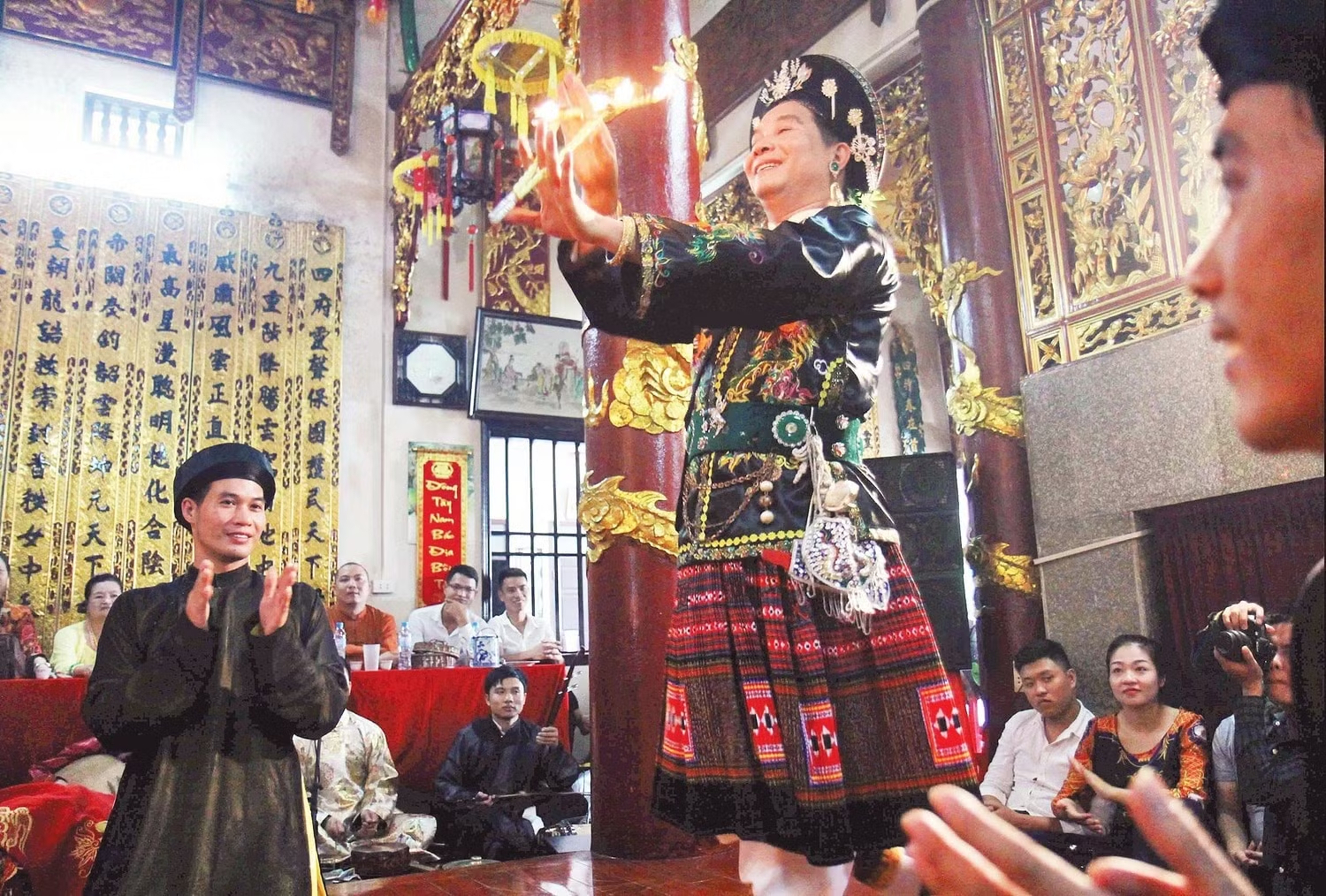
Using ceramics as their central artistic inspiration, the Dan Do artist group created the music program GOm Show – Sound from Ceramics. Ceramics inspired them to invent unusual instruments. Ceramics are not merely materials, they are bridges connecting people with the earth and sky.
After the craft of Dong Ho folk painting was honored by UNESCO, a group of students from the Faculty of Communication and External Culture at the Diplomatic Academy quickly produced “Dong Ho Circus Art.” Using a highly physical art form with minimal language barriers to recreate the stories hidden behind famous paintings is their chosen way to bring the essence of heritage to the community.
Audiences certainly have not forgotten the works that infused contemporary spirit into traditional colors and caused an online explosion during the wave of game shows such as Drum Rice, Co Doi Thuong Ngan, Da Co Hoai Lang. Nor can they forget the international imprint achieved by Duc Phuc and Phuong My Chi with songs inspired by national history. And projects marking milestones in the careers of many artists such as Hoang by Hoang Thuy Linh, Ancient Vietnamese Songs by Le Cat Trong Ly.
We can also add highly interesting applied innovations: bringing the “National Treasures” collection to desk calendars and catalogues and issuing stamps; transforming famous ancient sculptures into multi-sized versions as gifts or souvenirs; incorporating Hang Trong folk painting motifs into everyday applied products.

Young people are also at the forefront of heritage digitization projects, thereby building effective and accessible technological bridges that enhance public appeal. They are also the ones who, driven by love for traditional culture, diligently copy, research, and restore ancient costumes, preserve traditional music, and produce historical animated films through increasingly professional activities of groups such as Nguyen Phong Doan Linh, Y Van Hien, Viet Village Communal House, Cheo 48 Hours, Duoc Moi, Hac Than Studio.
The added values derived from the gifts left by ancestors do not stop at transmitting identity and pride, strengthening national unity, but also create a foundation for developing cultural and tourism economies, inspiring future generations to boldly transform “heritage” into “assets.” The active participation and boundless creative efforts of today’s youth across various fields, shaping the overall landscape of contemporary cultural industries (cultural tourism, performing arts, music, cinema, design, software…), demonstrate the initial success of the “heritage economy,” considered a strategic orientation for the sustainable development of Vietnamese culture.
For the vitality of Viet Nam, Vietnamese culture, and Vietnamese heritage to endure forever alongside the Vietnamese people!