When tradition is “touched” through emotion
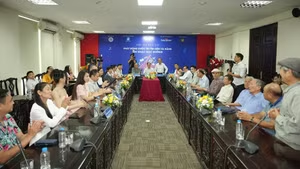
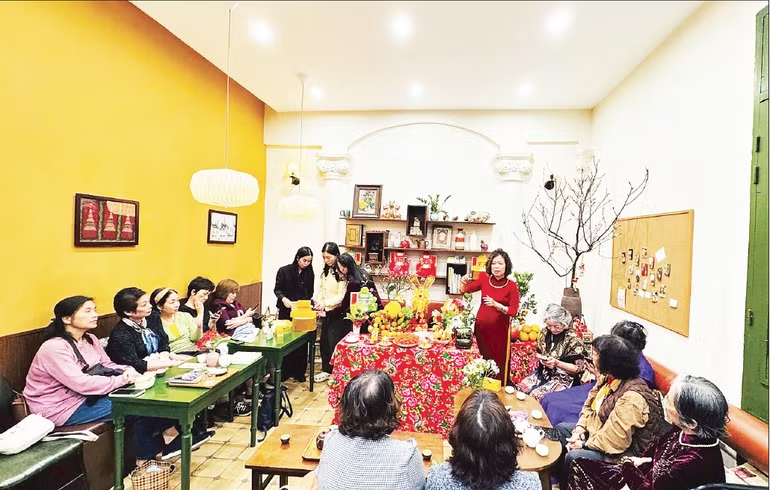
The workshop “New Year’s Eve Offering Tray – A Cultural Beauty of the Vietnamese People”, held amid the lively atmosphere in the run-up to Tet and moderated by journalist Vinh Quyen, attracted wide participation both online and in person. Within a warm and intimate setting, participants revisited the sacred ambience of the first day of the Lunar New Year, intertwined with memories of youth.
For many years, journalist Vinh Quyen has consistently created community spaces imbued with national identity through workshops that revive and disseminate the essence of Vietnamese traditions, particularly cuisine. Re-enactments of New Year’s Eve offering trays, traditional Tet feasts, regional festive trays from the three regions, and discussions on the preparation of Vietnamese dishes have all received enthusiastic public response.
Notably, her approach begins with the everyday. Rather than “teaching” cooking or rigidly reconstructing rituals, she tells the stories behind each dish — stories of homeland flavours, family memories, and customs passed down through generations. From these seemingly simple details, traditional values are awakened in contemporary life, becoming a natural thread connecting generations. Many workshop participants have shared that they leave not only with knowledge but with cherished memories, quiet emotion and a renewed desire to preserve and spread these values in daily life.
Explaining her motivation for pursuing such meticulous and heartfelt activities, Vinh Quyen said her greatest wish is to create spaces where traditional values no longer remain confined to books or museums, but return to everyday life — in family meals, in arrangements of offerings, in stories told unhurriedly together. In her view, modern society lacks stories told with feeling; once emotion is stirred, appreciation arises naturally.
At a time when some express concern over the simplification of traditional practices or even advocate an overly “Westernised” lifestyle, her approach suggests another perspective. The issue is not whether to choose “tradition” or “modernity”, but how these values are embraced. Only when they are lived, voluntarily chosen, and meaningfully integrated into daily life can they endure, rather than being preserved in a formalistic or imposed manner.
Sowing seeds through education and community
While Vinh Quyen’s activities aim to rekindle traditional memory among adults, the efforts of education specialist Dr Nguyen Thuy Anh focus on planting seeds from an early age, regarding this as essential to building spiritual resilience in younger generations. Through the Reading Books with Children Club and other educational spaces, she has persistently brought national heritage closer to children using creative, lively, and experiential methods.
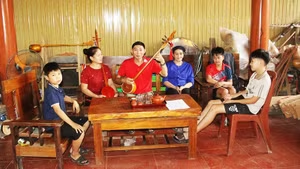
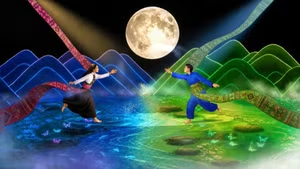
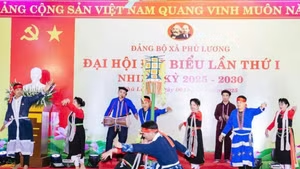
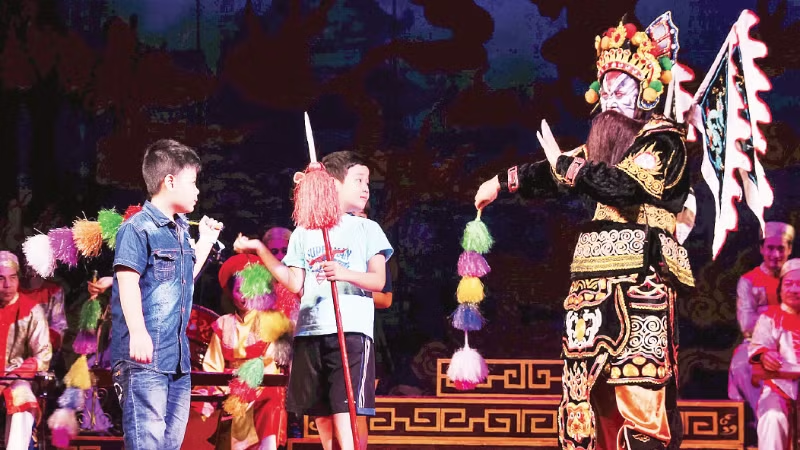
Dr Nguyen Thuy Anh explained that such experiential activities pursue two parallel objectives. First, they encourage young people to explore, recognise, and take pride in the beauty of the Vietnamese spirit, thereby building a strong “spiritual foundation” to live confidently and steadfastly. Secondly, through traditional values, children can absorb knowledge and skills naturally, without coercion. Xam (a form of folk performance through singing and music) melodies recounting the history of Thang Long, quan ho folk songs, or classical cheo plays not only introduce heritage but also nurture emotion, shape character, and instil social norms.
As a contributor to experiential learning textbooks, Dr Nguyen Thuy Anh emphasised the school’s role in integrating traditional art forms into education. Bringing artists into schools, organising flag-raising sessions featuring xam, cheo, tuong and quan ho, or arranging field trips to quan ho villages, communal courtyards, and traditional theatres have shown tangible effectiveness. In her view, with appropriate methodology and genuine love for the nation’s foundational values, inspiring appreciation among pupils is entirely achievable.
When traditional values are incorporated into education through vivid experiences, heritage ceases to be an abstract concept and instead becomes a natural part of school and community life. In doing so, comprehensive education is harmonised with character education, contributing to the formation of Vietnamese citizens who develop intellectually, morally, and culturally in balanced measure.
The creative continuation of the younger generation
In recent years, numerous youth-led projects and communities have generated a strong wave of interest in traditional values. One example is the Dai Viet Co Phong group, founded in 2014, which has grown into a large network connecting hundreds of thousands of young people passionate about researching and sharing knowledge of Vietnamese history, customs, and rituals. From traditional attire and ceremonies to spiritual practices, members not only exchange knowledge but also organise re-enactments, performances, and digital content creation, bringing historical values back into contemporary life through modern language and media.
Similarly, the “Mau dan toc” (Ethnic Colours) project, initiated by Nguyen Thi Huu, has adopted a creative approach by incorporating traditional folk paintings and colour palettes into applied products such as decorative lamps, notebooks, ceramic vases, and handbags. Through researching, reconstructing, and introducing traditional hues in clothing, fine arts, and everyday life, the project has helped the public — particularly young people — to more deeply recognise the refined beauty of national heritage.
The increasing emergence of such creative groups and projects reflects a positive shift in social awareness. Traditional values are no longer perceived as outdated or opposed to modernity, but as sources of inspiration for creativity and for affirming personal and collective identity in the context of globalisation. This, too, is a vivid manifestation of continuous transmission, in which each generation both inherits and enriches the invaluable legacy left by its forebears.
Cultural folklorist Nguyen Hung Vy observed that, amid reform and development, traditional values have not faded but gained further conditions for revival and wider dissemination. However, preservation cannot be separated from understanding and promotion. Each generation, he argued, must recognise that today will become the tradition of tomorrow. Transmission is not merely about safeguarding existing values, but about creating new ones grounded in identity to shape the future. When the values of truth, goodness, and beauty are nurtured in daily life, that spiritual current will continue to sustain society and help define Vietnamese identity in the process of integration.