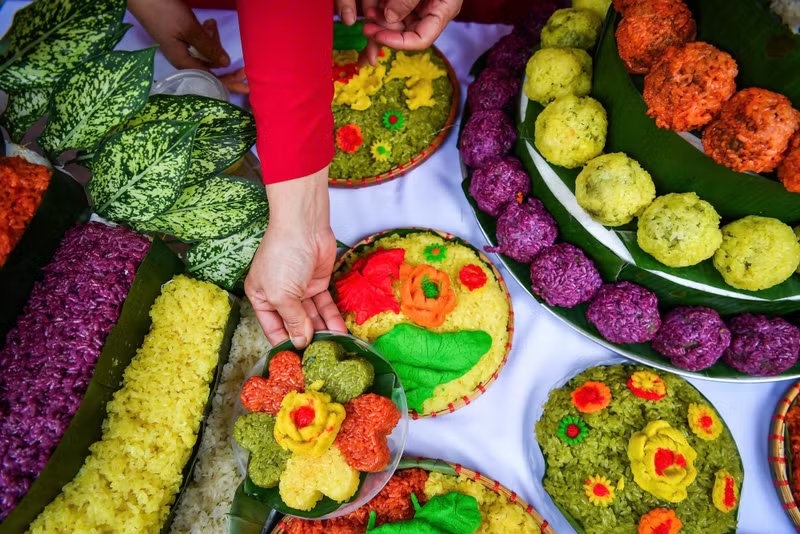
Offerings of xoi come in many forms, but the most popular remains xoi gac (sticky rice with gac fruit), almost a staple on ceremonial trays thanks to its vivid, festive red colour.
Then there is xoi vo — its name comes from the “vo”, a distinctive mixing technique during preparation. Once the rice is cooked, it is spread out on a bamboo tray and fanned to cool, then gently “rubbed” and mixed with cooked mung beans that have been pounded, shaped into small balls, and shaved into fine flakes. The result is xoi that is loose, light and glossy, each grain separates and plump. The fragrance of sticky rice blends with the mellow aroma of mung beans, making xoi vo delicate, elegant and unmistakably.
Another delightful example is xoi xeo. No one is quite sure where the name comes from, yet just hearing it conjures up a steaming parcel of golden sticky rice — yellow like daylily petals —topped with the rich crunch of fried shallots and rendered fat, and paired with thin slices of mung bean that cling gently to the rice. All of it is wrapped in the scent of lotus leaves or fresh green banana leaves. This is a familiar flavour of old Ha Noi mornings, on street corners in the Old Quarter.
Some people jokingly say the word “xeo” came from how irresistible it is—so tempting that even if the vendor chased customers away, they still would not leave. Others suggest it may come from the way it is served: after spooning the rice onto a lotus leaf, the seller uses a knife to slice the mung bean loaf diagonally and lay the slices across the top. Each customer gets their portion of mung bean “xeo-ed” on, slice by slice, as the orders come in.
One particularly distinctive Ha Noi breakfast is xoi lua, which at first glance appears a soft gold — between canary yellow and pale lemon. Under the mung bean layer, the corn kernels emerge in a polished ivory tone, resembling pearls on a necklace worn by the refined women of old Ha Noi. The milky sheen of the corn sits unexpectedly well with the deep yellow of the plump sticky rice, steamed until supple and moist. On top, mung beans are shaved into thin curls and arranged over the surface, the curved shavings resembling old roof tiles on pagodas and communal houses.
As xoi is portioned out, the vendor looks like a skilled performer: nimble fingers quickly spoon the rice, shave thin mung bean slices over the top, then drizzle rendered fat and sprinkle fried shallots. The shallots — sliced across the bulb and fried until crisp — turn a warm amber-brown, finishing the golden mound of xoi speckled with tender corn kernels. Xoi lua is typically served on lotus leaves.
In old Ha Noi, even wrapping xoi had its own style: the lotus leaf, shaped like a half-open paper fan, would be gently cupped inside a small Bat Trang ceramic bowl — pale greenish white, edged with a sea-blue rim. The vendor would spoon in the xoi, slice the beans, drizzle the fat, add the shallots, then fold the corners neatly closed.
Xoi can be eaten on its own or alongside meat, salad and other dishes as a main item at banquets. It is also enjoyed with sweet soups — che — as a dessert at the end of a meal, or while sipping tea in gatherings with friends and family.
Xoi lua, xoi xeo, xoi lac and xoi vung are common breakfast choices. Xoi gac is often served at the start of a feast after rounds of toasts. Plain xoi is eaten with pork, chicken, goose or duck in formal trays. Xoi mung bean and xoi hoa cau are sometimes shaped by mothers and grandmothers into small bite-sized balls for children. Meanwhile, xoi vo is frequently paired with che such as che hoa cau, che do dai, che ba cot, or syrup sweetened with jasmine-scented sugar.