From ceremonial horse to royal sacred beast
The “Kham Dinh Dai Nam Hoi Dien Su Le” (Official Compendium of Institutions and Usages of Dai Nam) records that as early as the reign of Emperor Minh Mang, the Vien Thuong Tu (Imperial Stud Office), located within the imperial citadel, was assigned to breed and train horses. All matters relating to horses serving the court were strictly regulated, from selection criteria and care regimes to the duties and sanctions applied to those directly responsible. This demonstrates that horses were not merely material assets but an important component of the Nguyen Dynasty’s ceremonial system and military organisation.
In practice, however, horses during this period left little mark on the battlefield. They were used mainly for drawing carriages, drills, official duties, and participation in major state rituals. The image of the horse was also chosen by Emperor Minh Mang to be cast and engraved on the Huyen and Anh Caudrons, two of the Nine Cauldrons placed in the courtyard of The Mieu Temple in the Hue Imperial Citadel, now recognised as national treasures. Over time, alongside shifts in aesthetic sensibilities and philosophical thought, the image of the horse was gradually elevated into that of the dragon horse, becoming a distinctive sacred creature of Hue.
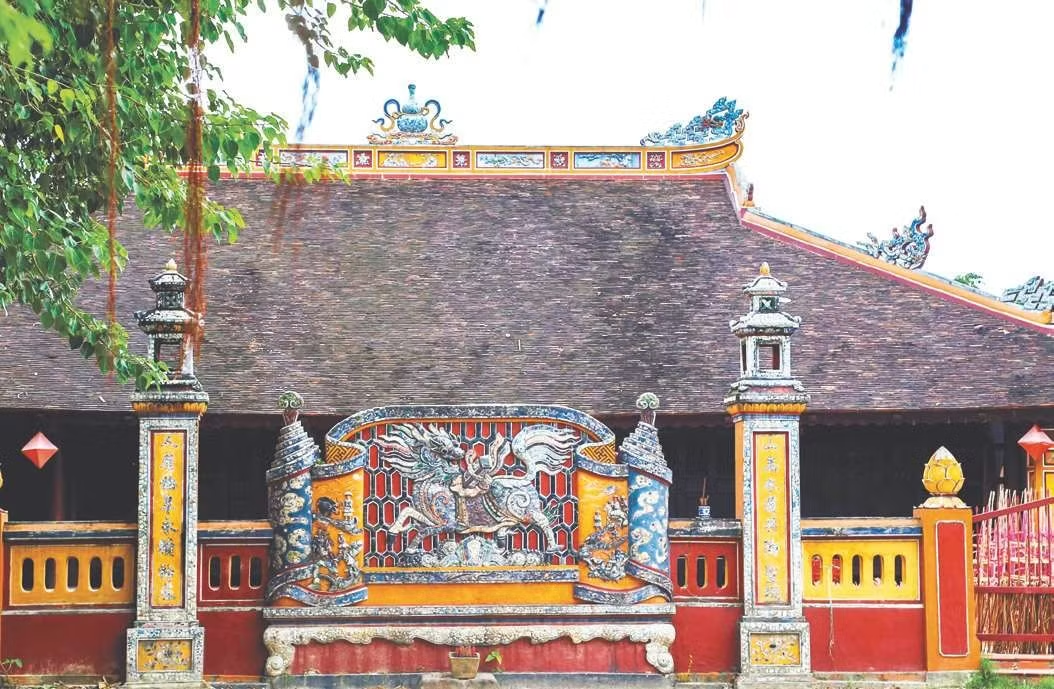
According to Dr Phan Thanh Hai, Director of the Hue Department of Culture and Sports, the dragon horse is a unique fusion of dragon, unicorn, and horse, associated with auspicious omens and symbolising wisdom, good fortune, and longevity. At a deeper symbolic level, it also embodies the expansive spirit of the noble man: the dragon’s ascent represents the vertical axis, while the horse’s gallop signifies the horizontal axis, together implying harmony between heaven and earth.
“This sacred creature combines the majesty of the dragon with the freedom and openness of the horse. In some beliefs, the dragon horse is seen as the embodiment of supernatural strength and wisdom, heralding the emergence of a sage. For this reason, the image of the dragon horse appears in many different settings, becoming a hallmark symbol in the decorative arts and court architecture of Hue,” Dr Phan Thanh Hai emphasised.
Researchers note that among the four sacred creatures, the dragon holds the most exalted position, with its imposing and powerful form appearing in the richest variety across Hue’s court architecture. Second only to the dragon in frequency of appearance is the dragon horse. Its image therefore leaves a distinct, easily recognisable imprint and is revered as a special sacred beast in cultural life.
The dragon horse in Hue’s feng shui landscape
The image of the dragon horse can be found in many important architectural works, including Hung Mieu Temple, Truong Sanh Palace, and Tu Phuong Vo Su Pavilion, as well as the mausoleums of the Nguyen emperors. However, the place where the dragon horse appears most frequently in Hue is on screen walls. Visitors can easily encounter dragon horse screen walls everywhere, from rural villages to urban neighbourhoods.
In feng shui belief, the presence of the dragon horse on screen walls enhances their protective function, helping to ward off foul, noxious, and fiery energies. This is why dragon horse screen walls have long been especially favoured by the people of Hue.
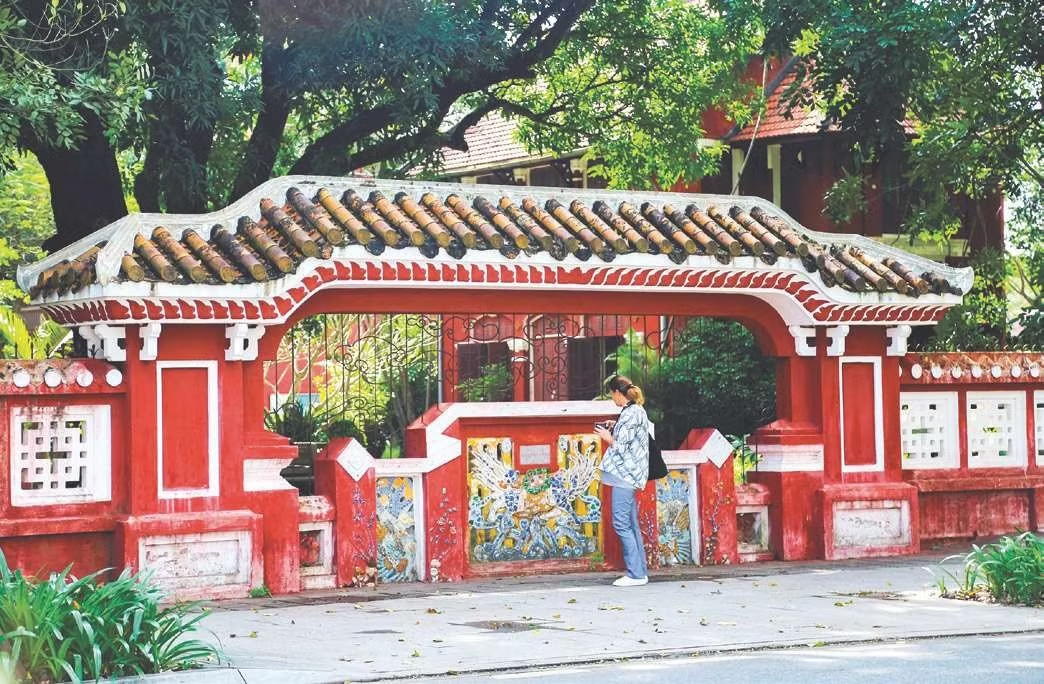
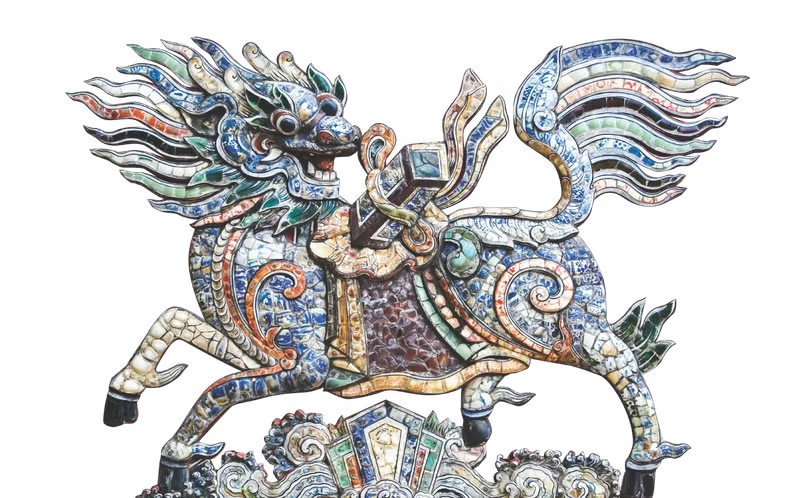
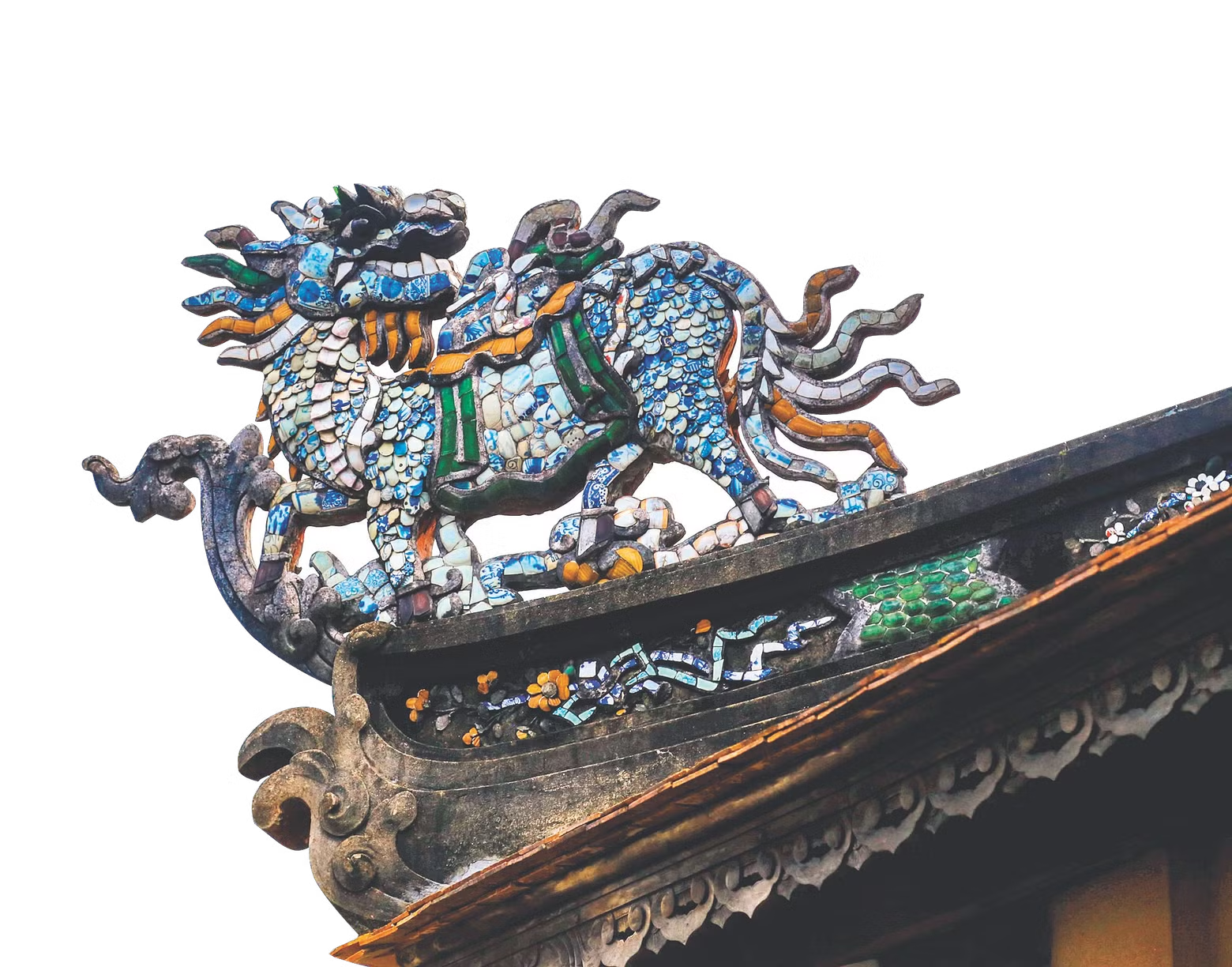
For generations, Hue artisans have employed ceramic and porcelain mosaic techniques to create dragon horse images on screen walls. Through the skilful hands of folk craftsmen, shards of pottery and porcelain are harmoniously arranged to form a sacred creature that is at once powerful and majestic yet graceful and vivid.
The flowing mosaic lines further highlight the spirit of the dragon horse, conveying meanings of auspiciousness, wisdom, and prosperity. It is precisely this refined combination of mosaic art and the dragon horse image that has produced screen walls of enduring vitality, resilient to the passage of time, and representing a pinnacle of Hue’s royal decorative arts.
A living heritage in contemporary life
With its vivid beauty and rich symbolism, the image of the dragon horse was chosen by Vietnamese and French artists as the emblem for the Hue Festival logo. The model was the screen wall in front of Quoc Hoc Hue High School for the Gifted. This is the most famous and oldest dragon horse screen wall in Hue, built in 1896 during the reign of Emperor Thanh Thai. Its placement is particularly striking, facing the Perfume River, Phu Van Lau Pavilion, and the Imperial Citadel.
The dragon horse is depicted rearing and riding the clouds, yet turning its head back, exuding an aura that is gentle, sacred, and intimate, like a message of prosperity bestowed upon this school of proud tradition.
Today, the image of the dragon horse continues to exist within cultural life and spaces in Hue. Even within the urban core, notable screen walls can be found at the former Privy Council (now the headquarters of the Hue Monuments Conservation Centre), the Temple of Tran Hung Dao, the Tuy Ly Vuong Residence, Kim Long Communal House, and An Hoa Communal House.
Venturing further to the outskirts, the dragon horse appears in the ancient village settings of Trieu Son, Phuoc Tich, Lai The, and Duong No. Whether standing amid bustling streets or nestled beside bamboo hedges, these screen walls quietly preserve a beautiful symbol within the cultural flow.
Ideas have also emerged for a thematic tourism route tracing the “footsteps of the dragon horse”, conceived as a journey linking past and present. Participants would follow each screen wall to experience the depth of history, architecture and fine art. The journey would be more than a simple walk through heritage sites, it would be an opportunity to listen to Hue tell the story of a symbol that has passed through many generations yet has never left the rhythm of life in the former imperial capital.
For the people of Hue, the dragon horse has long been regarded as a transformation of the unicorn, one of the four sacred creatures. In folk imagination, it bears the body of a horse, the head of a dragon, a scale-covered torso, an Eight Trigrams diagram on its back, and is always depicted in motion. It is not a creature that exists in reality but rather a product of imagination, crystallised from symbolic thinking and humanity’s spiritual aspirations.