Unexpected experiences
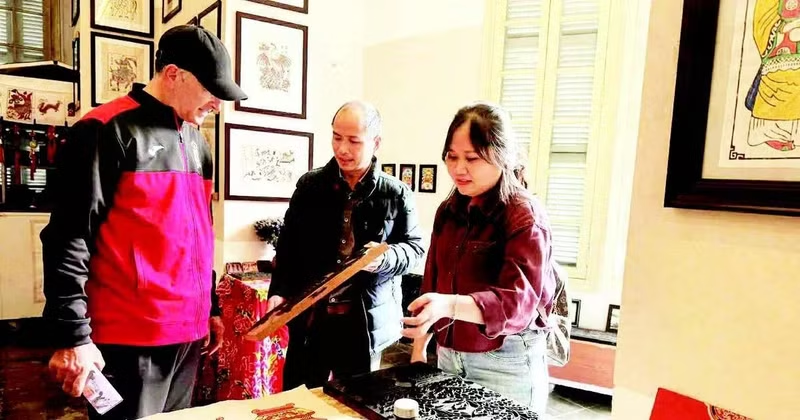
Just after 4 a.m., Dao arrived to pick me up to go for breakfast. Along Hung Vuong Street, next to the University of Education under Hue University, Ut’s bun stall opens at 4 a.m. and usually packs up around 5 a.m. Nearly ten customers sat close together, each on a single chair, with no tables. Dao explained that those who come to eat are often early-morning workers, people returning late from outings, those working at night venues, people out exercising, and tourists as well. What stood out was a large basin of leftover rice placed next to the baskets of noodles.
No explanation was needed, it was there to help fill the stomachs of those who might not consider eating breakfast so early an experience worth trying when coming to Hue. Of course, eating at 4 a.m. may be familiar to many people, but not everyone knows about it. That explains why, to date, Dao has taken more than 500 people to Ut’s bun stall, including me. Ut said her stall has existed for 35 years. Previously, she sold on Truong Dinh Street, behind the Morin Hotel, and has been on Hung Vuong Street for the past five years.
Because no rice was added, our breakfast ended very quickly, and the two of us left immediately to make room for others who had just arrived.
Ong Suu’s coffee stall is located in the flower garden area on Phan Dang Luu Street. At 5 a.m., it was still dark, yet within minutes all the seats were filled. As at Ut’s bun stall, I initially thought those who came so early must be labourers from various trades. However, instead of eating quickly and leaving, they lingered, unhurried, much like Hue’s everyday pace of life. What impressed me about Ong Suu’s coffee stall was not only the fact that the 82-year-old owner has been attached to this place for 50 years, but also that an old guard booth has been repurposed as the brewing area, making the space feel intimate, with no distinction between owner and customer. No wonder Ong Suu, whenever he has a free moment, pulls up a chair to chat, beginning with verses by Bui Giang as a warm greeting to a visitor from afar, before going on to talk about Hue, about his own life, and about his long-held dream of once travelling to Ha Noi, which he has yet to realise.
Hue is not for those in a hurry. Things that seem very small, very ordinary, and often overlooked are precisely where Hue most clearly reveals its rhythm of life. From his own experiences, and those of many people who have come to Hue and fallen in love with it, Dao wants to gather and distil them into 100 things worth trying when visiting Hue, as a way to help those who come later understand and love Hue more deeply.
Things worth trying
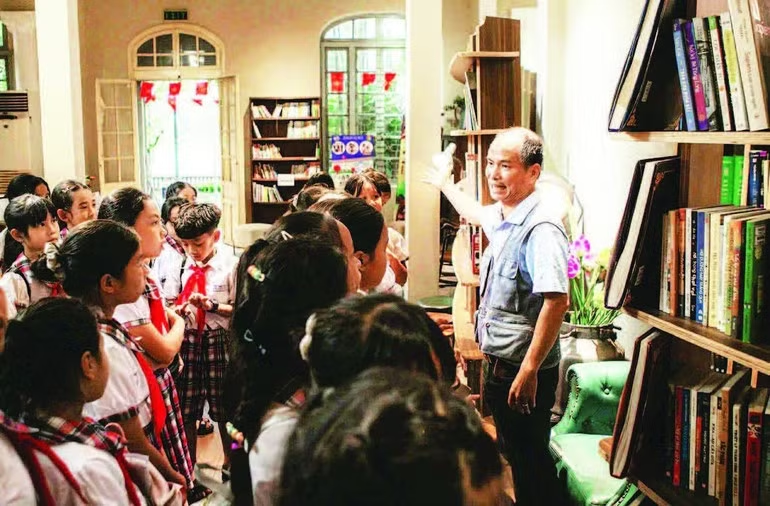
Born in 1978, Dao has probably lived and worked more in Ho Chi Minh City and Ha Noi than in his native Hue. He only returned eight years ago after studying in Ho Chi Minh City, working as an editor for Tuoi Tre newspaper, engaging in the tourism sector, and publishing books at Alphabooks. Yet his love for this tranquil city surpasses anywhere else. Dao said that his return was no longer about a son’s responsibility to be near his father when needed, but rather about feeling the need to contribute something to Hue. Dao participates in running the Hue Book and Culture Club, serves as an education adviser for pupils and students, and provides consultancy to businesses in building business management departments—yet he still wants to do more.
Dao explained that the project is a continuation and expansion of the clip series #daohoideptrai, created with the aim of telling stories about Hue. His original idea was to build a TikTok channel showing where to go today, where to go tomorrow in Hue, what to eat, and what to experience, produced by young people. However, Dao soon realised that TikTok mainly suits younger audiences, while others prefer images or reading. As a result, he and a group of students embarked on a new project. From an educational perspective - an area he cares deeply about - producing 100 things worth trying when visiting Hue helps young people learn tools and skills to improve their competence. In addition, each participant learns time management, teamwork and planning skills.
According to Dao, the number 100 is merely symbolic, as there could be many more things worth trying in Hue—ideally 365, corresponding to the 365 days of the year. As the slogan of Hue Newspaper and Radio and Television puts it, “Hue is always new”, meaning there is always something fresh to discover, not only in scenic landmarks but also in cuisine, architecture and craft village experiences. In fact, there are many things that even Hue locals themselves do not yet know.
To carry out the project, Dao asked people who had been to Hue to list things that they believed were worth trying. Some of their suggestions even surprised Hue residents. Conversely, there were many things they themselves had not yet experienced, and therefore these are precisely the things they and future visitors to Hue, should try.
Dao’s group then compiles and categorises the suggestions by fields such as cuisine, tourism and culture. They present the content in the form of an e-magazine, with links to specific locations so readers can follow them on Facebook or Instagram. At the same time, they plan to offer suggestions for experiential tours for visitors lasting one, two or three days.
Although the project only began in December 2025, Dao said that the list of 100 things worth trying when visiting Hue is essentially complete. However, he wants to turn these bullet points into detailed descriptions, with images and stories.
On this point, Dao shared that the way young entrepreneur Ho Ngoc Son promotes his business is also very effective. Born in 1992, Son has promoted his Ba Bu Bread shop by printing a numbered Ba Bu News bulletin, allowing customers to read and learn more about Hue, dining spots, tourist attractions and entertainment while waiting. Son explained that this is a form of connection and mutual support among local businesses through information sharing. Therefore, in the 100 things worth trying when visiting Hue project, Dao wants everyone to contribute in their own way, effectively turning them into local tour guides.
The ambition of producing a comprehensive guidebook about Hue may still lie ahead. Yet the efforts of Dao and his collaborators may help Hue become more than just a place of arrival and departure. For as long as there are people willing to tell the story of Hue through memory and affection, the former imperial capital will always retain a reason for people to return.