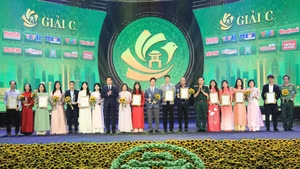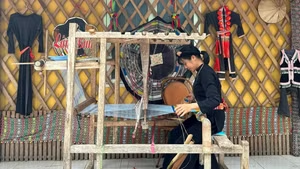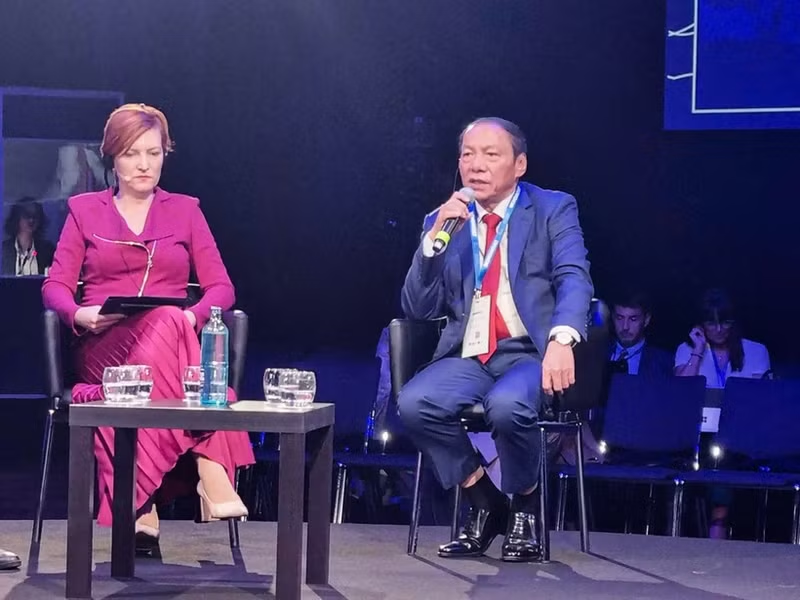
The achievements of cultural diplomacy in recent years have made an important contribution to positioning the Vietnamese cultural brand, bringing the image of an independent, self-reliant nation that is rich in identity and aspiration to shine on the world cultural map.
Spreading Vietnamese culture among international friends
According to the Ministry of Culture, Sports and Tourism, following the 13th National Party Congress, cultural diplomacy has made long-term strides, shifting strongly from breadth to depth. Enhancing national soft power through promoting the country’s image and the Vietnamese people has become a consistent task, contributing to consolidating political trust and elevating Viet Nam’s international standing amid deepening integration.
According to the 2024 Asia Power Index by the Lowy Institute, Viet Nam’s strongest improvement came from diplomatic and cultural influence. Viet Nam is now becoming one of Asia’s most attractive cultural destinations, consistently honoured at the World Travel Awards with titles such as “World’s Leading Heritage Destination” and “World’s Leading Nature Destination.”
The most outstanding success in affirming the Vietnamese cultural brand is its impressive presence at the world’s largest multilateral forums. The years 2023 and 2025 marked historic milestones as Viet Nam assumed roles in six key UNESCO governing mechanisms, becoming one of the countries with an important voice in shaping global policies on culture, education, and science. A large number of heritage sites and titles recognised by UNESCO have demonstrated the enduring value and appeal of the nation’s cultural treasures.
Another remarkable highlight is the breakthrough at EXPO 2025 Osaka, Japan. The Viet Nam National Pavilion won two international awards: a silver award for “Best Exhibition Design” and a bronze award for “Best Team Performance.”
During six months of operation, the pavilion attracted nearly 1.7 million direct visitors and millions of online visits, while hosting more than 1,400 artistic performances, creating a “Vietnamese cultural fever” in the heart of Japan. This success not only affirmed creativity but also demonstrated the capacity of Viet Nam’s cultural diplomacy workforce to organise global-scale events.
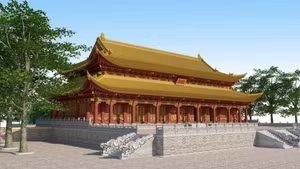
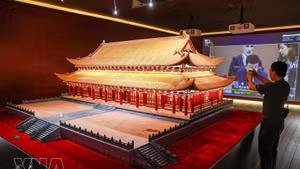
Domestically, the first “World Cultural Festival in Ha Noi” (2025) became a new symbol of peaceful connectivity. The event brought together 48 countries and UNESCO, attracting more than one million visitors to the Thang Long Imperial Citadel. With a message of sharing and social responsibility, the festival raised 2.5 billion VND to support communities affected by natural disasters, affirming that Viet Nam is not only a meeting place of world cultural quintessence but also a nation rich in compassion.
A shift in strategic thinking and implementation
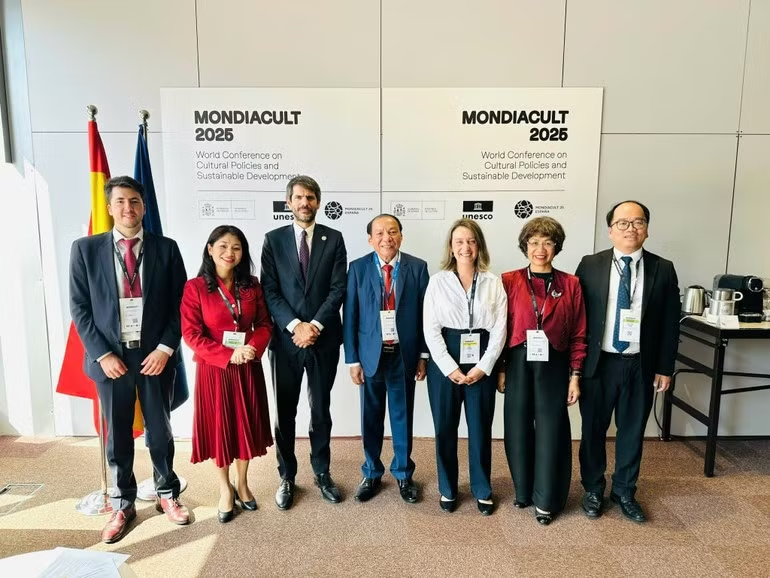
Looking back at these achievements, one can clearly see a fundamental shift in leadership thinking and direction. Minister of Culture, Sports and Tourism Nguyen Van Hung affirmed: “The ministry has resolutely directed a strong transition from the mindset of ‘meeting and exchange’ to that of ‘substantive cooperation’. Accordingly, international cooperation agreements in culture, sports, information, and tourism have been signed at various levels, creating a solid framework for activities. This perspective has brought Vietnamese culture and arts deeper into bilateral and multilateral agendas. Notably, Viet Nam’s initiative on the ‘international decade of culture for sustainable development’ — adopted by UNESCO in 2025 — demonstrates our leading role in shaping global development thinking beyond 2030, affirming culture as an inseparable pillar of sustainable development.”
Meanwhile, from an operational perspective, Head of the International Cooperation Department Nguyen Phuong Hoa stated that 2025 represents a breakthrough period with a long-term strategic vision. Despite facing a complex global situation and personnel constraints, cultural diplomacy has continued to “shine” thanks to a spirit of proactiveness and creativity.
She emphasised that implementing the policy of deep international integration has turned cultural diplomacy into a bright spot, with activities going beyond promotion to participating in shaping international rules through UNESCO and ASEAN mechanisms.
“Cultural diplomacy has now become an indispensable component of the external activities of Party and state leaders. In 2025, the Ministry of Culture, Sports and Tourism chaired seven high-level artistic programmes serving overseas visits by the Party General Secretary and the State President to strategic partners such as Indonesia, Singapore, Kazakhstan, the US, and Russia. Vietnamese melodies resonating at world-renowned venues such as the New York Museum of Art and at friendship concerts have conveyed a powerful message of a peaceful, friendly and refined Viet Nam,” Nguyen Phuong Hoa affirmed.
Although significant achievements have been recorded, to ensure that cultural diplomacy truly becomes a resource driving socio-economic development and enhancing national standing in this era of national rise, Nguyen Phuong Hoa stressed the need for more fundamental and synchronised solutions.
First, institutions and breakthrough strategies must be improved. The development and implementation of the project “Vietnamising international culture, internationalising Vietnamese culture” is a strategic step. This is not only about bringing Vietnamese culture to the world but also about selectively absorbing global cultural quintessence to enrich national identity and build Viet Nam into an attractive hub of international cultural exchange. The International Cooperation Department is urgently reviewing the previous cultural diplomacy strategy in preparation to submit a new strategy to 2030, with a vision to 2045, in line with the spirit of the 14th National Party Congress.
Second, cultural industries linked with digital transformation must be further promoted. It is necessary to strengthen connections between reputable global cultural institutions and foreign investors to co-produce outstanding cultural products bearing the Vietnamese brand. The application of technology and digital transformation in culture and the arts not only helps spread the national image more quickly and widely but also generates direct economic value. The success of the Viet Nam National Pavilion at EXPO 2025, with more than 5.3 million online visits, offers valuable experience to be replicated.
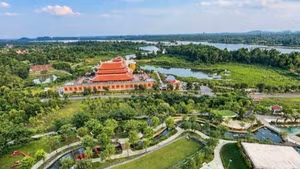
Third, the role of localities and the network of creative cities should be enhanced. The inclusion of Hoi An, Da Lat and most recently Ho Chi Minh City in the UNESCO Creative Cities Network has opened new development space. Localities should be supported in fulfilling international commitments and turning heritage and creativity into competitive advantages, as Ninh Binh has successfully done by restructuring its economy based on Trang An heritage.
Fourth, methods of mobilising resources must be renewed. Lessons from EXPO 2025, where socialised funding accounted for 30% of the total budget, demonstrate the enormous potential of contributions from enterprises and overseas Vietnamese communities. Public–private partnership models should be promoted, and the participation of intellectuals and artists — who play a core role in cultural creativity — should be mobilised to implement external tasks effectively.
Fifth, attention must be paid to developing high-quality human resources. Cooperation with foreign partners should be strengthened to train and nurture talents in culture and the arts, enabling them not only to excel professionally but also to understand international law and modern diplomatic skills.
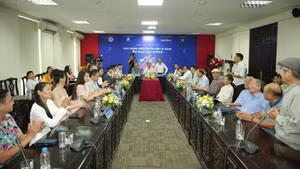
The achievements of cultural diplomacy in recent years testify to the soundness of the Party’s independent, self-reliant, and identity-rich foreign policy. As Le Hai Binh, Deputy Director of the Ho Chi Minh National Academy of Politics, emphasised at a seminar titled “Orientations for the development of Vietnamese culture to 2030, vision to 2045 and issues for cultural diplomacy”: Within Viet Nam’s comprehensive diplomacy, cultural diplomacy is the “spiritual foundation that creates identity.” With renewed confidence and strength, Vietnamese cultural diplomacy is firmly entering a new period, contributing meaningfully to the successful realisation of the strategic goals marking the 100th anniversary of the Party and the 100th anniversary of the nation, and strongly spreading the image of a “prosperous and happy” Viet Nam among international friends.