Opening up new development space
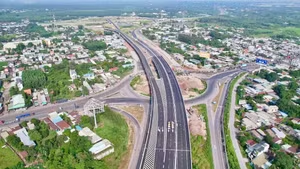
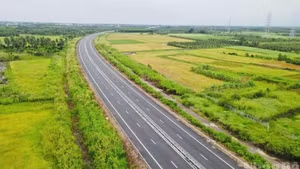
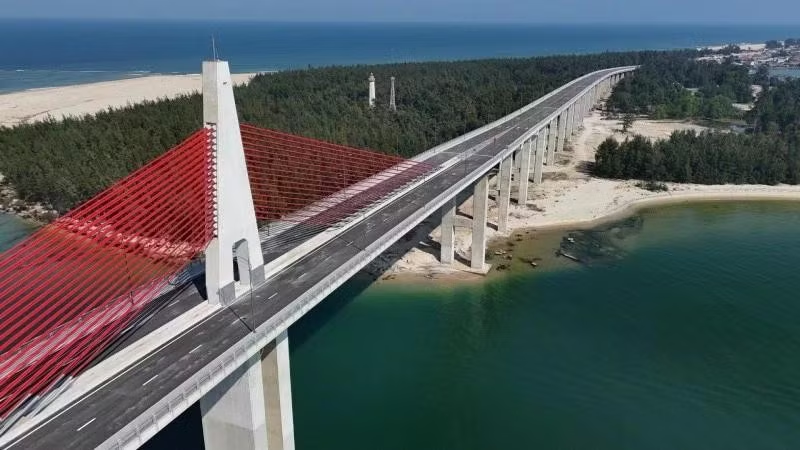
For a long time, Hue’s development space was concentrated mainly along the historic urban axis on the banks of the Huong (Perfume) River. As inner-city land resources have become increasingly constrained and infrastructure has come under mounting pressure, the formation of new development corridors towards the sea has become an inevitable requirement. The coastal road combined with the Thuan An estuary overpass has therefore been identified as one of the key driving axes, linking coastal areas with the Chan May–Lang Co Economic Zone and opening up a new development corridor for Hue.
According to Le Anh Tuan, Director of the Hue City Department of Construction, the orientation to expand development space towards the sea has been fully and synchronously integrated into the provincial master plan and the overall master plan for Hue city, both approved by the Prime Minister. The seaward-oriented transport system—including coastal roads, ring roads, radial routes and connections to seaports, airports and the national railway—is identified as the foundation for modern urban development, regional connectivity and integration.
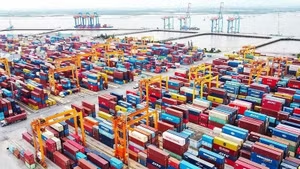
Alongside the Thuan An coastal route, the city has invested and continues to invest in a number of key transport projects such as Nguyen Hoang Bridge, Nguyen Hoang Road and the Ring Road No. 3. These projects not only help to ease traffic pressure in the inner city but also open up new land reserves for development in the western and north-western areas of the city. Towards the sea, the Chan May deep-water port is being further expanded, gradually enhancing its role as a logistics gateway and creating conditions for the formation of a coastal service–industry–tourism chain.
It is evident that opening the urban “gateway” towards the sea is gradually clarifying Hue’s multi-directional development structure, creating long-term development potential in the context of the city having become a centrally governed municipality.
Addressing transport infrastructure shortcomings that cause flooding
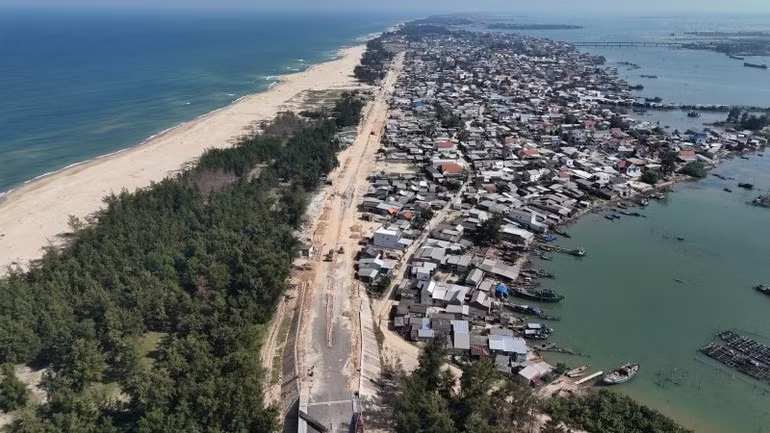
Alongside the expansion of development space, Hue is facing major challenges from climate change, particularly urban flooding. In reality, the existing transport system is among the sectors most visibly affected during periods of heavy rainfall and prolonged flooding.
According to assessments by the Department of Construction, many transport routes across the city are frequently inundated, causing congestion and localised isolation. The causes stem not only from heavy rainfall and upstream flooding, but also from the technical characteristics of many transport works built in earlier periods, when requirements for flood drainage and climate change adaptation were not fully considered. Low road elevations, limited bridge and culvert capacities, together with overloaded drainage systems, have all heightened the risk of flooding.
In response to this reality, the approved plans clearly identify the need to adjust thinking in transport infrastructure investment. New transport works must ensure adequate flood discharge capacity, while key drainage corridors will be gradually upgraded and dredged, rivers and estuaries regulated, and a synchronised drainage system developed from urban areas to lagoons and the sea.
Le Anh Tuan noted that the City Department of Construction will continue to advise the city’s People’s Committee to prioritise investment in projects that both create development momentum and fundamentally address the flooding challenge, treating climate change adaptation as a mandatory requirement from the planning and design stages.
From a social perspective, expanding urban space towards the sea is reflected not only in roads and infrastructure projects, but also in the perceptions of coastal communities. Nguyen Van Loi, a fisherman in Thuan An, shared that in the past, travelling to the city centre was difficult and time-consuming, but with the gradual improvement of the transport system, mobility and livelihoods have become more convenient, and the distance between coastal areas and the city centre has been shortened.
This demonstrates that opening the urban door towards the sea is not only about expanding land, but also about narrowing the development gap between the centre and peripheral areas. As transport infrastructure both creates new development space and ensures safety against floods, Hue is gradually shaping a sustainable urban structure that is climate-resilient and more closely connected to the lives of its people.