Despite not being widespread, the Vietnamese theatre is now seeing the emergence of more talented female directors, bringing interesting momentum to the country’s stage.
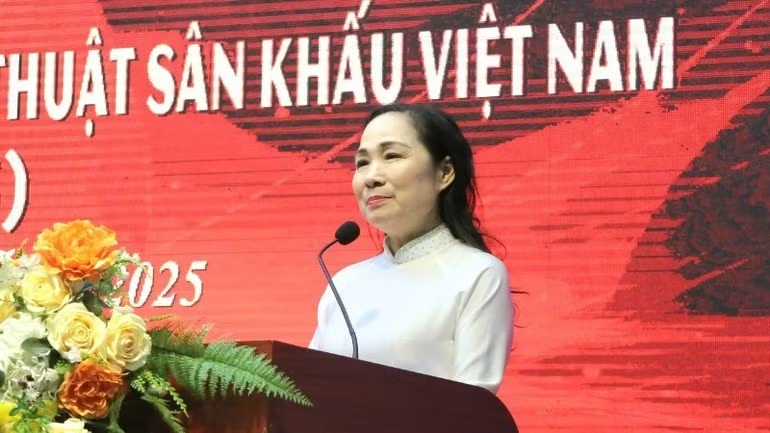
If the playwright is the one who conceives the script, the director is the one who gives birth to the play. Each director’s personal style greatly influences the artistic colour of a work. Watching the plays staged by People’s Artist Trinh Thuy Mui in the role of a “female general” of the stage, such as “Female King in Me Linh”, “Echoes of a Bygone Era”, “Crying Under the Blue Sky”, “Stars That Never Fade”, “The Crimson Peach Blossom”, “The Calligrapher”, and “The Burden of the Nation”, audiences can not only recognise her ability to explore diverse themes from history to contemporary life, but also the composure, mastery, and experience of someone deeply rooted in traditional cheo art.
Born in 1963, the female director does not seek to impress audiences through bold formal experimentation; instead, she chooses to conquer audiences by delving into the genre’s structure and the psychology of characters.
For instance, in the play “General Vo Nguyen Giap”, Trinh Thuy Mui moved audiences to tears through evocative “moments of silence,” particularly in the scene which depicts the general visiting wounded soldiers. There was almost no dialogue, only the actor’s gaze and quiet stillness, yet it was enough to stir deep emotions among viewers. In “Red Rain”, she created a cheo version filled with lyrical depth while still preserving the heroic spirit of a time of battle.
With her ability to select and weave together the most compelling details from a script, characters in her plays always have space to express inner conflicts and engage in dialogue with their times. As a result, the lyric, symbolic conventions, and stylised features of traditional cheo are preserved, while the works still carry a contemporary breath, offering audiences a fresh experience.
Trinh Thuy Mui studied stage directing while serving as Deputy Director of the Ha Noi Cheo Theatre. In her leadership role at an art unit, she realised the need to deepen her professional expertise in evaluating theatrical works. Since the success of her graduation play “The Love Story of the Missing Man”, she has officially devoted herself to stage directing.
Later, despite her busy roles as Director of the Ha Noi Cheo Theatre and currently as Chairwoman of the Viet Nam Theatre Artists’ Association and Vice Chairwoman of the Viet Nam Union of Literature and Arts Associations, she has continued to pursue her passion for stage creativity. Along with the Outstanding Director award at the National Cheo Theatre Festival in 2013 and the Dao Tan Prize for Outstanding Cheo Director, her directing talent has been affirmed through dozens of plays, many of which have won gold and silver medals at professional theatre festivals.
This may also explain why audiences often perceive a distinctive aesthetic flavour when watching the works directed by women: delicate, graceful, and meticulous in visual design and stage space organisation, yet still strong-willed and decisive.
This is clearly reflected in the directing style of People’s Artist Hoang Quynh Mai, who has earned deep respect within the theatre community through a series of plays across different forms, including “Ngu Bo Waterfront”, “The Sacred Sword Returned to the Divine Turtle”, “Sand dunes”, “A Fairytale Love Story”, “The Holy King of the Le Dynasty”, “Heaven’s Mandate”, “The Swan’s Robe”, “Nguyen Cam Ca–Kieu”, “The Loyal Minister”, “Three Movements of the Lord”, “The Fire of Phien Ngung”, “Devotion to the Nation”, and “Pure as Jade – A Noble Soul”.
Through these works, one can always see the carefulness and precision in storytelling and stage design of the female director born in 1968. Her stage space resembles a layered painting, where every colour, setting and detail is carefully calculated to guide the audience’s emotions.
Even when conveying historical stories, her works never feel outdated. She skilfully balances epic elements with modern aesthetic structures, incorporating new stage languages through movement, lighting, rhythm, and deeply expressive performances. As a result, the genre’s poetics remain intact while the overall production appears fresh and attractive.
Hoang Quynh Mai shared that when people first learned of her intention to pursue stage directing, many tried to discourage her because it is a demanding and exhausting path, especially for women. However, it seemed as though she had fallen under theatre’s spell and could never leave it. The more she worked, the more passionate she became, despite often being away from home, spending day and night in rehearsals and carrying the pressure of a play’s success or failure.
As the youngest Vietnamese folk opera female director to be awarded the title of People’s Artist and a highly sought-after name trusted by many art units, she still approaches every new script with the same mindset as when she first entered the profession. She constantly reminds herself to maintain youthful thinking and creative endurance. For her, each work is therefore a journey of dedication.
When staging “Imperial Concubine Diem Bich”, she travelled alone to Yen Tu several times in the bitter cold of winter to fully experience the sacred atmosphere of the Buddhist land. When seeking inspiration for “A Lifetime of Loyalty to Thang Long”, she visited Quan Thanh Temple many times, sensing the faint fragrance of magnolia blossoms and listening to the gentle chirping of crickets in Bach Thao Garden, gathering impressions and emotions to bring to the stage.
The well-deserved fruits of the persistent artistic labour of People’s Artist Hoang Quynh Mai include seven awards for Outstanding Director at professional theatre festivals and competitions, along with numerous gold and silver medals for her works.
As the chief coordinator of all creative aspects of a stage production, gender may contribute to a unique perspective in directing. However, it is talent, dedication, and tireless, serious artistic work that form the foundation on which directors establish their identities.
According to People’s Artist Hoang Quynh Mai, theatre does not favour any gender. The work of a director has only one common denominator: the work itself. Both audiences and professionals judge directors by the final result; just like a coach in a match, the most important thing is to lead the match to victory.