The guardians of traditional cultural spirit
In A Roang 1 Village (A Luoi 4 Commune), village elder A Viet A Lia is now over 75 years old. His hair has turned completely white and his sinewy hands bear the marks of time, yet every week he carefully takes out the village’s treasured gong set to clean and tune it. To him, gongs are not merely musical instruments, but the soul of the village. “As long as the gongs remain, the village remains,” he says. From the new rice festival, weddings, rituals to honour Giang (the supreme deity), to farewell ceremonies for those returning to their ancestors, the sound of gongs is the thread that connects people with deities, the land and the heavens.
Elder A Viet A Lia recalls that there was a time when, due to hardship, many gong sets were sold in exchange for rice and salt. He went from house to house persuading villagers to keep their gongs, teaching the younger generation how to play them with the right rhythm and spirit. “If you play it wrong, Giang will be sad,” he says with a gentle smile. Today, the village gong team not only serves ritual purposes but also performs at cultural festivals at commune, district and city levels.
Not far away, whenever one passes through A Roang 2 Village (A Luoi 4 Commune), the melodies of khen panpipes and the sound of gongs resonate through the forest, created by artisan A Mu (67), a renowned maker of traditional musical instruments of the Co Tu ethnic minority people. Pieces of bamboo and wooden sticks, seemingly lifeless, are transformed by his hands into khen panpipes, flutes and gongs imbued with spirit. He says he has followed this craft all his life as if answering a promise to his ancestors: “Since I was a child, I’ve been fascinated by the sound of instruments; whenever I hear the khen, my blood seems to dance along.” Yet that passion is accompanied by a deep concern: few young people today take up the craft, and traditional instruments are gradually being lost.
In recent years, besides making instruments for tourists, artisan A Mu has opened free classes for young people in the commune. Each afternoon, the sound of khen blends with birdsong and echoes throughout the valley. These khen panpipes, gongs and cymbals are not merely instruments; they are memories and the rhythm of community life. A Viet Tu, one of A Mu’s students, says: “Without teacher Mu, I would never have known that I could play the khen or learn the traditional songs of my own people.”
Spreading Co Tu cultural values
Nearly 80 years old, village elder Cu Lai – Nguyen Hoai Nam – from PaRing – Can Sam Village (formerly Hong Ha Commune, now A Luoi 5 Commune) continues tirelessly on his journey to preserve, teach and spread the culture of the Co Tu ethnic people in this highland area. The local people are deeply familiar with the sound of gongs and drums and the dances led by elder Cu Lai.
Having worked for many years in grassroots cultural services and later as Secretary of the Party Committee of Hong Ha Commune, he clearly understands the situation and the urgent need to preserve the culture of A Luoi’s highland communities amid development and integration. He is the one who teaches traditional folk songs, music and dances not only of the Co Tu people but also of the Ta Oi, Pa Co and Pa Hy communities here.
Elder Cu Lai has always cherished the desire to pass on folk songs, dances and music of the Co Tu, Pa Co and Pa Hy peoples to younger generations. A fortunate opportunity later allowed him to connect with a university to open a musical instrument class for more than ten local residents. Together with other elders, he continued to organise classes to teach folk songs and dances to young people in the area. As a result, many have become proficient in playing instruments such as panpipes, flutes, horns, gongs and cymbals. Many young people have also come to know the dances and lyrics of their own ethnic heritage.
For many consecutive years, the cultural movement in Hong Ha was widely recognised, with regular performances at festivals and events in various localities. Some artisans who were once taught by elder Cu Lai now continue to teach younger generations themselves. This is the great joy and fulfilment of preserving and transmitting culture that he has always hoped for. In 2019, he was honoured with the title of Meritorious Artisan in the field of folk performing arts, awarded by the President. Many of his outstanding students have also been recognised as Meritorious Artisans, such as Ho Thi Tu (Pa Co ethnicity) and Nguyen Tien Doi (Co Tu ethnicity).
“Living Treasures” in the flow of modern life
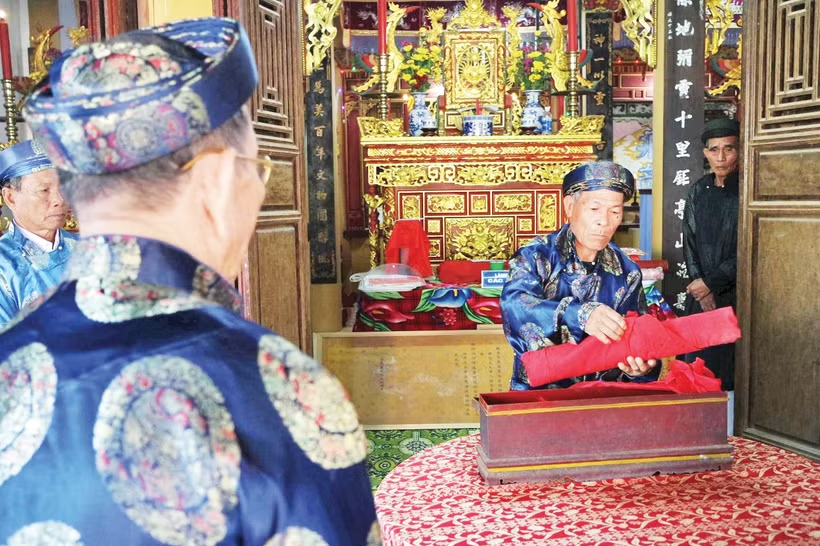
In villages of the former Hong Thuong Commune (now A Luoi 3), mentioning A Viet Dhung brings immediate recognition of a man regarded as a “living repository” of Pa Co folk knowledge. He knows by heart dozens of ancient ritual chants and has deep understanding of customs and customary laws. Dhung explains: “Performing spiritual rituals teaches people to respect nature and live in harmony with the mountains and forests. Each ritual contains lessons on morality and community conduct.”
Fearing that such knowledge might be lost, he has worked with local cultural officials to record the chants and explain each line. He also teaches his descendants, despite knowing that preserving such traditions is not easy in modern times. “As long as there are people who understand, culture remains alive,” he says.
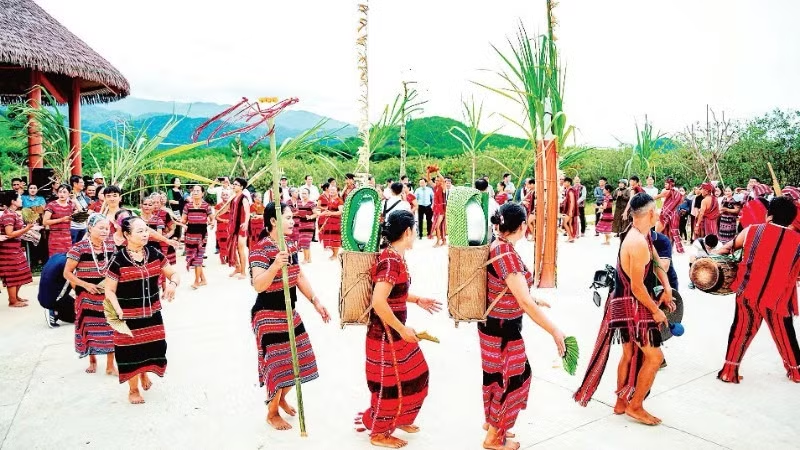
In the home of village elder Ho Van Hanh in A Nieng Le Trieng Village (A Luoi 1 Commune), the space is filled with traditional musical instruments, which he considers his greatest legacy. On that day, his house was crowded with young men and women from the village. Dressed in traditional attire, they stood in formation under his guidance. Then, the movements of traditional dances and songs began to rise in rhythm.
Elder Hanh proudly says: “I have opened two training classes (with 14 members) for children and young people, teaching traditional dances and songs such as ca loi, cha chap and ba boi, instructing them in gong playing, horn blowing, preserving language, writing, costumes and distinctive decorative patterns of our people, to serve traditional festivals like the new rice celebration and the buffalo-stabbing festival.”
Elder Ho Van Hanh is known as a “living treasure” amid the great forest – a folk cultural artisan honoured with the title of Meritorious Artisan by the President in 2019. Despite his advanced age, his strength and agility rival those of much younger men. His steps are swift, his voice deep and passionate. For many years, he has tirelessly passed on the distinctive cultural values of his people to younger generations in villages, communes and localities along the Truong Son range.
In the flow of renewal and change, village elders, artisans, ritual masters, gong players and instrument makers are the true “living treasures”. They do not merely preserve memories; they serve as bridges between past and present. What is most precious is that many of them do not keep culture to themselves, but are willing to teach, share and adapt so that culture may continue to live within a new way of life.