Under Project 6, “Preserving and promoting the fine traditional cultural values of ethnic minority groups in association with tourism development”, part of the National Target Programme for socio-economic development in ethnic minority and mountainous areas for the 2021–2030 period (phase one from 2021 to 2025), cultural efforts have yielded many practical results.
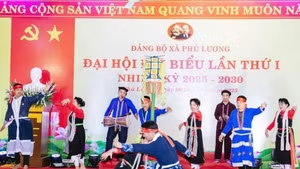
In many localities, festivals, traditional folk melodies and handicrafts have been restored, helping to enrich spiritual life and stimulate community-based tourism. Culture is not only being preserved; it is also becoming a development resource, a bond that connects people to their homeland and their ethnic identity.
However, in many remote, isolated, border and island regions where socio-economic conditions remain difficult, the work of preserving and promoting cultural values requires sustainable approaches and coordinated efforts across all levels and sectors.
Thanks to national target programmes, many localities have received support to conduct research, restore traditional spaces and develop distinctive cultural and tourism products. Yet, beyond this initial phase, what matters most is maintaining and promoting these values within community life.
According to many experts and administrators, cultural promotion at the grassroots level in the nation’s frontier areas faces obstacles due to the lack of specific mechanisms and stable resources. Current funding is largely concentrated in the initial stage, suitable for restoration, while long-term sustainability and development require localities to proactively allocate budgets and link management responsibilities with efforts to preserve and disseminate cultural values in everyday life.
Notably, after the implementation of the two-tier government model, competent agencies need to issue documents establishing a legal framework from central to local levels to ensure unified implementation of this mandate.
Another challenge lies in the shifts within population structure. Young people—the generation expected to inherit cultural identity—are leaving traditional cultural spaces. Many ethnic minority youths who pursue education or employment seldom return to their hometowns. This situation raises the risk of cultural continuity being disrupted.
The reality shows that every ethnic group has its own identity, in which culture is the spiritual strength that helps communities hold fast to their land, protect their villages and defend national sovereignty. Culture can only endure when it is nurtured both by its creators and by local communities. Therefore, cultural preservation cannot be separated from educating and training younger generations, instilling an early awareness of cultural inheritance.
Recently, a series of inter-level boarding schools for ethnic minority pupils at primary and lower-secondary levels have been and are being built in 248 border communes. This is not only a major educational initiative but also a strategic cultural step—provided that traditional cultural content is integrated into the curriculum of these schools. Border-region students will thereby be nurtured in love for their homeland, national pride and an awareness of safeguarding their cultural identity from an early age.
When younger generations clearly understand their role as inheritors, and know how to cherish and carry forward the cultural values of their ethnic groups, they will become the keepers of the flame, allowing traditional culture to thrive vibrantly in daily life. At that point, every song and every dance will truly form the foundation that strengthens border regions.