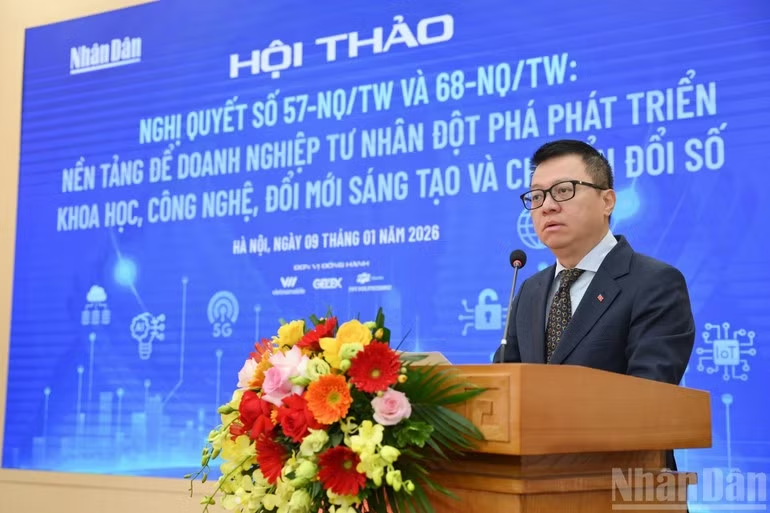
Under the draft documents of the 14th National Party Congress, national digital transformation is defined as a comprehensive revolution, with the goal that by 2035 the digital economy will account for more than 40% of GDP, and that 10 to 15 “Make in Viet Nam” digital technology groups will be formed to lead the innovation ecosystem.
Alongside this, many private enterprises are expected to pioneer the application of artificial intelligence, big data, blockchain, and fintech in order to boost productivity and engage more deeply in global supply chains.
Private enterprises at the heart of the innovation ecosystem
Reality shows that science and technology, innovation, digital transformation, and the private economic sector are closely mutually reinforcing. Many large-scale private enterprises have invested heavily in research and development and new technologies, thereby creating jobs for millions of workers. In parallel, the 15th National Assembly has promptly improved the relevant legal framework, providing a coherent and transparent legal foundation that helps private enterprises be confident in making long-term investments.
Comrade Le Quoc Minh, Member of the Party Central Committee (PCC), Editor-in-Chief of Nhan Dan Newspaper, Deputy Head of the PCC’s Commission for Communication-Education and Mass Mobilisation, and President of the Viet Nam Journalists Association, said the Party identifies the private economy as one of the most important driving forces of the national economy. Together with the state economy, it can create breakthroughs in innovation and the development of the digital economy, green economy, and circular economy, integrate deeply into global value chains, and realise the aspiration for a prosperous and happy country.
At the seminar “Resolution No. 57-NQ/TW and Resolution 68-NQ/TW: A foundation for private enterprises to make breakthrough progress in science, technology, innovation and digital transformation” recently held in Ha Noi, Dr Nguyen Hien Phuong, Chief Executive Officer of Vietnamobile, said that Resolution No. 57-NQ/TW and Resolution No. 68-NQ/TW — when positioned within the broader set of major Party directions and the new legal system — have opened up a policy space that is both coherent and breakthrough-oriented for the private sector.
For Vietnamobile, a telecommunications enterprise outside the state sector, this is not only an opportunity to affirm its role in the national digital infrastructure, but also a driver for strong reforms in its business model, governance, and technology to adapt to the new development phase.
Fintech and challenge of expanding financial access

From the experience of a major financial technology enterprise, Nguyen Ba Diep, MoMo’s founder, said fintech is becoming one of the important drivers of economic growth in many countries, including Viet Nam.
According to Diep, combining big data, artificial intelligence, blockchain, and cloud computing has enabled fintech to offer financial services in ways that are more transparent, efficient, and significantly lower-cost than traditional models.
He stressed that fintech’s biggest highlight is its ability to expand financial access for groups that previously found it difficult to access banking services, such as small household businesses, freelance workers, and low-income earners in rural areas. Access to payment, savings, and lending services via smartphones not only improves social welfare, but also stimulates consumption, expands business activity, and directly contributes to GDP growth.
“Viet Nam’s four technology companies that once reached unicorn status are all fintech enterprises. That shows the special role of this sector in the national innovation ecosystem,” Nguyen Ba Diep emphasised.
However, for technology enterprises to accelerate, he said strong enough policy levers are needed — especially cutting administrative procedures, unlocking capital flows, completing the legal framework, and developing high-quality human resources.
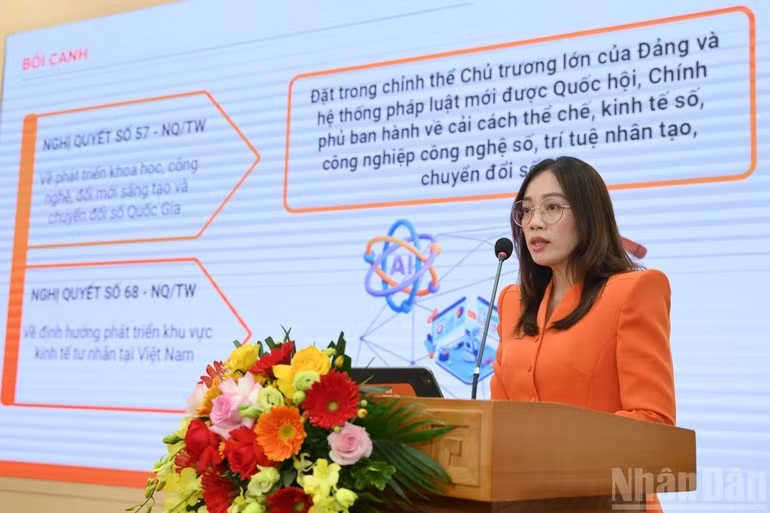
From the perspective of a major technology group, Dang Tung Son, Vice Chairman, Senior Vice President, and Chief Strategy Officer of CMC Technology Group, affirmed that Resolutions 57 and 68 are two strategic pillars of national digital transformation. “If Resolution 57 identifies science and technology, innovation, and digital transformation as drivers of growth, Resolution 68 makes clear that the private economy is the pioneering force to realise that driver,” Son said.
According to him, Viet Nam’s economy is entering a fundamental transition —from a growth model based on natural resources and cheap labour to one based on knowledge, technology, and innovation. In that process, private enterprises — especially small and medium-sized enterprises — are the dynamic force that is willing to take risks and capable of turning ideas into substantive economic value.
A strong backing needed for digital transformation
From the state management perspective, Nguyen Tat Thai, Deputy Head of the Department of Forecasting, Statistics and Monetary and Financial Stability under the State Bank of Viet Nam, said the banking sector has been translating the spirit of Resolutions 57 and 68 into a series of coherent financial and credit policies.
According to Thai, maintaining macroeconomic stability, controlling inflation, and ensuring the safety of the banking system are prerequisites for enterprises to confidently make long-term investments in science and technology and digital transformation.

The State Bank of Viet Nam has introduced a controlled trial mechanism — a sandbox — in banking, creating a legal corridor for fintech solutions such as peer-to-peer lending, data-driven credit scoring, and data sharing via Open API. In parallel, it has provided 100% of administrative procedures in the form of online public services, helping save enterprises thousands of billions of VND in compliance costs. Notably, outstanding credit to the private sector currently accounts for more than 92% of total outstanding credit across the economy, underscoring the central role of this sector in the development strategy.
From an academic perspective tied to business experience, Dr Nguyen Nhat Quang, Vice President of VINASA (Viet Nam Software and IT Services Association), said innovation has long been “in the DNA” of private enterprises. “Private enterprises must innovate continuously to survive. Today they sell this product, tomorrow they move to another; today they produce in one way, tomorrow they improve to cut costs. The smaller the enterprise, the stronger the innovation drive,” Quang analysed.
In his view, the issue is not the spirit of innovation, but the level of science and technology and the capacity to access digital technology. Small and medium-sized enterprises often lack the knowledge to choose appropriate technologies and lack the capital to invest in upgrades.
Quang said the spirit of Resolutions 57 and 68 needs to be integrated closely, with the State playing a supporting role through technology innovation funds, loan guarantee mechanisms, and interest-rate support for technology investment projects that can raise productivity, reduce emissions, and strengthen competitiveness.

Nguyen Thi Thanh Thuc, Chairwoman of AutoAgri, candidly pointed to a major bottleneck being intellectual property. Without protection for inventions and innovations, she said, all efforts to innovate risk being undermined. Complex procedures, a lack of transparent data, and a backlog of applications stretching for years are discouraging many enterprises and inventors.
Thuc also stressed the gap between policy and implementation, especially at the grassroots level, where many officials do not fully understand digital transformation, traceability, or cultivation area codes — leading to hesitation and a reluctance to act. “If resolutions are to take effect in real life, those implementing them must first understand — and dare to act,” she said.