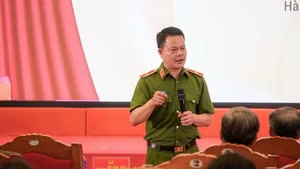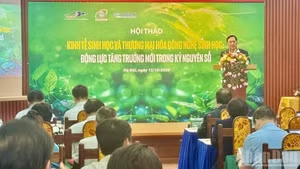
Le Thanh Tung, Head of the Knowledge Dissemination Department of the Viet Nam Union of Science and Technology Associations, said that communication and knowledge dissemination activities remain fragmented and uncoordinated. In some places, knowledge dissemination still relies heavily on one-way communication, while the ability to transform specialised knowledge into easy-to-understand content remains limited. Many units do not have dedicated staff, while funding is limited and their capacity to invest in technology, produce modern communication products, and measure effectiveness remains low.
In addition, the new information environment is creating unprecedented challenges. Generative artificial intelligence, social media, and content-distribution algorithms enable knowledge to spread rapidly, but they also allow fake news, misinformation, and unscientific content to proliferate at an alarming rate.
Notably, many organisations, such as the Viet Nam Union of Science and Technology Associations, possess extensive pools of experts and knowledge, but their capacity to standardise data, digitise, classify, search, share, and reuse content remains limited. Shared databases and digital content repositories are not commensurate with the potential of the system.
Drawing on practical experience in biodiversity conservation, Trinh Le Nguyen, Director of the People and Nature Reconciliation (PanNature), said that the Viet Nam Union of Science and Technology Associations serves as a gathering place for scientific intellectuals to participate in research, knowledge dissemination, consultancy, social criticism, and assessment. However, the number of people directly working in biodiversity conservation remains relatively small. Therefore, evidence-based communication needs to be strengthened so that nature conservation issues can be presented in easy-to-understand language and directly linked to the country's daily life, economy, and security.
Knowledge dissemination activities must move beyond the framework of “communicating information,” and focus on developing the public’s capacity for lifelong learning, scientific literacy, digital literacy, and proactive adaptation to rapid technological changes.
According to Ho Dinh Luong, Chairman of the Phu Tho Union of Science and Technology Associations, it is necessary to shift from disseminating academic knowledge to providing commercially applicable solutions for localities, renew communication methods, and carry out comprehensive digital transformation in the dissemination of science and technology knowledge. Digital-platform applications and artificial intelligence should be adopted, while cooperation to connect knowledge domestically, regionally, and globally should be strengthened to build reliable and accurate scientific databases, giving localities additional open data resources for research, academic exchange, and practical application.
In the new period, knowledge dissemination activities must move beyond the framework of “communicating information,” and focus on developing the public’s capacity for lifelong learning, scientific literacy, digital literacy, and proactive adaptation to rapid technological changes.
Dr. Tran Van Tung, Chairman of the Viet Nam Association for Science and Technology Information, said that communication channels must be diversified, with greater efforts made to disseminate scientific and technological knowledge through digital platforms, social media, podcasts, and short videos using simple, easy-to-understand language. Knowledge should be brought into production, with programmes organised to connect knowledge directly with rural and remote areas, supporting local farmers and businesses in applying technological advances to daily life.
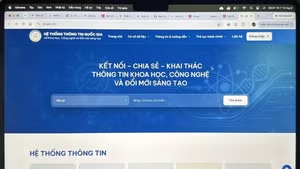
With its functions and responsibilities, the Viet Nam Association for Science and Technology Information has always worked alongside the Viet Nam Union of Science and Technology Associations to disseminate scientific and technological knowledge and information by organising conferences, seminars, and scientific forums, developing specialised digital libraries, open knowledge portals, and organising and implementing massive open online courses.
Communication channels need to be diversified, with greater efforts made to disseminate scientific and technological knowledge through digital platforms, social media, podcasts, and short videos using simple, easy-to-understand language.
Dr. Tran Van Tung
Chairman of the Viet Nam Association for Science and Technology Information
The Viet Nam Union of Science and Technology Associations currently has numerous press agencies and scientific journals, which could form a specialised science communication network if their potential were effectively harnessed.