With the RoK’s accumulated investment capital reaching nearly 100 billion USD to date and bilateral trade standing at around 90 billion USD, the economic relationship between the two countries is entering a phase of profound, higher-quality development.
Viet Nam is prioritising the development of emerging fields such as semiconductors, artificial intelligence (AI), clean energy, and the green transition, which are expected to offer significant potential for expanding cooperation with Korean partners.
Beyond attracting capital, Viet Nam is proactively transforming itself from a manufacturing destination into a regional hub for innovation and technology development.
Viet Nam is aggressively accelerating institutional reforms, improve the investment and business environment, develop digital infrastructure, and a high-quality workforce, while promoting strategic technology sectors.
Meanwhile, the RoK, with its strengths in technology, research and development capabilities, and a globally recognised innovation ecosystem, serves as a vital partner for Viet Nam in effectively harnessing opportunities in these areas.
As Korean technology groups step up investment in Southeast Asia to diversify supply chains and capitalise on cost advantages, Viet Nam, with its strategic location and abundant workforce, remains a key destination in this strategy.
After years of successful business operations, major Korean companies such as Samsung Electronics, SK Group, POSCO, and Hanwha Group are expanding their presence in Viet Nam, moving beyond manufacturing towards high technology, energy, and strategic infrastructure.
Businesses within LG Group are accelerating the expansion of their production operations in Viet Nam, alongside large-scale recruitment plans to meet growing global orders, particularly in high-tech sectors.
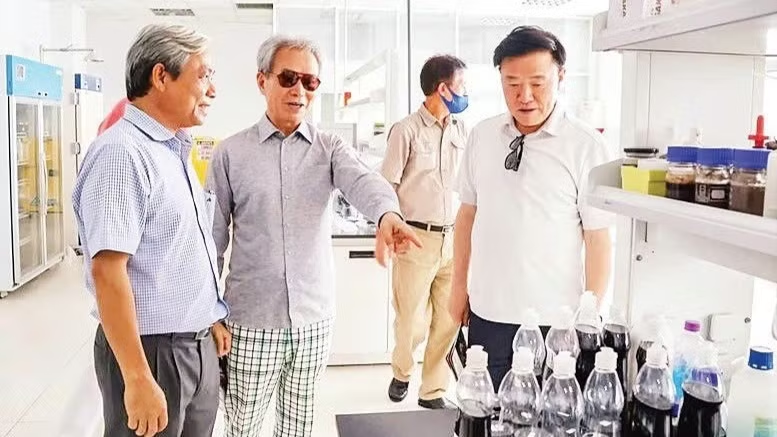
Commenting on the potential for bilateral cooperation, Kwon Sung Taek, Vice Chairman of the Korea–Viet Nam Economic and Cultural Association (KOVECA), noted that while economic relations between the RoK and Viet Nam had developed vertically over the past 30 years, led by major companies such as Samsung, LG, Hyosung, and Hyundai Motor, cooperation would shift horizontally over the next 30 years, with stronger participation by small and medium-sized enterprises (SMEs) from both countries, thereby laying the foundation for more robust, higher-quality growth in bilateral economic relations.
Cooperation among SMEs has the potential to transcend component supply chains to include technology transfer, joint ventures, and digital transformation.
Key opportunities include assisting highly skilled Korean SMEs localise and upgrade their supply chains through cooperation with Vietnamese companies, thereby strengthening the self-reliance of Vietnamese enterprises while enabling Korean companies to secure their global production bases.
According to Kwon Sung Taek, stronger cooperation between the two sides would propel promising companies into global unicorns through joint research and development, combining the RoK’s planning capabilities with Viet Nam’s infrastructure and human resources to facilitate technology transfer between businesses in the two countries.
Korean SME brands in sectors such as cosmetics and food also have opportunities to connect directly with Vietnamese consumers through the rapidly growing e-commerce market.
Kwon Sung Taek likened the major conglomerates that paved the way to the main arteries, while SMEs are the capillaries that help connect and spread value throughout the economy.
In particular, the participation of Korean IT companies in the digital transformation of Vietnamese SMEs stands as a highly effective model of cooperation.
According to the KOVECA Vice Chairman, cooperation among SMEs can be regarded as a key pillar in transforming Viet Nam–RoK relations from quantitative growth towards qualitative advancement.
Viet Nam–RoK bilateral relations face enormous opportunities and potential to shift from production cooperation towards a technology and innovation partnership.
The two countries are entering a new phase of cooperation, in which technology, innovation, and strategic trust are becoming new drivers for the substantive and effective development of their comprehensive strategic partnership.

![[Infographic] Comprehensive strategic partnership between Viet Nam and Denmark](https://en-cdn.nhandan.vn/images/SCsTDAWshkugd_CR7euN3dJE8R5tBjXTeI_Ei3N1rqlMQ51GV2YGcjvxpQFD7-NjQniu1tgyhNBVDsDJmLSxVpkf6BzifI5ne9fyVawgZKkw1QSqvshBTU8QQcE1uc2tD2kFaBWIxM59QGKFzthJwQ/comprehensive-strategic-partnership-between-viet-nam-and-denmark-8462.png.avif)