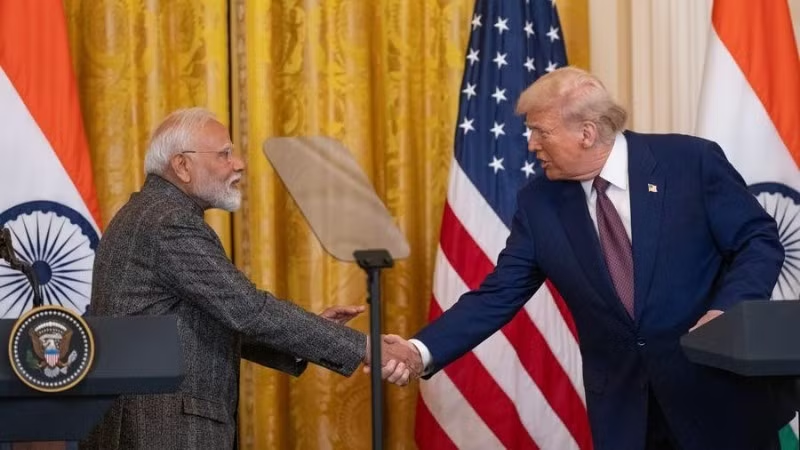
The deal also serves as a test of the South Asian nation’s ability to strike a balance between economic interests and political and diplomatic pressures in an increasingly unpredictable world.
One of the most notable and controversial aspects of the recent India-US trade agreement is India’s commitment to stop purchasing oil from its long-standing partner Russia. In return, Washington has agreed to reduce reciprocal tariffs on Indian goods to 18%.
This provision exposes the complex realities behind a trade deal that officials on both sides have hailed as opening a new chapter in US-India relations.
From a commercial perspective, the agreement clearly strengthens India’s position within the global trading system and creates new opportunities for businesses in both countries.
The Federation of Indian Export Organisations (FIEO) has described it as the greatest agreement ever and predicted that exports will soon see a surge in orders.
However, the path to the US-India trade agreement was far from smooth. Both sides had to gradually adjust their positions and policies amid competitive pressures and political considerations.
India reached the agreement relatively late, after many other countries had already struck deals with the US, largely because it refused to open its agricultural market to American products. This prompted concerns among investors, with some foreign investment funds withdrawing more than 20 billion USD from the Indian market.
Moreover, according to international observers, India no longer enjoys the same benefits from buying Russian oil as it did in 2022, when discounts ranged from 15 to 20 USD per barrel. Today, the discount is around 5 USD.
India’s adjustment of its energy supply sources is therefore not merely a concession to intense US pressure, but is widely seen as a strategic choice aimed at reducing risks and balancing relations with multiple partners amid fierce competition among major powers.
The South Asian country is actively pursuing a policy of partner diversification, as evidenced by the free trade agreement with the European Union reached after nearly 20 years of negotiations.
From the US perspective, President Donald Trump argued that restricting Russia’s oil revenues would increase pressure on Moscow and help bring the conflict in Ukraine to an earlier end.
Washington’s strategic shift in its trade relations with India is also driven by New Delhi’s growing influence on the international stage. The EU and the United Kingdom have already signed trade agreements with India, prompting the US to act so as not to fall behind in global competition.
Despite being welcomed by officials and businesses in both countries, the US-India trade agreement still contains many vague and unclear elements. Numerous questions remain unanswered.
Analysts have raised doubts over the details of India’s plan to purchase more than 500 billion USD worth of US goods, a figure mentioned by President Trump.
Ajay Srivastava, Director of the Global Trade Research Initiative, has pointed out that India currently imports less than 50 billion USD worth of goods from the US each year, making the 500 billion USD figure appear more aspirational than a concrete commitment.
The scale of reductions in India’s imports of Russian oil has also yet to be disclosed.
Credit rating agency Moody’s has previously noted that it would be extremely difficult for India to halt Russian oil purchases completely and immediately, as doing so could disrupt the country’s economic growth.
The US-India trade agreement thus represents a test of New Delhi’s ability to balance economic interests with diplomatic and geopolitical pressures, while also reflecting Washington’s approach to what it has termed “tariff diplomacy”.