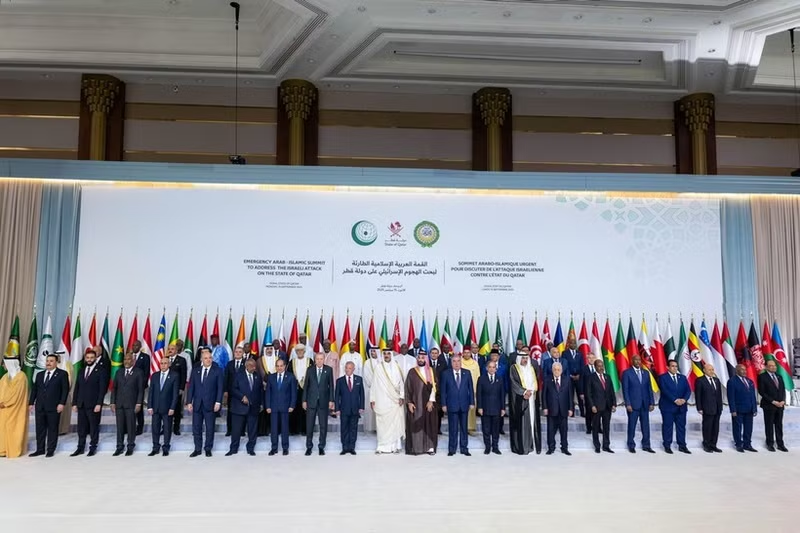
For the first time in nearly 40 years, OIC ministers gathered in Istanbul to discuss ways to promote the importance of transport, one of the “backbone” sectors of regional economic development. Chairing the second OIC Conference, Turkish Minister of Transport and Infrastructure Abdulkadir Uraloglu affirmed that transport has emerged as a fundamental pillar not only of economic development but also of humanitarian solidarity and the region’s overall resilience in the face of crises.
He highlighted two key corridor initiatives: the Middle Corridor, running between Asia and Europe, considered one of the shortest, safest, and most cost-effective routes in connecting Gulf countries with the two continents.
Meanwhile, the Development Road Project aims to establish a new east-west and north-south connection from the Gulf through Turkey to Europe via uninterrupted road and rail routes, with the goal of reducing transport time and costs.
He also introduced Turkey as an indispensable link in the global logistics network, noting that Ankara has invested more than 355 billion USD in transport and communications infrastructure over the past 23 years. To realise these initiatives of regional connectivity corridor development, the conference proposed establishing a Road Transport Centre under the OIC’s auspices, expected to be submitted at the next ministerial meeting in 2028.
Economic relations between the European Union (EU) and the Gulf Cooperation Council (GCC) have long been promoted through multilateral and bilateral cooperation frameworks. Although negotiations on the EU-GCC Free Trade Agreement (FTA), initiated in the 1990s, were suspended in 2008 due to irreconcilable differences in ambition, cooperation between the two sides has continued through initiatives such as the EU-GCC Dialogue on Trade and Investment (2017) and the EU-GCC Dialogue on Economic Diversification (2019). The EU has always maintained a positive trade balance with all Gulf countries. The EU-GCC investment picture is quite diverse, with 22% of the 80 bilateral investment agreements of the GCC being with EU member states.
The EU’s stable economy is an important factor amid the situation of global uncertainty and rising protectionism. Thanks to its market strength and regulatory consistency, the EU remains a reliable, rules-based partner in an era of global tariff volatility. Meanwhile, multilateral cooperation remains feasible in promoting trade and economic stability, including regulatory harmonisation in key areas such as transport. The EU’s role in the Red Sea through Operation Aspides, with the task of protecting commercial shipping, also signals its commitment to an issue of top importance to GCC countries.
EU-GCC cooperation is being promoted in many fields such as energy, climate change mitigation, people-to-people exchanges, humanitarian aid and development, as well as security and regional issues. In today’s volatile world, both sides place increasing importance on strengthening cooperation. Gulf countries are key energy partners of the EU, serving as major suppliers of oil and natural gas to Europe.
At the same time, Gulf states are accelerating integration plans and attracting strong participation from international enterprises, including European businesses, into the Gulf markets in order to diversify their economies and reduce dependence on oil. Improved cooperation in road transport and the prospect of integrating rail and expressway networks are expected to facilitate the transport of goods between the two sides.
Diversifying connectivity corridors among OIC member states will benefit the entire region by enhancing integration into the global trade system. Meanwhile, strengthening transport connections between Gulf countries and Europe will help connect the two regions more closely, creating an important foundation for strategic cooperation areas.