With the safety valve stopping working, the legal constraints on the two powers’ nuclear arsenal development have been lifted. The world is now facing the risk of a new arms race, with unpredictable consequences.
Signed in 2010, New START set limits on the development of Russia’s and the US’s nuclear arsenals. Under the treaty, each side was allowed to deploy no more than 1,550 strategic nuclear warheads and no more than 700 delivery vehicles, including intercontinental ballistic missiles, submarine-launched ballistic missiles, and heavy strategic bombers. New START also enabled Washington and Moscow to exchange data regularly and conduct on-site inspections to ensure compliance.
After the US successively withdrew from the Anti-Ballistic Missile Treaty and the Intermediate-Range Nuclear Forces Treaty, New START became the final barrier restraining the development of strategic weapons by Russia and the US. Despite disruptions and incomplete implementation amid bilateral geopolitical tensions, the treaty remained the only instrument that helped sustain a degree of confidence between the two nuclear powers.
New START’s expiration does not mean the world will immediately slip into a new arms race. However, its end means that, for the first time since the early 1970s, there is no mechanism to control the nuclear arsenals of Washington and Moscow. Russia and the US are no longer obliged to adhere to limits and transparency requirements regarding the size of their nuclear arsenals.
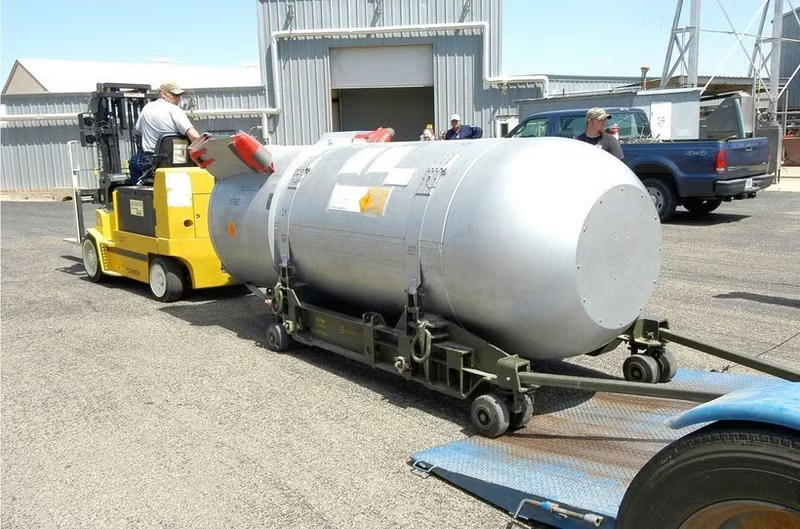
Russia and the US are the world’s two largest nuclear powers by warhead numbers. Holding around 90% of the world’s nuclear warheads, Moscow and Washington hold the most crucial key to keeping the world safe from the dangers posed by these weapons of mass destruction. Therefore, New START’s expiry creates a gap in the legal framework for nuclear arms control — potentially opening the way for a new nuclear race that could be more dangerous and harder to contain than during the Cold War.
Before New START expired, Russia proposed that both sides continue observing the treaty’s warhead limits for an additional year. Dmitry Medvedev, Deputy Chairman of Russia’s Security Council, stressed that the treaty remained an important foundation for building trust between the two powers.
Washington, meanwhile, showed little enthusiasm for the proposal. US President Donald Trump has leaned towards seeking a new arms control agreement that would involve more than just the US and Russia. Analysts, however, say that negotiating and concluding a new multilateral treaty will not be easy.
Since the end of the Cold War, the international community has made notable progress in curbing nuclear proliferation and managing the risk of nuclear conflict. Even so, according to the Stockholm International Peace Research Institute (SIPRI), while the number of deployed nuclear weapons has fallen sharply from Cold War levels, the world still has more than 12,000 nuclear warheads. More than half of the world’s population lives in countries that possess nuclear weapons or belong to nuclear alliances. Worryingly, progress on nuclear disarmament agreements has largely stalled, increasing the risk of global security instability.
UN Secretary-General António Guterres has repeatedly warned that nuclear risk is now at an alarmingly high level, and that miscalculation or escalation could lead to catastrophic consequences. Against this backdrop, experts are urging the international community to support global efforts on disarmament and non-proliferation, while ensuring the right of all countries to develop and use nuclear energy for peaceful purposes.