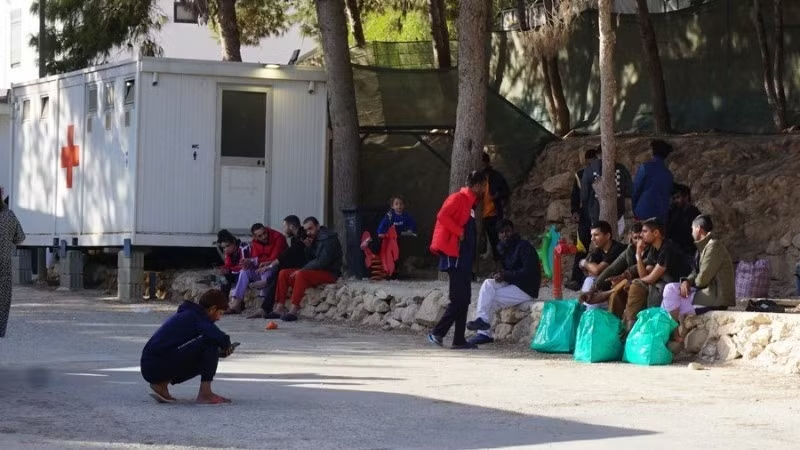
As conflict in the Middle East continues to escalate, European countries are becoming increasingly determined to erect firm “breakwaters” against a looming migration surge — one that carries potential risks to security and social welfare systems.
A shift in the governance mindset of European leaders regarding migration is becoming evident. In the first three months of 2026, a series of policy decisions at both national and regional levels signalled a tougher approach towards irregular migration. Migration is no longer viewed solely as a humanitarian issue but is increasingly considered a critical component of broader policies aimed at safeguarding national security and social stability.
For example, Italy’s right-wing government proposed tightening migration regulations in February 2026, granting ministers the authority to ban sea arrivals in exceptional circumstances.
In Germany, the Bundestag approved a domestic plan to reform the Common European Asylum System (GEAS), aimed at strengthening control and improving the management of irregular migration. At the regional level, the European Parliament (EP) adopted a new list of safe countries for the return of irregular migrants, alongside the establishment of migrant reception centres in third countries.
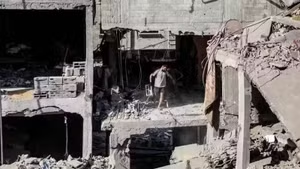
A decade after the severe migration crisis of 2015–2016, the haunting memories of that turbulent period are resurfacing and threatening the Old Continent once again. German media have warned that if the conflict in the Middle East drags on, a humanitarian crisis could threaten Iran and neighbouring countries, potentially triggering migration flows similar to those seen in 2015.
In recent years, Iranians have consistently ranked among the largest groups applying for asylum in Europe. The cycle of conflict in the Middle East is exposing Europe’s vulnerability to overlapping pressures stemming from the energy crisis, economic volatility, and a series of security challenges, including the possibility of military retaliation, migration waves, and the threat of terrorism.
Europe now faces a paradox: it needs migrant labour to fill workforce shortages as its population ages rapidly and birth rates decline, yet anti-immigration sentiment continues to simmer across many countries in the region. In such an environment, even a single violent incident can be enough to ignite strong opposition.
In reality, far-right parties advocating anti-immigration agendas are gaining increasing momentum. Recently, the European Commission (EC) officially unveiled a new counter-terrorism agenda named ProtectEU. The move carries significant importance as the conflict in the Middle East spreads and Europe becomes a potential target for terrorist and extremist groups that are adopting increasingly sophisticated methods of operation.
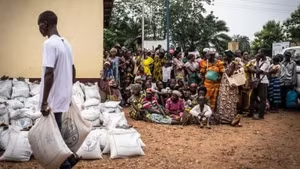
The European Union’s new Pact on Migration and Asylum will come into force in June 2026. Although regarded as a historic step forward in addressing migration challenges, the pact has also sparked considerable controversy. Human rights organisations argue that accelerating screening procedures, expulsions, and repatriations may undermine the right to seek asylum for people fleeing war and poverty who are entitled to protection under international law.
Geography also remains a critical factor. Traditional entry points for irregular migrants such as Greece, Spain, and Italy will inevitably face significant pressure in receiving migrants, processing asylum applications, and returning those whose claims are rejected.
Irregular migration remains a persistent challenge, placing Europe in a difficult balancing act between international humanitarian obligations on the one hand and the responsibility to ensure security, stability, and social welfare on the other.
Nevertheless, in the face of the very real threat of a large-scale migration wave from conflict zones in the Middle East, rising domestic political pressure, and the lessons drawn from the historic migration crisis of 2015, European governments are compelled to proactively build “breakwaters” to protect their nations and the region as a whole.