However, in light of the dramatic shifts in the global geopolitical landscape, the need for reform within the planet’s largest multilateral organisation has become more urgent than ever. In this context, the United Nations General Assembly has just adopted a landmark resolution, laying the foundation for a comprehensive reform process.
The General Assembly resolution, considered “historic,” not only affirms the commitment to enhancing the organisation’s effectiveness but also helps to address long-standing bottlenecks.
In fact, since 1946, the United Nations has adopted more than 40,000 resolutions, decisions, and declarations, contributing to addressing a range of global challenges related to humanitarian issues, development, peace, security, and human rights.
According to the United Nations, the enormous workload mentioned above also puts this multilateral organisation in a difficult position, with many tasks overlapping or duplicating, and the number of reports and meetings increasing, burdening the entire system.
With the new resolution, for the first time, the United Nations has proposed a comprehensive approach throughout the mission’s “lifecycle”, optimising each link in the chain of activities, from design and implementation to evaluation of results.
This is a significant milestone in the implementation of the UN80 Initiative, launched a year ago, aimed at creating comprehensive changes to make the United Nations operate more efficiently, transparently, and flexibly, thereby strengthening its central role in global governance. UN Secretary-General Antonio Guterres assessed that the resolution demonstrates the shared commitment of members to translate the UN80 Initiative into concrete action.
The adoption of the resolution is only the beginning of the reform process ahead. To implement the comprehensive reform process under the UN80 Initiative, the United Nations still faces many challenging tasks.
These include improving operational efficiency through cost-saving measures, streamlining the apparatus, and reducing redundancies; reviewing how assigned tasks are carried out; and adjusting the structure throughout the entire system.
Despite these obstacles, it is clear that for the world’s largest multilateral organisation, reform is both an urgent requirement and an opportunity to reposition itself in the new context.
Over the past 80 years, the United Nations has made a profound mark in maintaining peace, promoting development cooperation, and protecting human rights globally.
As the “common home” of 193 member states, the United Nations plays an active role in conflict resolution, leading initiatives in humanitarian assistance, promoting development cooperation, and coordinating action in responding to global issues. United Nations support is particularly important for developing and least developed countries.
However, in the context of a rapidly changing world, the United Nations is facing new challenges. Increasing competition among major powers in all fields makes the resolution-making process difficult.
Efforts to play a mediating role in conflicts and promote development goals are also hampered by a lack of consensus among member states, especially within the Security Council.
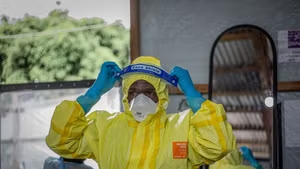
This multilateral organisation must address a range of global issues such as climate change, humanitarian aid, natural disasters, and epidemics with limited financial resources. This new context demands that the United Nations optimise its operations, become more efficient and more flexible.
Analysts believe that in a world increasingly fragmented, with the rise of unilateralism and growing global challenges, reform is the inevitable path for the United Nations to continue playing its pivotal role in peace, security, and sustainable development.
With a solid foundation of achievements and prestige built over decades, the United Nations will continue to maintain its irreplaceable position as the “captain” of global governance.