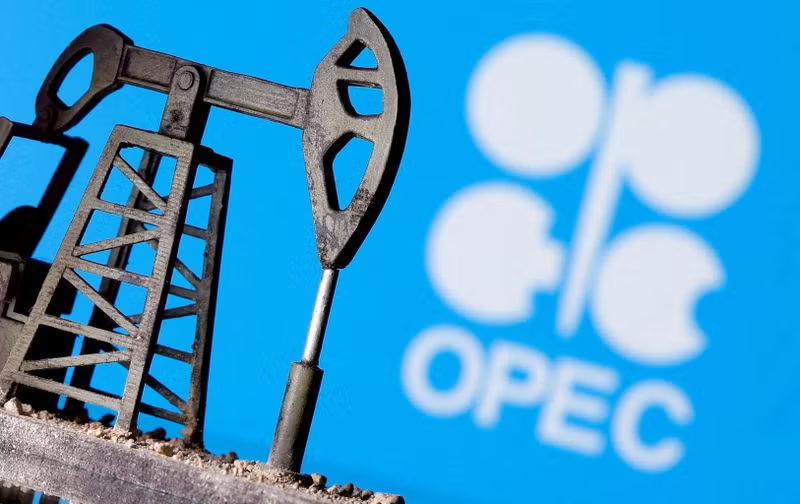
At the same time, the United Arab Emirates (UAE) has unexpectedly announced its withdrawal from the Organisation of the Petroleum Exporting Countries (OPEC) and the OPEC+ group, raising doubts about the market-leading role of top oil exporters and plunging the market into uncertainty.
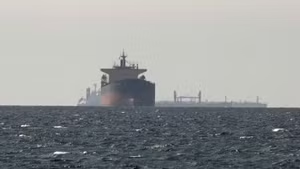
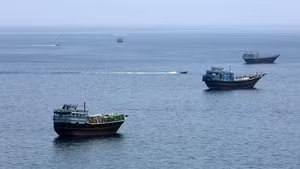
Global oil prices surged after Washington prepared a scenario to blockade Iran’s ports, sparking fears that Tehran may continue or expand restrictions on passage through the Strait of Hormuz – a critical global commercial shipping route.
Experts warn that if this scenario unfolds, oil supply chains could face severe disruption, while the market increasingly abandons hopes for a swift peaceful resolution or early reopening of the route.
According to the International Energy Agency, closing the Strait of Hormuz would force regional producers such as Saudi Arabia, the United Arab Emirates, Iraq, and Kuwait to cut at least 10 million barrels per day, equivalent to about 10% of global supply. Since the US–Israel–Iran conflict erupted, leading to the Strait’s closure, oil prices have risen by more than 50%.
For OPEC and OPEC+, the UAE’s exit weakens the ability to regulate the market through quotas and turns the UAE into an unpredictable factor amid unprecedented volatility.
OPEC members currently produce about one-third of global crude oil output but account for nearly half of exports. Established in 1960, OPEC aims to harmonise members’ oil policies to protect common interests. Accordingly, the organisation coordinates production quotas to stabilise international oil prices and limit adverse fluctuations.
For OPEC and OPEC+, the UAE’s exit weakens the ability to regulate the market through quotas and turns the UAE into an unpredictable factor amid unprecedented volatility.
OPEC’s role was already diminishing due to the rise of US shale oil. At present, the Strait of Hormuz closure curbs output from the UAE and Gulf states, causing supply shortages and reducing the effectiveness of quota policies.
In the longer term, once the shipping route is reopened, the UAE’s absence from OPEC could ignite market share competition and oil price wars. Prior to the Middle East conflict, the UAE was one of OPEC’s largest producers (after Saudi Arabia, Iraq, and Iran), with output of about 3.6 million barrels per day (around 3% of global supply).
Leaving OPEC frees the UAE from current agreements and allows increased exports; its additional capacity of about 1 million barrels per day alone would exert significant pressure on the remaining members’ coordination efforts.
Oil prices currently remain driven by Middle East conflict and supply signals. Balancing supply and demand in the coming period will likely fall to a small OPEC+ core led by Saudi Arabia and Russia.
The exit of one of OPEC+’s most influential members raises fears of a domino effect leading to further withdrawals. However, some OPEC+ members have stated they have no plans to follow the UAE. Russia has declared it will continue participating in the alliance and hopes the system remains operational. This means the UAE cannot simply ramp up supply in the short term to influence market price drops.
Oil prices currently remain driven by Middle East conflict and supply signals. Balancing supply and demand in the coming period will likely fall to a small OPEC+ core led by Saudi Arabia and Russia.
Analysts note that if the market believes the UAE’s OPEC exit will lead to increased output, oil prices could face downward pressure. Conversely, if this move heightens geopolitical tensions and risks of price wars, the market is more likely to see intensified volatility rather than deep declines.