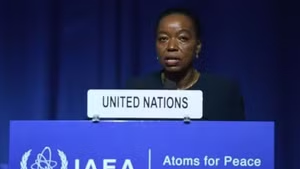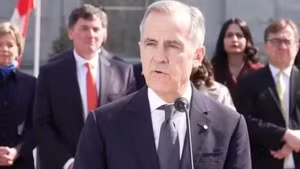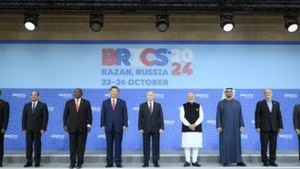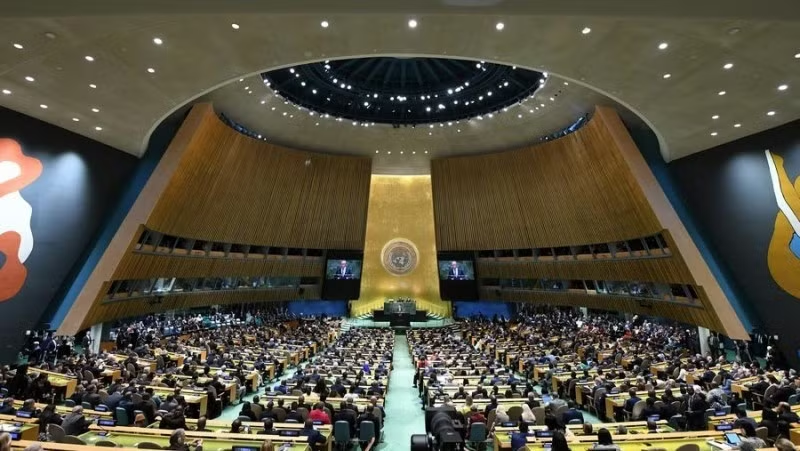
Though playing an irreplaceable role in the global governance system, the United Nations faces myriad difficulties due to fierce strategic competition among major powers, limited funding, and simultaneous crises in climate, humanitarian affairs, health and security. The new context also places the organisation before its greatest challenges yet in terms of trust and finance.
Thus, the race to find a new United Nations Secretary-General is not merely a change in senior personnel, but an event opening a new chapter of development for the organisation with reforms in operations and structure. The person chosen for the “hot seat” will shoulder the mission of enhancing the image, standing, voice and future direction of the United Nations.
At recent dialogue sessions for the Secretary-General position organised by the UN, all four candidates in the race emphasised reform and the goal of building a modern, effective and reliable organisation.
The four candidates for UN Secretary-General include Michelle Bachelet, former President of Chile and former UN High Commissioner for Human Rights; Rafael Grossi, Director General of the International Atomic Energy Agency; Rebeca Grynspan, former Vice President of Costa Rica; and Macky Sall, former President of Senegal.
The successor to António Guterres will face difficult tasks, handling a series of challenges such as geopolitical volatility, rising conflicts, climate change and rapid technological transitions, while promoting reform and shaping a brighter future for the organisation.
By regulation, the candidate must be nominated by the UN Security Council and approved by the General Assembly. Meanwhile, relations among the permanent members of the Security Council are strongly influenced by US–China trade competition, the conflict in Ukraine and warfare in the Middle East, making it difficult for the countries to reach compromises in order to make a choice.
Reforming the United Nations is a daunting task, particularly reforming the Security Council. Secretary-General António Guterres has repeatedly called for significant reform of the Council, urging its expansion to be more representative.
German Chancellor Friedrich Merz has voiced strong support for granting Africa a permanent seat on the Security Council. Africa, the region with issues comprising the bulk of the Council’s agenda yet without any permanent seat, is seen by public opinion as mismatched with the current global geopolitical reality.
The United Nations is implementing the UN80 Initiative on comprehensive reform, marking the initial steps of a long journey ahead. Realising this initiative requires close coordination among countries and strong political commitment to maintain reform momentum.
The successor to António Guterres will face difficult tasks, handling a series of challenges such as geopolitical volatility, rising conflicts, climate change and rapid technological transitions, while promoting reform and shaping a brighter future for the organisation.