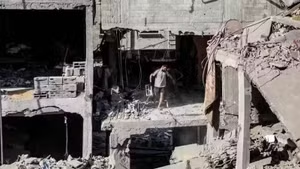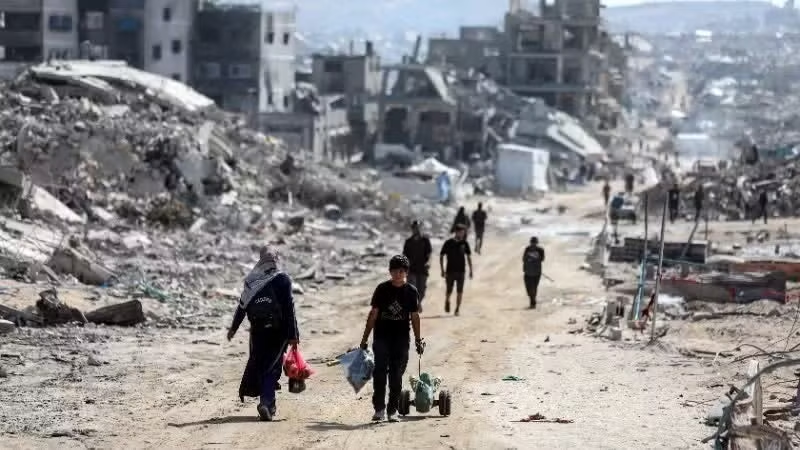
While the US and Israel consistently view the disarmament of Hamas as a precondition for peace in Gaza, the movement has repeatedly demanded that the Israeli state swiftly withdraw its forces from the coastal strip. Hamas had previously agreed to lay down its arms in exchange for peace in Gaza but has recently reversed course and firmly rejected the proposal. The prospect of peace for Gaza remains remote. In this context, the parties involved continue to make incremental efforts towards the ultimate goal of restoring peace in the enclave.
Nickolay Mladenov, special envoy of the Gaza Peace Council, has been working tirelessly to advance the reconstruction phase under a plan proposed by US President Donald Trump, at a time when cooperation between Hamas and Israel is still widely seen as deeply strained. The Gaza Peace Council, a US-led international mechanism overseeing post-conflict governance in Gaza, has set a deadline for Hamas to lay down its arms by the end of the week.
Mladenov met a senior Hamas delegation in Cairo, Egypt, and conveyed the expectation of reaching a disarmament agreement within the week. However, regional mediators such as Egypt, Qatar, and Türkiye have been less optimistic and are exerting pressure to urge Hamas to accept the US-backed proposal.
Conversely, Hamas has expressed scepticism that Israel will withdraw its forces within the year. This lack of trust and mutual suspicion has left the Gaza peace plan effectively stalled, with little tangible progress. The end-of-week deadline was set after Hamas delayed its response to the disarmament proposal for a month. The plan includes dismantling the extensive underground tunnel network in Gaza and surrendering weapons in phases.
According to the roadmap, the process is expected to last eight months, beginning with the National Committee for Gaza Administration (NCAG) assuming responsibility for security and concluding with Israel’s complete withdrawal from the coastal enclave. The plan is divided into two parts: a 12-point framework outlining steps to achieve a comprehensive peace settlement for Gaza and a five-phase roadmap for disarmament. All armed groups in Gaza would participate in the disarmament process under NCAG supervision, based on the principle of “one authority, one legal system, one armed force”. A dedicated committee would oversee the disarmament process, while reconstruction activities would only be carried out in demilitarised zones.
Although the roadmap for peace in Gaza is clearly defined, international observers remain unconvinced about the parties’ willingness to comply. Their scepticism is not unfounded: Hamas has alternated between delaying, remaining silent, and most recently rejecting any discussions on disarmament, while Israeli forces have yet to halt their military operations. Hamas has set conditions, stating it would only consider disarmament after the completion of the first phase of the Gaza ceasefire agreement and a full Israeli withdrawal.
Abu Ubaida, spokesperson for the al-Qassam Brigades, argued that raising the issue of disarmament at this stage is merely a pretext used by Israel to prolong military actions against Palestinians. He further accused Israel of obstructing the implementation of humanitarian provisions in the agreement by continuing attacks on civilians, blocking the delivery of humanitarian aid into Gaza, and keeping the Rafah border crossing closed. The Palestinian side maintains that it has fully honoured its commitments and has called on mediators to exert pressure on Israel to fulfil its obligations in Phase 1 of the ceasefire before moving on to negotiations for the next phase.
Analysts have voiced concern over the parties’ failure to adhere to the peace roadmap, leaving the process protracted and far from resolution. They have urgently called for the enforcement of a ceasefire and the unhindered delivery of humanitarian aid in order to restore normal life for people in Gaza.